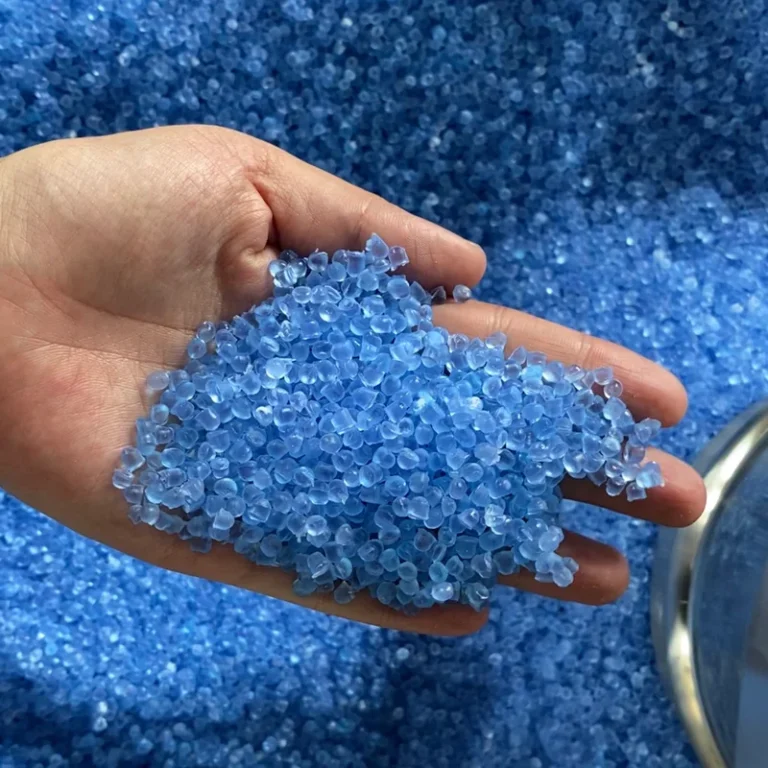
What Materials Can a PVC Compounding Extrusion Line Process?
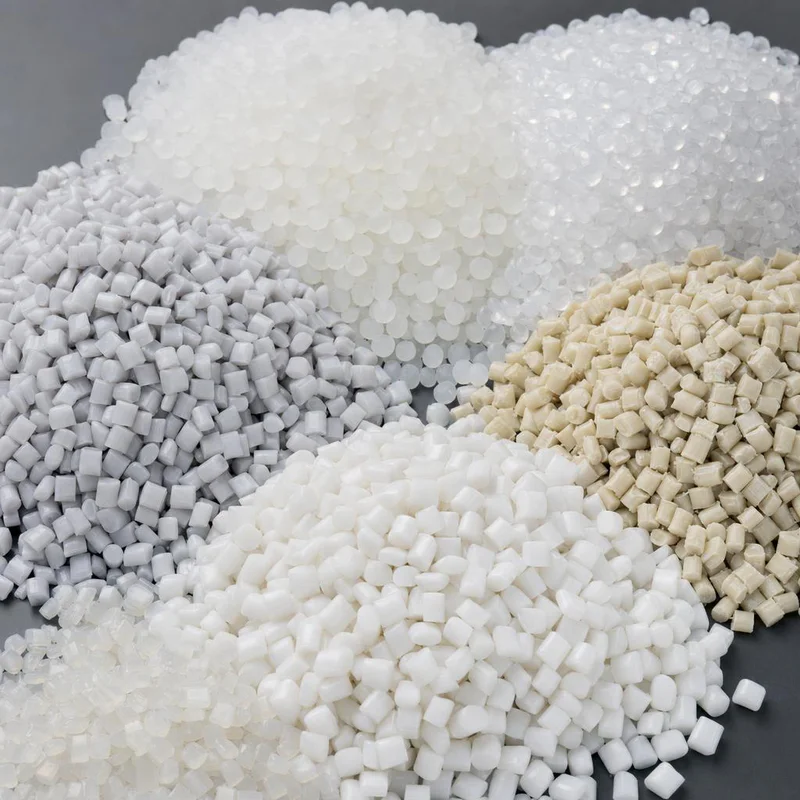
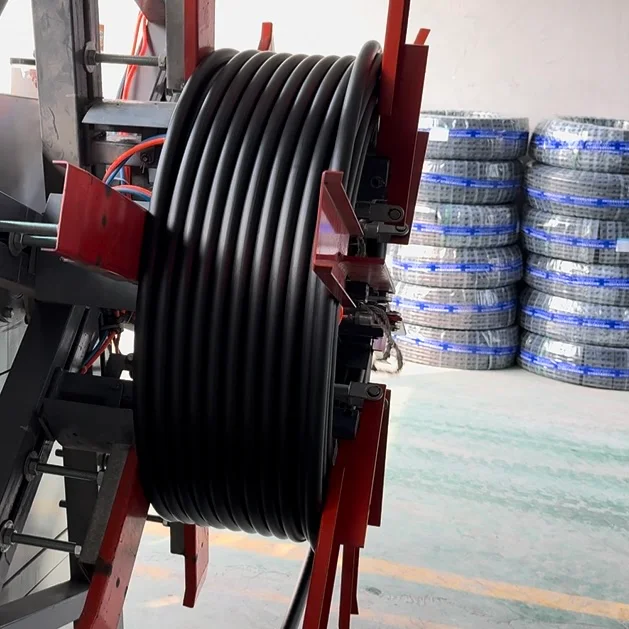
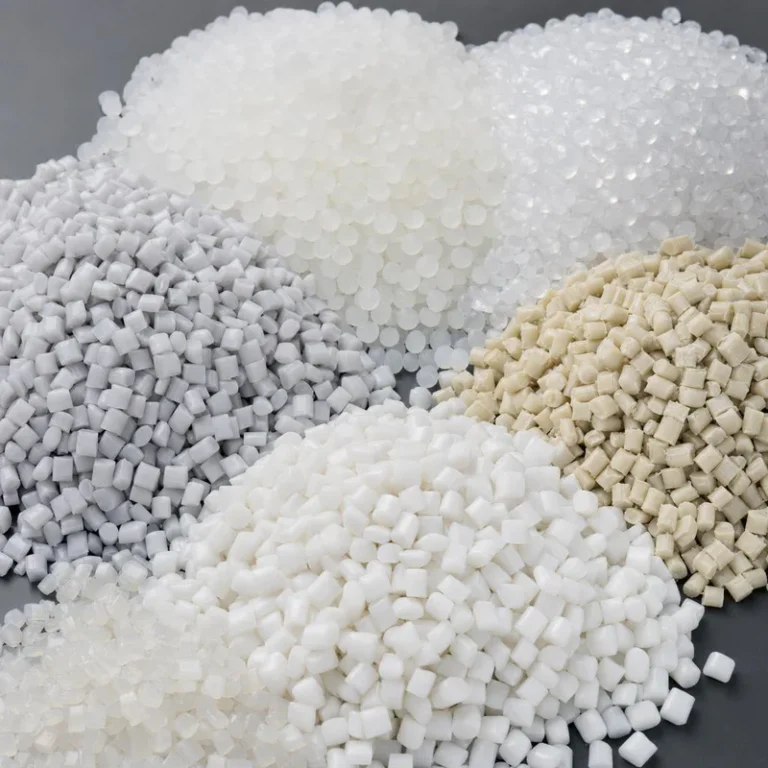
A PVC compounding extrusion line can process many PVC-based formulations, including soft PVC, rigid PVC, cable compounds, pipe compounds, profile compounds, shoe sole materials, transparent PVC, and filled or modified PVC granules.
For manufacturers, choosing the correct PVC granulation and compounding system is not only about the extruder model. It also depends on the PVC recipe, additive system, required output, pelletizing method, cooling efficiency, and final pellet quality.
Based on QTech-Machinery’s SJZ65/132 PVC hot cutting pelletizing line project, this article explains what materials a PVC compounding extrusion line can process and how customers can select the right configuration.
1. What soft PVC materials can a PVC compounding extrusion line process?
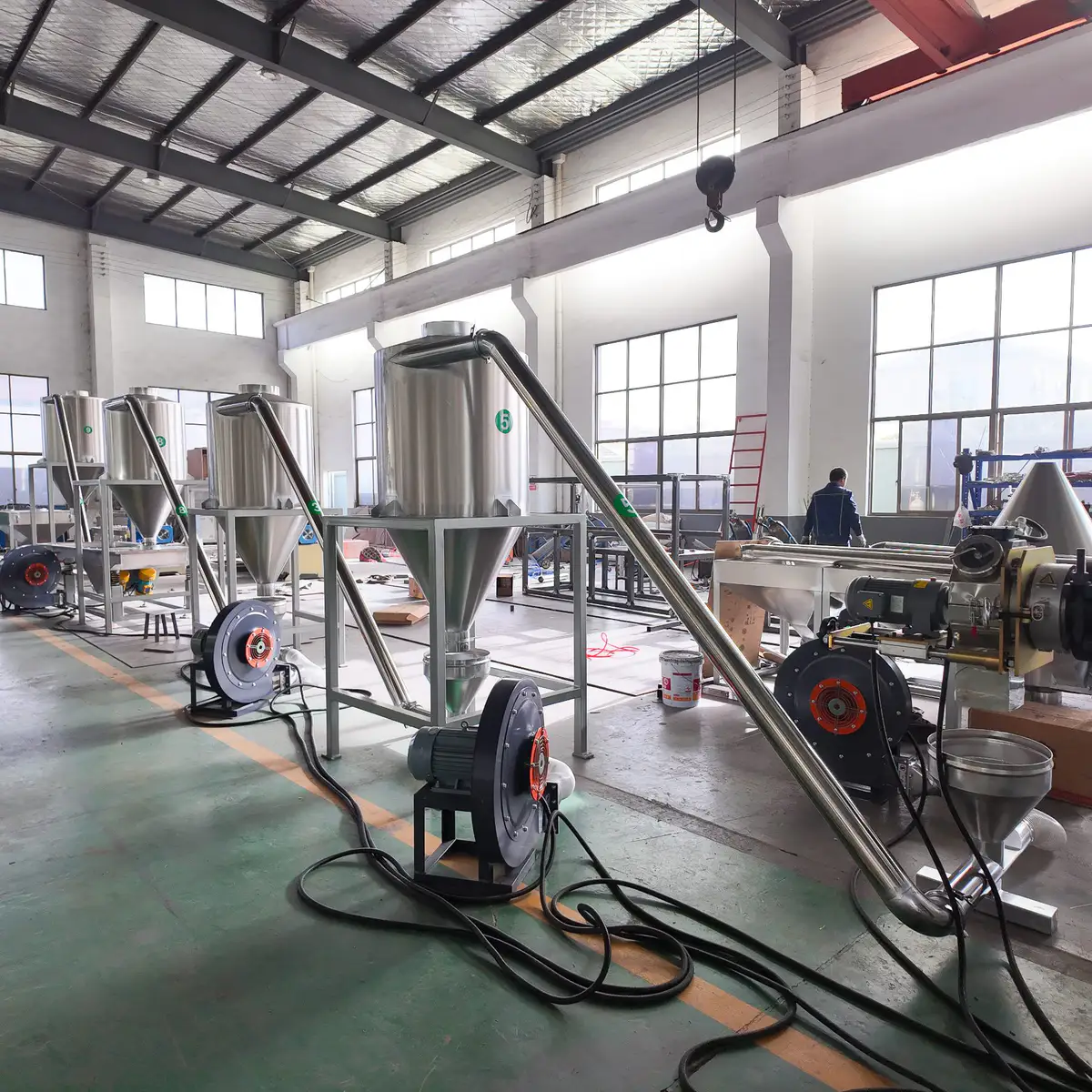
A PVC compounding extrusion line can process soft PVC materials with plasticizers, stabilizers, fillers, pigments, and other additives for flexible products.
Soft PVC is one of the most common materials processed by a PVC granulation and compounding extrusion line. It normally contains PVC resin, plasticizer, stabilizer, filler, lubricant, pigment, and sometimes flame retardant or impact modifier.
Soft PVC granules can be used for:
- Flexible hoses
- Cable sheathing
- Shoe soles
- Floor mats
- Sealing strips
- Flexible profiles
- Medical or general-purpose soft PVC products
For soft PVC processing, the material requires good mixing before extrusion. In our project configuration, the line uses an SRL-Z300/600 high-speed heating and cooling mixer, which helps disperse PVC powder, plasticizers, stabilizers, and fillers evenly before the material enters the extruder.
The SJZ65/132 conical twin screw extruder is suitable for PVC materials because it provides stable conveying, gentle plasticizing, and strong mixing performance. This is important because PVC is heat-sensitive and requires controlled processing conditions.
2. Can rigid PVC compounds be produced by this extrusion line?
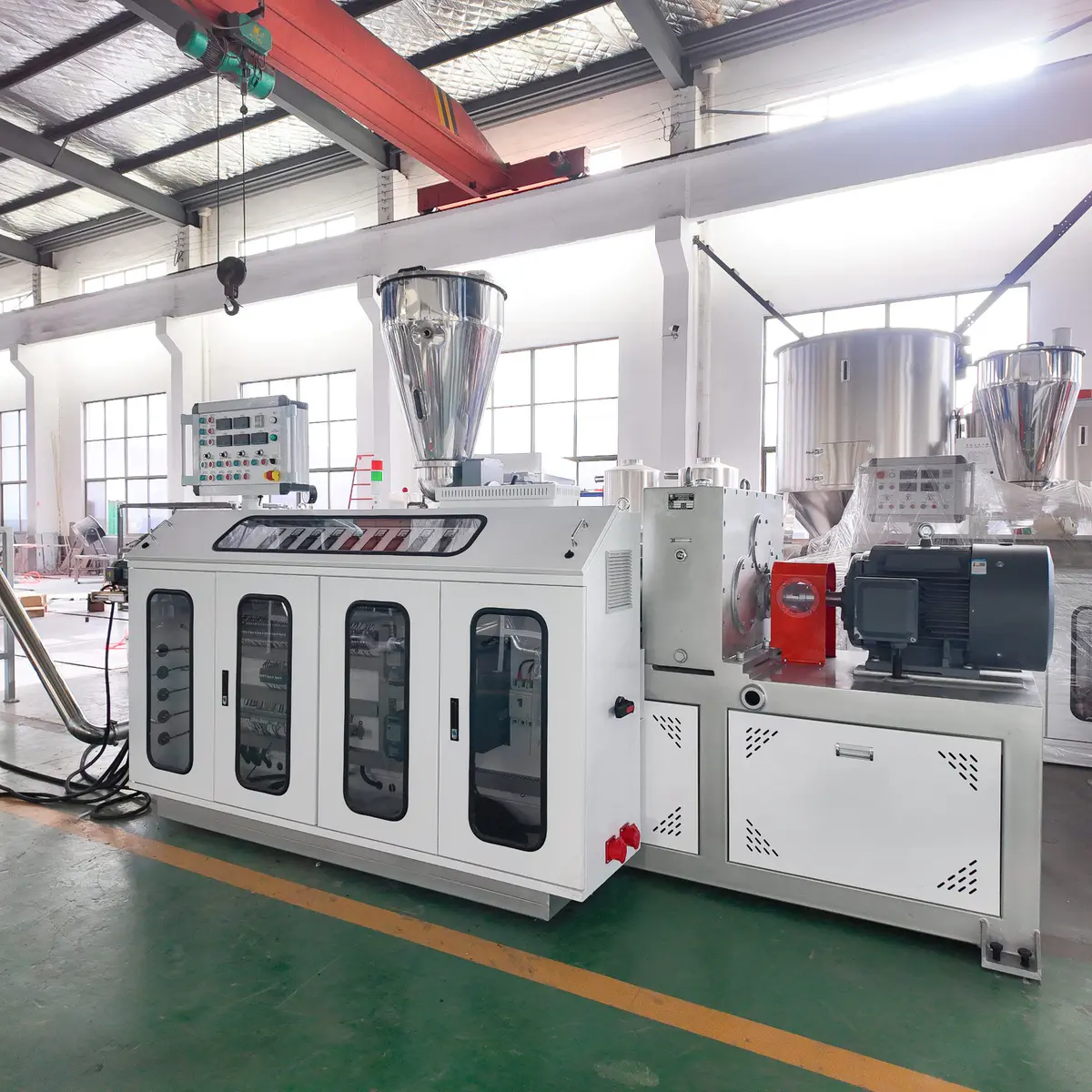
Yes, rigid PVC compounds for pipes, profiles, fittings, and construction materials can be processed by a properly configured conical twin screw extrusion line.
Rigid PVC compounds usually contain less or no plasticizer. They are widely used in construction, infrastructure, agriculture, and industrial applications.
Typical rigid PVC granule applications include:
| Application | Common Use |
|---|---|
| PVC pipe compounds | Water supply pipes, drainage pipes, conduit pipes |
| PVC profile compounds | Window profiles, door profiles, decorative profiles |
| PVC fitting compounds | Elbows, tees, couplings, connectors |
| Construction materials | Panels, boards, cable protection products |
Rigid PVC requires stable plasticizing and precise temperature control. If the temperature is too low, the material may not plasticize completely. If the temperature is too high, PVC may degrade and cause discoloration or poor pellet quality.
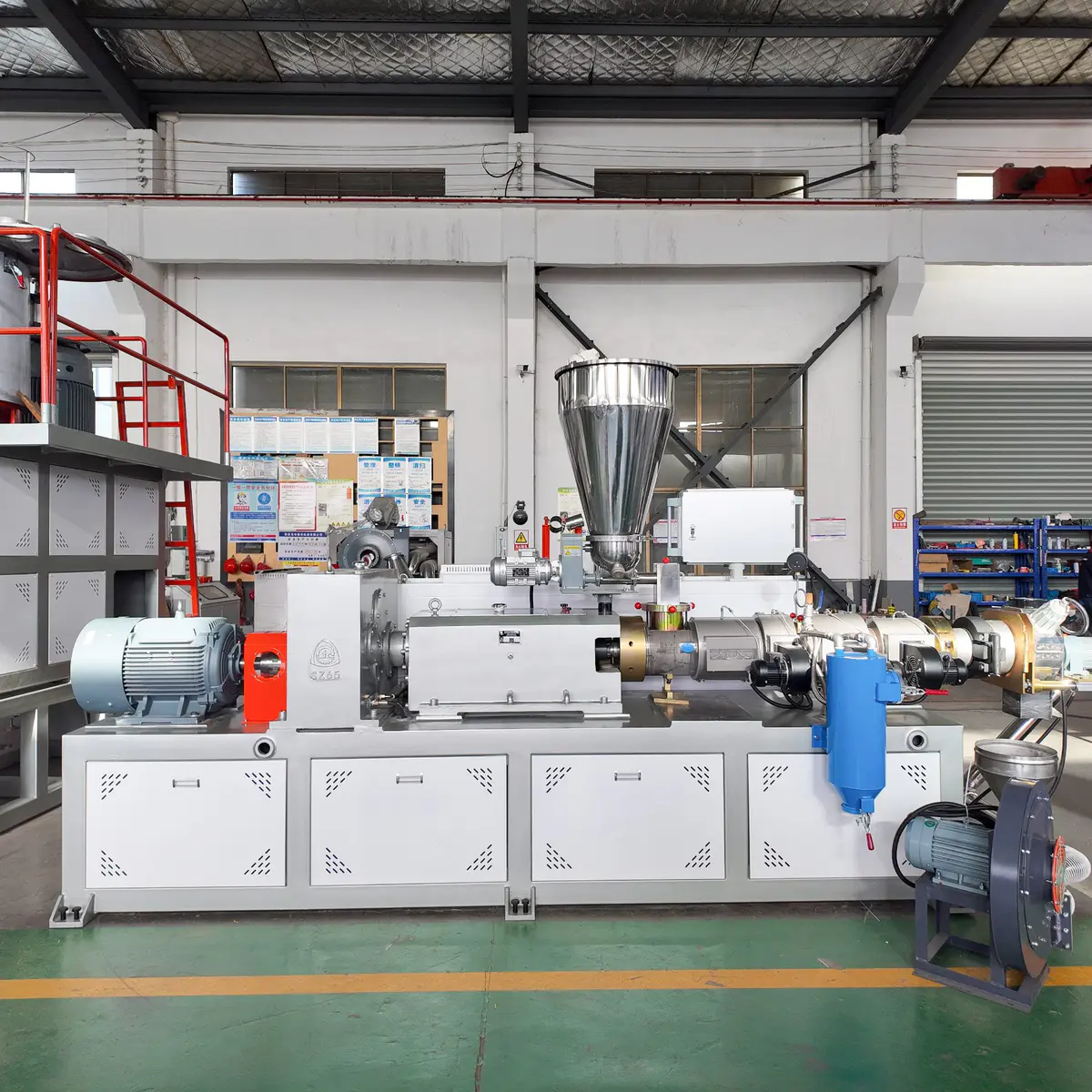
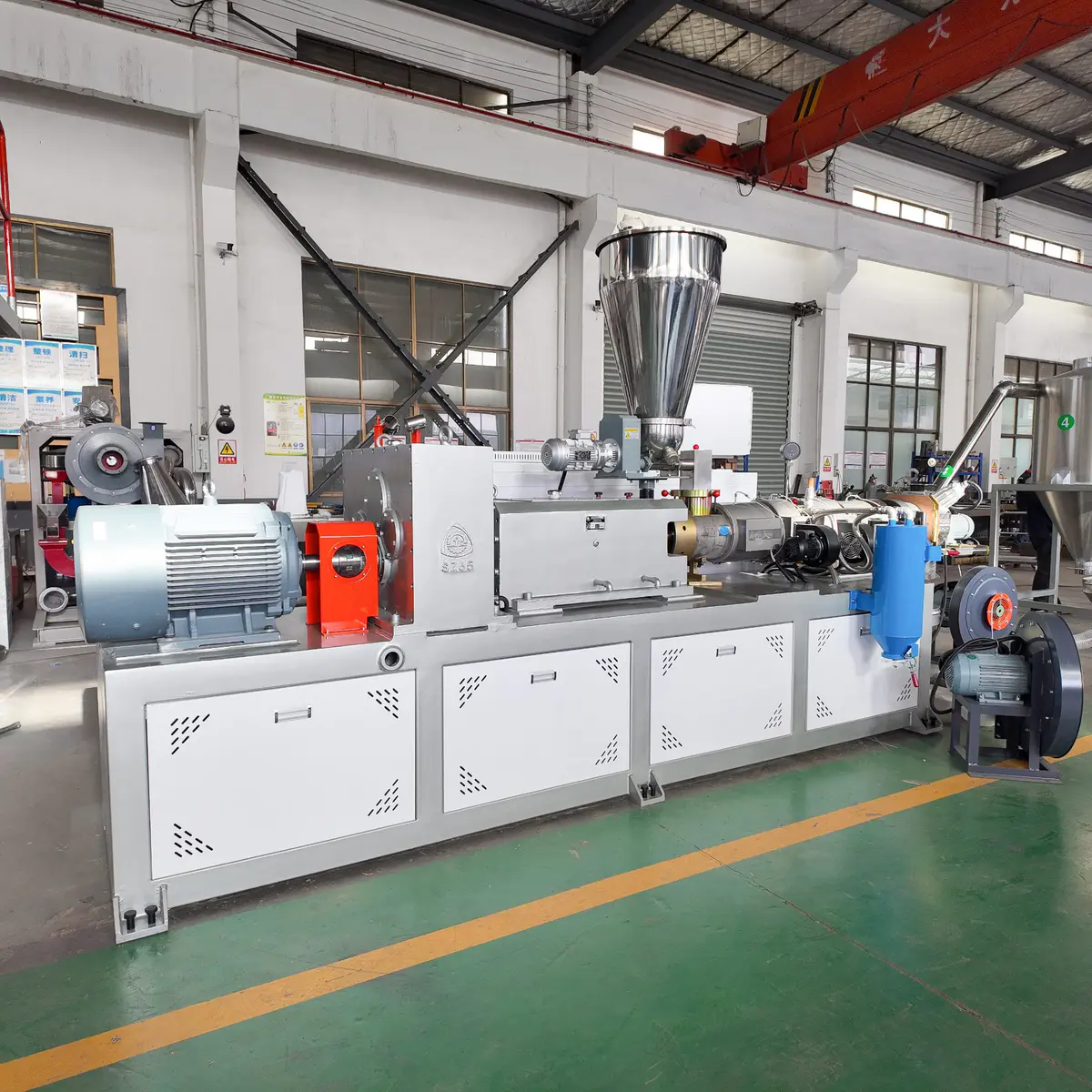
In the QTech-Machinery case, the SJZ65/132 conical twin screw extruder is equipped with:
- Screw diameter: Φ65/132 mm
- Screw working length: 1430 mm
- Screw speed: 1–35 rpm
- Main motor power: 37 kW
- Screw and barrel material: 38CrMoAlA
- Surface treatment: nitriding and hard chrome plating
This configuration is designed for stable PVC compounding and granulation, especially for heat-sensitive PVC formulations.
3. Is this line suitable for PVC cable compounds?
Yes, PVC cable compounds are one of the main materials that can be produced by a PVC compounding extrusion line.
PVC cable compounds are used for wire insulation, cable sheathing, power cables, communication cables, and flame-retardant cable materials.
A typical PVC cable compound may include:
- PVC resin
- Plasticizer
- Calcium carbonate
- Stabilizer
- Flame retardant
- Lubricant
- Pigment
- Processing aid
Cable compounds require stable pellet quality because inconsistent granules may affect cable extrusion performance later. Uniform granules help improve feeding stability in downstream cable extrusion machines.
The QTech-Machinery PVC pelletizing line uses a die face hot cutting pelletizing system. The PVC melt is cut directly at the die face by Cr12 cutting blades, helping produce more uniform granules.
Key pelletizing configuration:
| Item | Specification |
|---|---|
| Pelletizing method | Die face hot cutting |
| Die material | ZG40Cr |
| Cutting blade quantity | 2 pcs |
| Blade material | Cr12 tool steel |
| Cutting motor power | 2.2 kW |
| Speed control | Yaskawa inverter |
For PVC cable compound manufacturers, this hot cutting system is useful because it supports continuous production, stable pellet shape, and efficient material handling.
4. What PVC pipe and profile compounds can be processed?
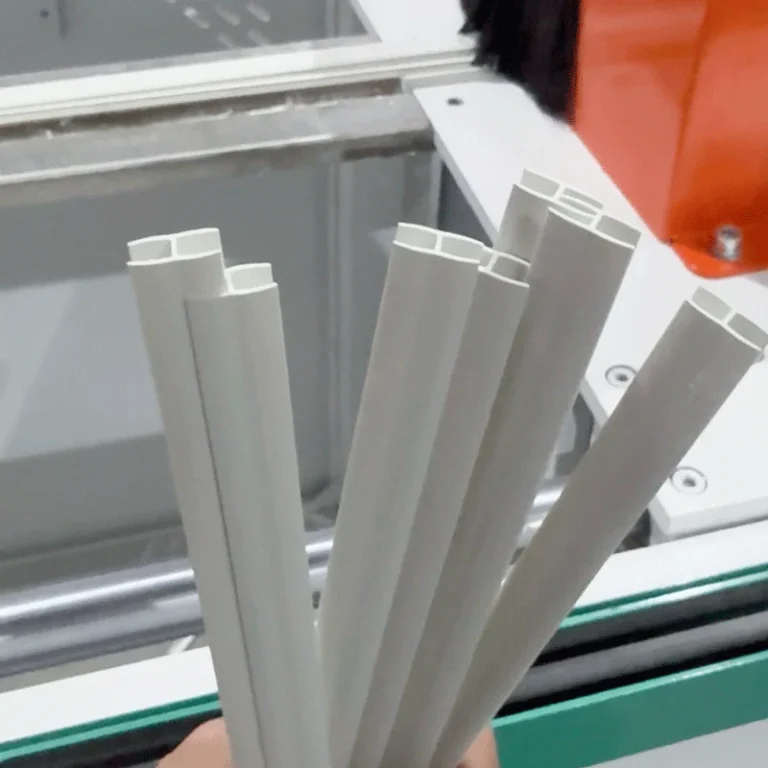
The line can process PVC pipe and profile compounds used for extrusion-grade granules in construction, irrigation, drainage, and building material industries.
PVC pipe and profile manufacturers often need compound granules with consistent formula distribution. A complete PVC compounding line allows producers to prepare their own PVC formulations and improve control over raw material quality.
Common pipe and profile compound materials include:
| Material Type | Final Product |
|---|---|
| PVC pipe compound | Drainage pipe, water pipe, conduit pipe |
| PVC profile compound | Window profile, door profile, decorative profile |
| PVC foam compound | Foam board, foam profile |
| Filled PVC compound | Cost-effective construction materials |
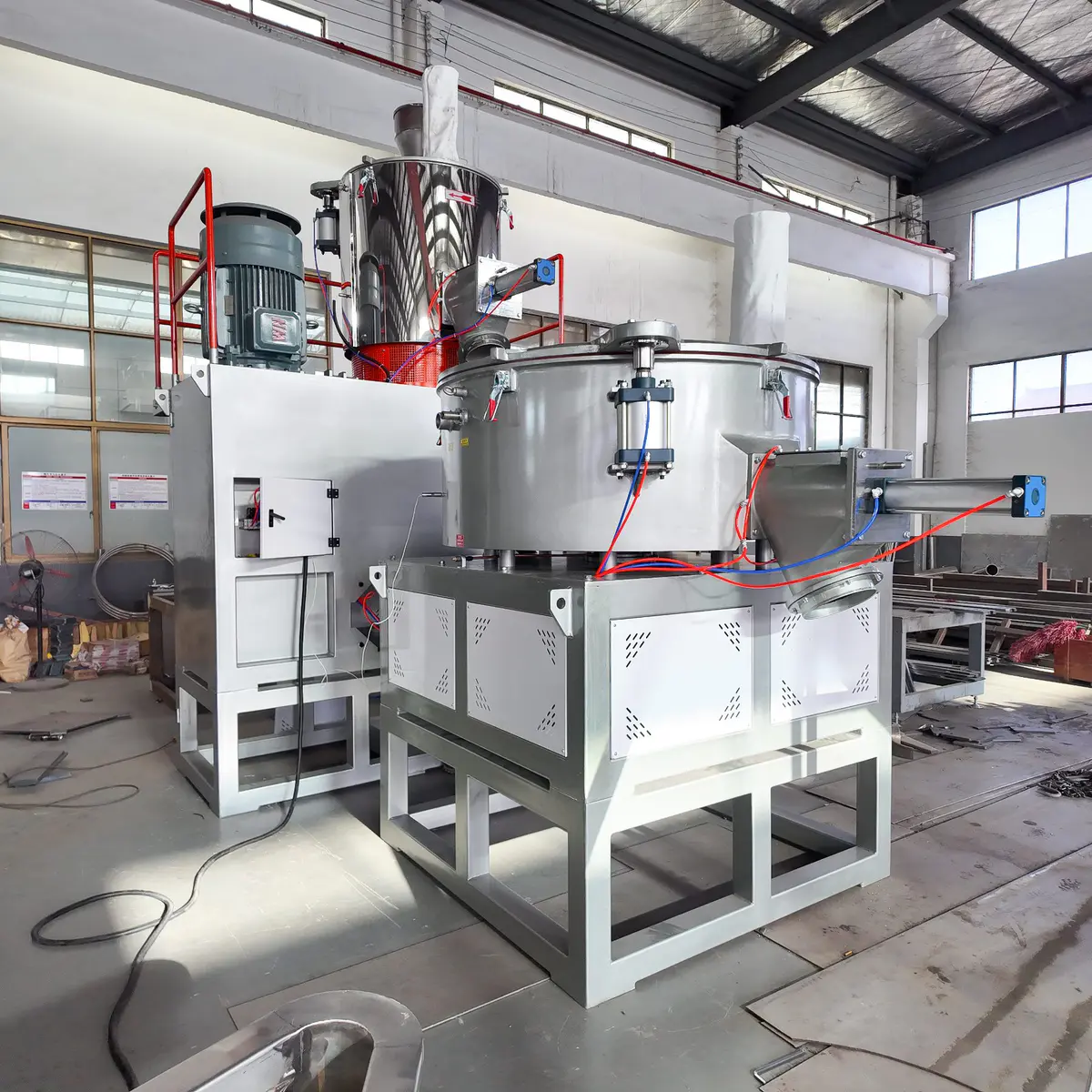
For pipe and profile compounds, the mixing step is especially important. The SRL-Z300/600 high-speed mixer can complete both hot mixing and cooling mixing, helping prevent material agglomeration and improving additive dispersion.
Mixer configuration from the customer case:
| Item | Specification |
|---|---|
| Mixer model | SRL-Z300/600 |
| Structure | Heating mixer + cooling mixer |
| Total volume | 300 L / 600 L |
| Effective volume | 200 L / 350 L |
| Motor power | 55 kW / 11 kW |
| Blade speed | 1380 rpm / 60 rpm |
| Inverter brand | Yaskawa |
This configuration is suitable for customers who want a complete process from PVC powder mixing to final pellet storage.
5. Can PVC shoe sole and flexible product materials be compounded?
Yes, soft PVC shoe sole compounds and flexible PVC product materials can be produced with the correct formulation and pelletizing configuration.
PVC shoe sole materials usually require softness, flexibility, color stability, wear resistance, and sometimes foaming performance. The formulation may include plasticizers, stabilizers, fillers, pigments, lubricants, and other modifiers.
Typical products include:
- PVC shoe soles
- Slipper compounds
- Flexible mats
- Soft strips
- Flexible molded products
For these materials, the production line must provide:
- Uniform mixing of additives and pigments
- Stable plasticizing of soft PVC formulation
- Controlled cutting speed for pellet size
- Efficient cooling and conveying after hot cutting
- Screening to remove irregular pellets
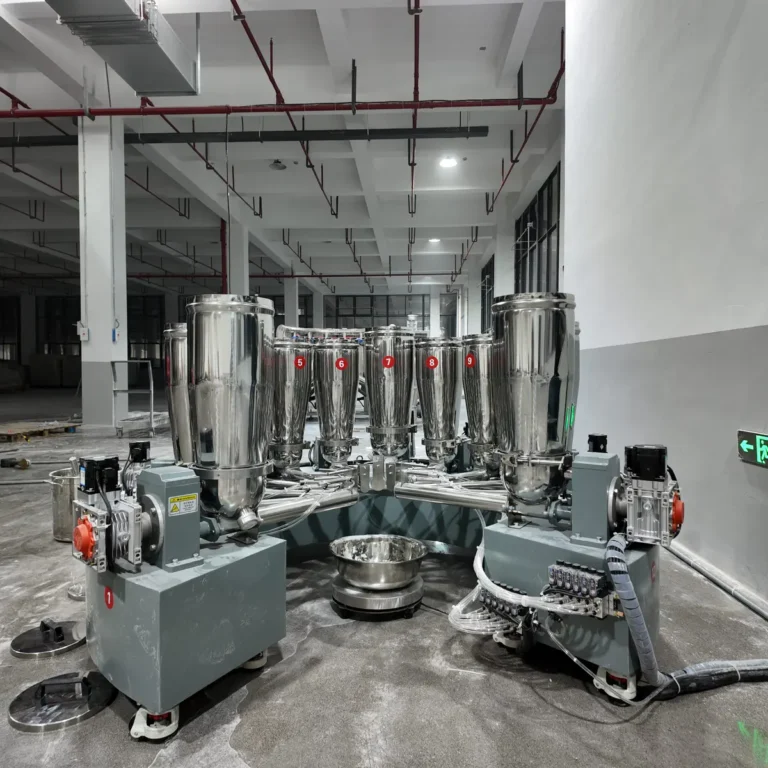
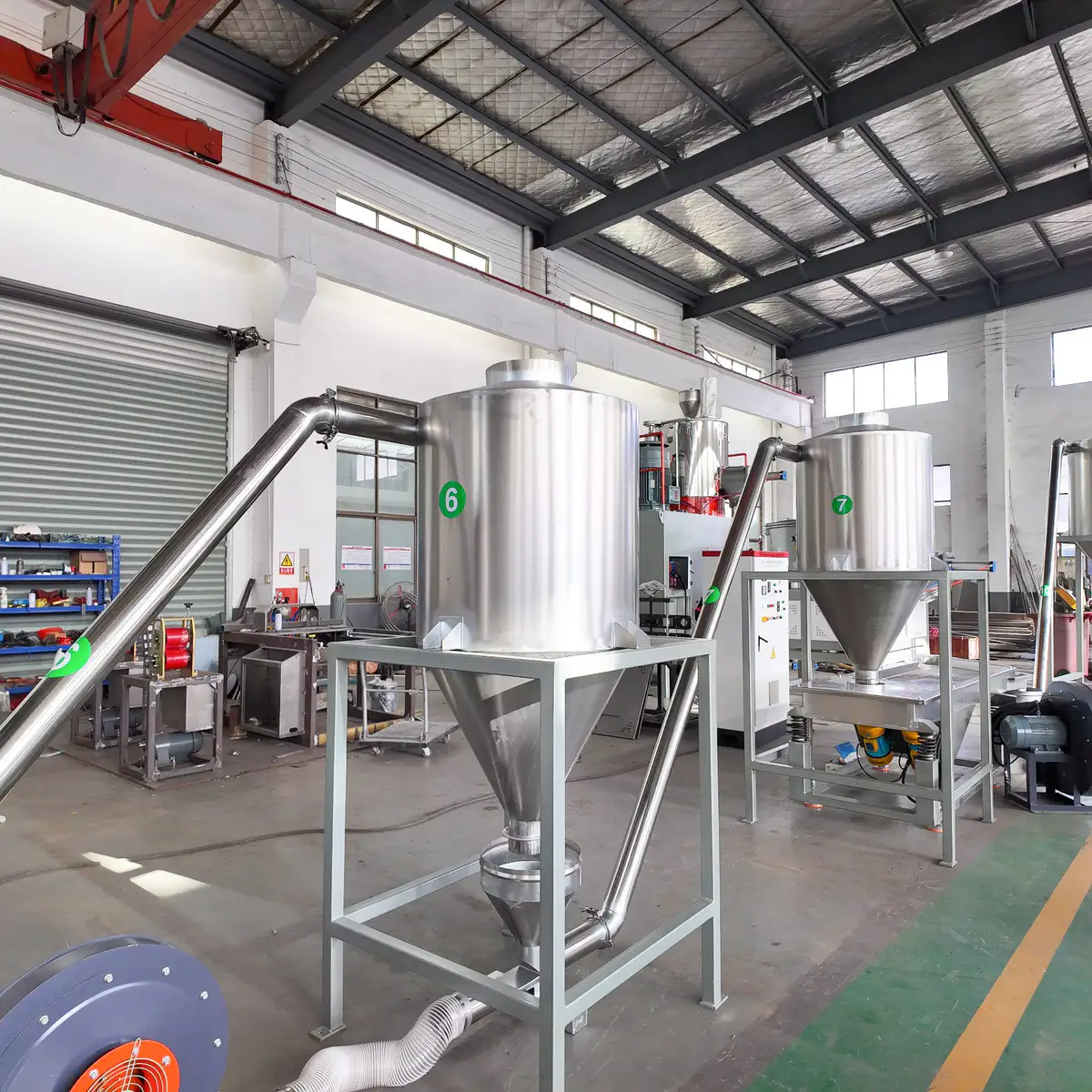
The QTech-Machinery PVC granulation line includes a three-stage pneumatic conveying system, which helps cool and transfer hot-cut granules after pelletizing.
Conveying and separation configuration:
| Item | Specification |
|---|---|
| Conveying stages | 3 stages |
| Conveying fan power | 3 kW × 3 sets |
| Drying fan power | 1.5 kW × 1 set |
| Air pipe material | 201 stainless steel |
| Cyclone silo quantity | 3 sets |
| Cyclone silo capacity | 500 kg |
This system reduces manual handling and improves production continuity for soft PVC and flexible PVC compound production.
6. Can filled PVC compounds with calcium carbonate be processed?
Yes, filled PVC compounds containing calcium carbonate or other fillers can be processed, but the screw design, mixing quality, and extrusion stability are important.
Many PVC compound manufacturers add calcium carbonate to reduce cost, improve dimensional stability, or adjust product performance. Filled PVC compounds are widely used in pipes, profiles, boards, sheets, and molded products.
However, filled PVC can create processing challenges:
- Poor filler dispersion
- Higher screw and barrel wear
- Unstable melt flow
- Dust during feeding
- Irregular pellet size
- Higher motor load
That is why a complete system with automatic feeding, high-speed mixing, conical twin screw extrusion, hot cutting, conveying, cyclone separation, screening, and storage is recommended.
The QTech-Machinery configuration includes a spiral loader before the mixer, which reduces manual feeding work and improves production continuity.
Spiral loader configuration:
| Item | Specification |
|---|---|
| Loading capacity | 1000 kg/h |
| Material box capacity | 150 kg |
| Feeding pipe diameter | 114 mm |
| Motor power | 2.2 kW |
| Feeding method | Spiral screw conveying |
For filled PVC compounds, customers should inform the machinery supplier about filler percentage, bulk density, moisture condition, and target output before selecting the line.
7. Can transparent or color PVC compounds be produced?
Yes, transparent and color PVC compounds can be produced, but temperature control, mixing uniformity, and material cleanliness are very important.
Transparent PVC and color PVC compounds have higher requirements for appearance. Any overheating, contamination, or poor pigment dispersion may cause visible defects in final products.
Common applications include:
- Transparent PVC hose
- Color cable compound
- Decorative PVC profile
- Soft transparent sheet compound
- Colored PVC granules for injection or extrusion
For these materials, customers should pay attention to:
- Clean mixer and conveying system
- Stable processing temperature
- Accurate pigment feeding
- Proper stabilizer selection
- Good pellet cooling
- Effective screening before storage
In the QTech-Machinery line, the final pellets pass through a vibrating screen before entering the finished product silo. This helps remove oversized or irregular granules and improves the consistency of the final product.
Final screening and storage configuration:
| Item | Specification |
|---|---|
| Vibrating screen length | 2.5 m |
| Vibrating motor power | 0.2 kW × 2 sets |
| Screening function | Pellet size classification |
| Finished silo capacity | 600 kg |
| Finished silo material | 201 stainless steel |
For transparent or colored PVC compounds, QTech-Machinery can also adjust the contact material, conveying layout, and cleaning convenience according to customer requirements.
8. How do customers choose the right PVC compounding extrusion line for their material?
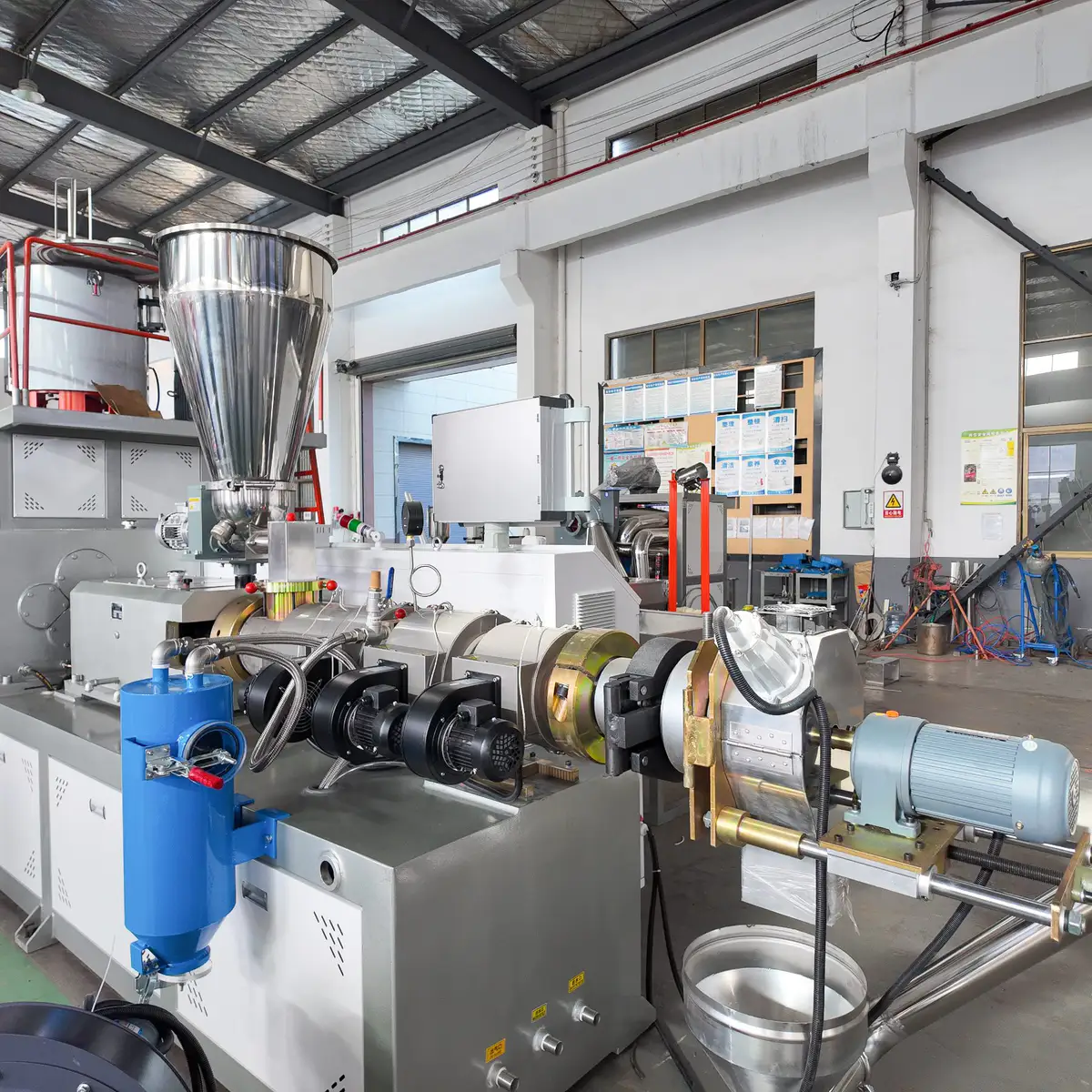
Customers should choose the line based on PVC formula, application, output capacity, pelletizing method, cooling system, automation level, local voltage, and factory layout.
Different PVC materials require different configurations. A soft PVC cable compound line may not be exactly the same as a rigid PVC pipe compound line. Therefore, customers should provide detailed production information before quotation.
Customer Selection Steps
| Step | What Customers Should Confirm | Why It Matters |
|---|---|---|
| Step 1 | Final product application | Cable, pipe, profile, shoe sole, hose, etc. |
| Step 2 | PVC formula type | Soft PVC, rigid PVC, filled PVC, transparent PVC |
| Step 3 | Required output | Determines extruder and mixer size |
| Step 4 | Pellet size requirement | Affects die and cutter design |
| Step 5 | Raw material form | Powder, premix, filler ratio, additives |
| Step 6 | Cooling and conveying needs | Affects pneumatic conveying layout |
| Step 7 | Factory voltage and space | Determines electrical and layout design |
| Step 8 | Automation level | Affects labor cost and production efficiency |
For example, in the QTech-Machinery overseas customer case, the buyer required a compact and reliable PVC granulation line with:
- Stable PVC compound pellet production
- Conical twin screw extrusion system
- Hot face cutting system
- Pneumatic conveying and cooling
- Final pellet separation and screening
- Complete line from mixing to finished pellet storage
QTech-Machinery supplied a full SJZ65/132 PVC granulation and compounding extrusion line to meet these requirements.
Product Configuration Used in the Customer Case
Below is the core configuration of the QTech-Machinery PVC pelletizing project.
| Production Section | Equipment | Main Function |
|---|---|---|
| Material feeding | Spiral loader | Automatically feeds PVC powder and additives |
| Mixing system | SRL-Z300/600 high-speed mixer | Hot mixing and cooling mixing |
| Extrusion system | SJZ65/132 conical twin screw extruder | Plasticizing and extruding PVC compound |
| Pelletizing system | PVC hot cutting pelletizing die | Die face hot cutting for uniform pellets |
| Conveying system | Three-stage pneumatic conveying system | Transfers and cools PVC pellets |
| Separation system | Cyclone separation silos | Separates pellets from airflow |
| Screening system | Vibrating screen | Removes oversized or irregular pellets |
| Storage system | Finished product silo | Collects qualified PVC granules |
Why Choose QTech-Machinery for PVC Compounding Extrusion Lines?
QTech-Machinery provides complete PVC granulation and compounding extrusion solutions based on customer material, output, product application, and factory layout.
Our advantages include:
1. Complete Turnkey Line Configuration
We can provide a complete production line from raw material feeding to final pellet storage, including mixing, extrusion, pelletizing, conveying, cooling, separation, screening, and storage.
2. Suitable for Multiple PVC Materials
Our PVC compounding extrusion line can be configured for:
- Soft PVC granules
- Rigid PVC granules
- PVC cable compounds
- PVC pipe compounds
- PVC profile compounds
- PVC shoe sole materials
- Filled PVC compounds
- Transparent and colored PVC compounds
3. Conical Twin Screw Extruder for PVC Processing
The SJZ65/132 conical twin screw extruder is suitable for PVC because it offers stable plasticizing, controlled shear, and reliable output for heat-sensitive PVC materials.
4. Hot Cutting Pelletizing for Uniform Granules
The die face hot cutting system helps produce consistent pellet size and shape, which is important for downstream extrusion or injection production.
5. Full Run Test Before Delivery
QTech-Machinery can perform machine testing before shipment to help customers check equipment operation, production flow, pelletizing effect, and control system.
6. OEM and ODM Support
The line can be customized according to customer voltage, formula, output capacity, factory space, automation requirements, and local market needs.
Products We Can Provide
QTech-Machinery can supply the following machines and complete systems for PVC granulation and plastic extrusion projects:
| Product Category | Product List |
|---|---|
| PVC compounding line | PVC granulation and compounding extrusion line |
| Extruder | SJZ conical twin screw extruder |
| Mixing system | SRL-Z high-speed heating and cooling mixer |
| Feeding system | Spiral loader, automatic feeding system |
| Pelletizing system | PVC hot cutting pelletizing die |
| Conveying system | Pneumatic conveying and cooling system |
| Separation system | Cyclone separator and pellet collection silo |
| Screening system | Vibrating screen |
| Storage system | Finished product silo |
| Other extrusion lines | PVC pipe extrusion line, PVC profile extrusion line, plastic recycling extrusion line |
Documents We Can Provide Before or After Purchase
For customers planning a PVC compounding extrusion line project, QTech-Machinery can provide supporting documents for technical evaluation, purchasing, installation, and operation.
| Document Type | Description |
|---|---|
| Technical quotation | Machine configuration, specifications, and commercial terms |
| Process flow chart | Complete production process from feeding to storage |
| Equipment layout drawing | Factory layout reference based on customer workshop |
| Electrical configuration list | Main motors, inverters, control components |
| Machine specification sheet | Main technical parameters of each machine |
| Installation guide | Foundation, electricity, water, and air requirements |
| Operation manual | Machine operation and maintenance instructions |
| Testing video | Run test video before shipment |
| Packing list | Shipment and container loading details |
| Spare parts list | Recommended spare parts for daily maintenance |
Related Customer Case
QTech-Machinery supplied one complete SJZ65/132 conical twin screw PVC pelletizing line to an overseas customer for PVC compound granules production.
The line was designed for:
- PVC material processing
- Hot cutting pelletizing
- Pneumatic conveying and cooling
- Cyclone separation
- Final screening
- Finished pellet storage
You can view the related customer case here:
PVC Pelletizing Line Manufacturer | PVC Granulation & Compounding Extrusion Line
Recommended Internal Links
To help customers learn more about QTech-Machinery and related solutions, here are some useful internal links:
- QTech Machinery Home
- PVC Granulation & Compounding Extrusion Line Case
- QTech Machinery Cases
- Contact QTech Machinery by WhatsApp
- Quote a Similar PVC Pelletizing Line
External Forum References and Industry Notes
PVC compounding is a practical production topic often discussed by engineers, technicians, and processors in plastics forums. These discussions commonly focus on PVC degradation, processing temperature, screw selection, stabilizer systems, and formulation control.
For example, processors often mention that PVC is heat-sensitive and must be processed with careful temperature control. In practical production, if PVC stays too long in the barrel or is processed at excessive temperature, discoloration and degradation may occur.
Useful external discussion and reference sources include:
-
Eng-Tips Plastics Engineering Forum
- This forum includes engineering discussions related to plastic processing, extrusion issues, material behavior, and troubleshooting.
-
Plastics Technology – Extrusion Articles
- Plastics Technology provides technical articles on extrusion processing, troubleshooting, screw design, and material handling.
-
- The plastics community includes informal discussions from processors, engineers, and buyers about plastic materials and production issues.
-
PVC.org – PVC Material Information
- PVC.org provides general information about PVC applications, sustainability, additives, and material characteristics.
These references support one important point: PVC processing requires the right combination of formulation, mixing, extrusion temperature, screw design, pelletizing method, and cooling system. This is why a complete and properly configured PVC compounding extrusion line is important for stable production.
Conclusion
A PVC compounding extrusion line can process many materials, including soft PVC, rigid PVC, PVC cable compounds, pipe compounds, profile compounds, shoe sole materials, transparent PVC, colored PVC, and filled PVC compounds.
For customers who want stable granule quality and continuous production, a complete line with high-speed mixing, conical twin screw extrusion, hot cutting pelletizing, pneumatic conveying, cyclone separation, vibrating screening, and finished pellet storage is recommended.
QTech-Machinery’s SJZ65/132 PVC hot cutting pelletizing line provides a practical solution for PVC compound granule production. The line can be customized according to customer formula, target output, pellet size, factory voltage, and workshop layout.
If you are planning a PVC granulation project, you can send us your raw material formula, target capacity, final application, pellet size requirement, and local voltage. Our engineers can recommend a suitable PVC compounding extrusion line configuration for your factory.