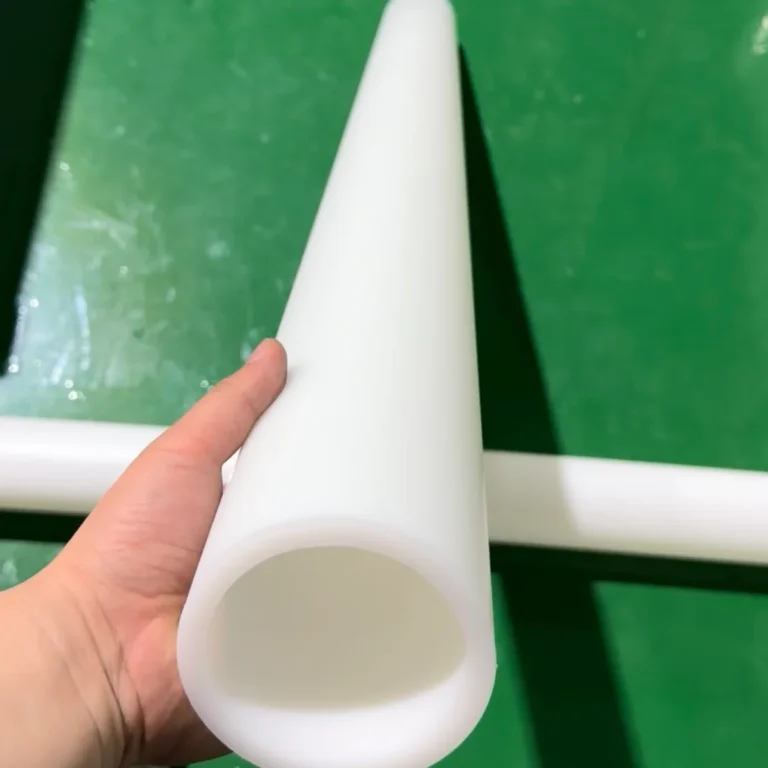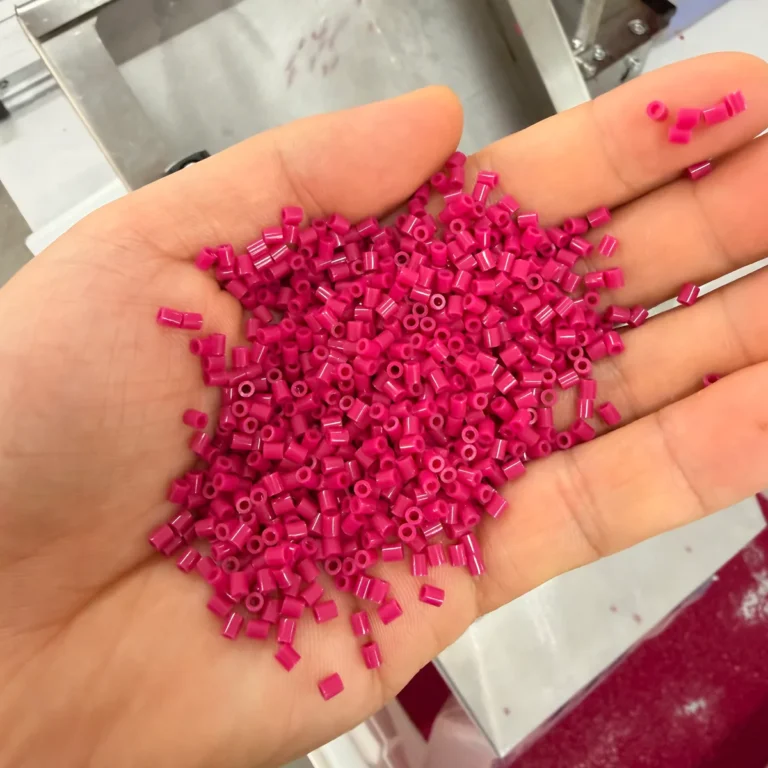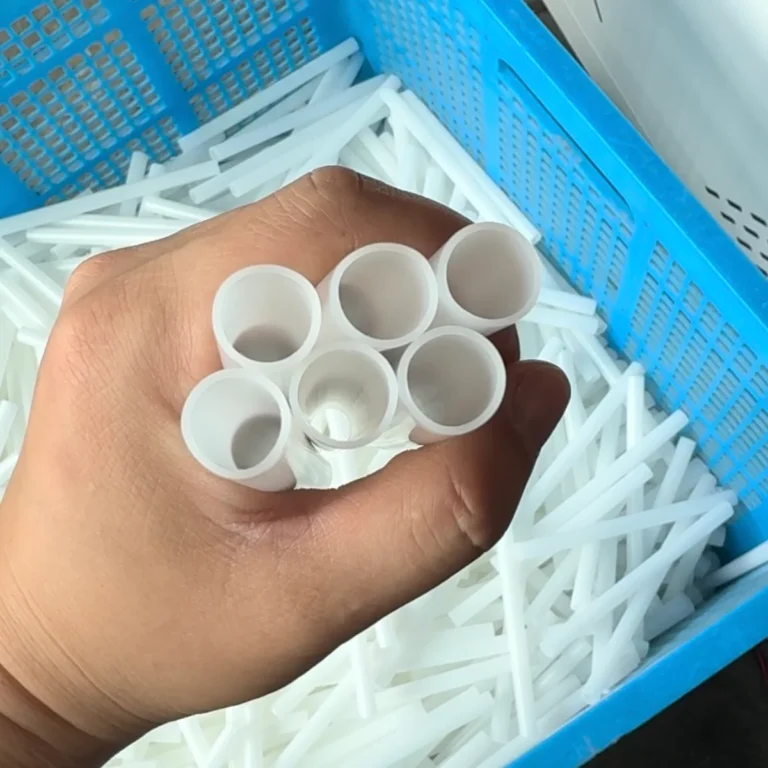
What Is a PVC Pelletizing Extrusion Line?
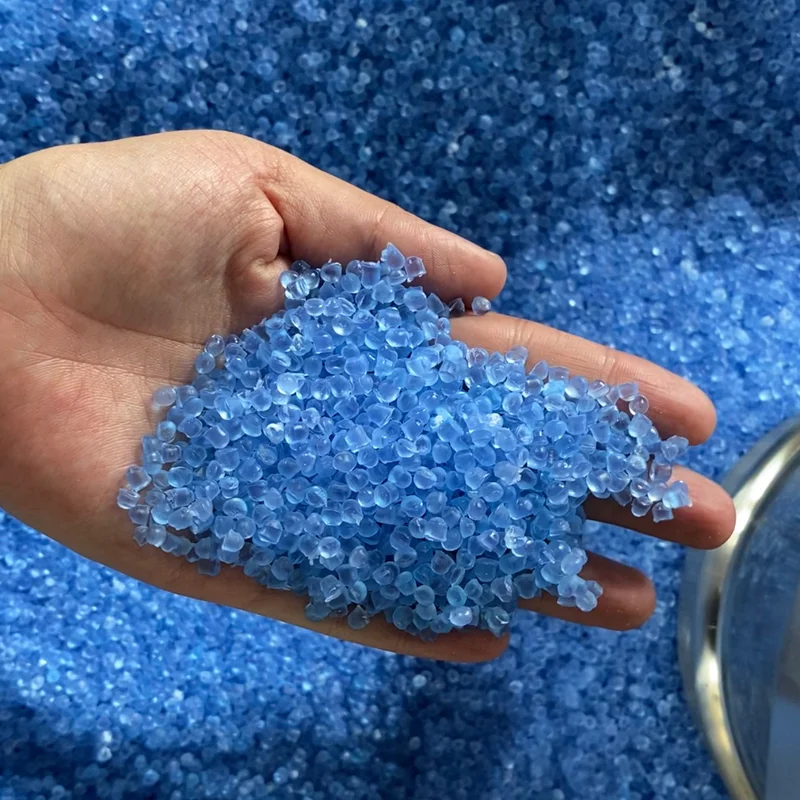
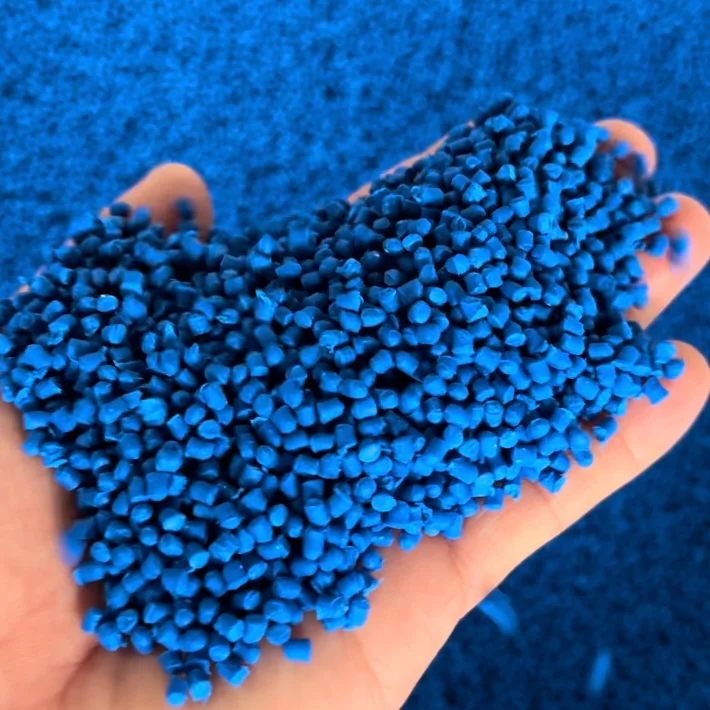
A PVC pelletizing extrusion line is a complete compounding and granulating system used to process PVC powder, plasticizers, stabilizers, fillers, pigments, and additives into uniform PVC pellets. These pellets can then be used for producing cables, hoses, soft PVC tubes, transparent PVC products, profiles, seals, flooring, irrigation products, and other industrial plastic applications.
Unlike simple plastic pelletizing, PVC pelletizing requires accurate temperature control, strong mixing ability, stable feeding, low-shear processing, efficient die-face cutting, and rapid cooling. PVC is heat-sensitive, so the extrusion line must prevent material degradation while ensuring uniform dispersion and consistent pellet shape.
Based on the QTech Machinery PVC pelletizing extrusion line case, a successful solution should be customized according to PVC formulation, pellet type, output target, softness or hardness requirement, transparency requirement, local voltage, and factory layout.
Reference case: PVC Pelletizing Extrusion Line
1. What is a PVC pelletizing extrusion line?
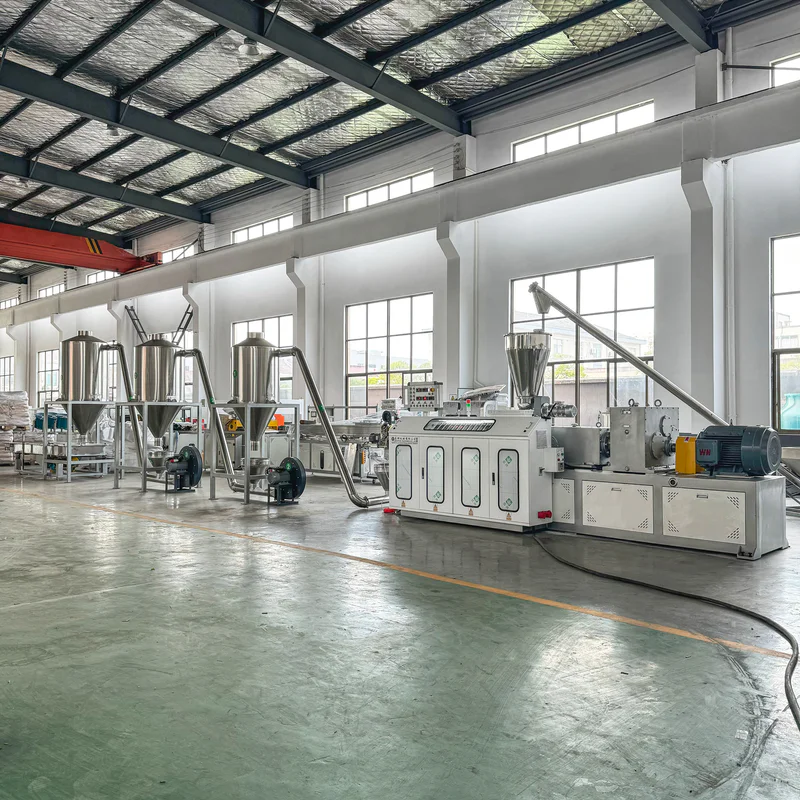
A PVC pelletizing extrusion line is a complete system that mixes, melts, extrudes, cuts, cools, screens, and conveys PVC material into uniform pellets.
A PVC pelletizing extrusion line converts PVC raw materials into granules that are easier to store, transport, and process in downstream production. The system usually starts with PVC powder and additives. These materials are fed into the extruder, where they are heated, mixed, plasticized, and pushed through a pelletizing die. The hot material is then cut into pellets, cooled, screened, and collected.
A typical PVC pelletizing line includes:
| Main Section | Function |
|---|---|
| Feeding system | Transfers PVC powder or compound into the extruder |
| Conical twin-screw extruder | Mixes, plasticizes, and conveys PVC material |
| Hot die face pelletizing mold | Cuts molten PVC into pellets at the die surface |
| Air conveying system | Transports and cools pellets |
| Vibrating screen | Separates qualified pellets from oversized or undersized particles |
| Cooling system | Prevents pellets from sticking and maintains quality |
| Control system | Controls temperature, speed, feeding, and operation |
| Collection system | Stores finished pellets for packaging or next process |
In the QTech Machinery case, the customer was a leading power technology company that needed to produce high-quality transparent soft PVC material. QTech designed and delivered a customized PVC pelletizing extrusion line to meet the client’s requirements for efficiency, durability, and precision.
2. What materials can a PVC pelletizing extrusion line process?
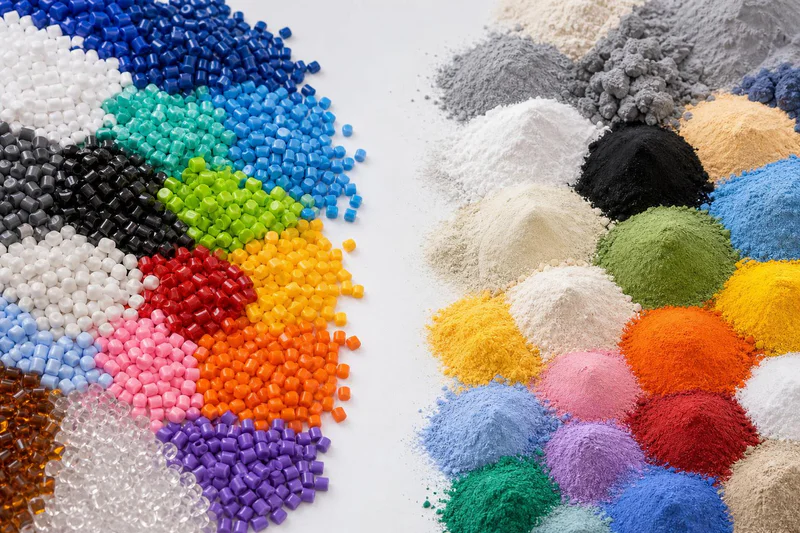
A PVC pelletizing extrusion line mainly processes soft PVC, rigid PVC, transparent PVC, filled PVC, modified PVC, and customized PVC compounds.
PVC pelletizing is widely used in both soft and rigid PVC applications. Different formulations require different screw designs, temperature settings, cutting systems, and cooling methods.
Common PVC pelletizing materials include:
| Material Type | Main Features | Typical Applications |
|---|---|---|
| Soft PVC | Flexible, elastic, easy to process | Cable compounds, hoses, seals, footwear |
| Transparent soft PVC | Clear appearance, flexible, clean surface | Transparent tubes, cable sheathing, medical or packaging-related products |
| Rigid PVC | Strong, dimensionally stable | Profiles, fittings, pipes |
| Filled PVC | Lower cost, improved stiffness | Construction materials, flooring, industrial products |
| Modified PVC | Customized performance | Special cable, automotive, and industrial applications |
| Recycled PVC blends | Cost-effective, reusable | Secondary products and recycling applications |
In the QTech case, the customer specifically required a line for transparent soft PVC material. Transparent soft PVC requires stable plasticizing and clean processing because poor temperature control or contamination can affect clarity, color, and pellet quality.
PVC is highly sensitive to heat. If the temperature is too high or residence time is too long, PVC may degrade, discolor, or release corrosive gases. Therefore, the extrusion line must be designed with accurate heating, cooling, and screw speed control.
3. Why is a conical twin-screw extruder commonly used for PVC pelletizing?
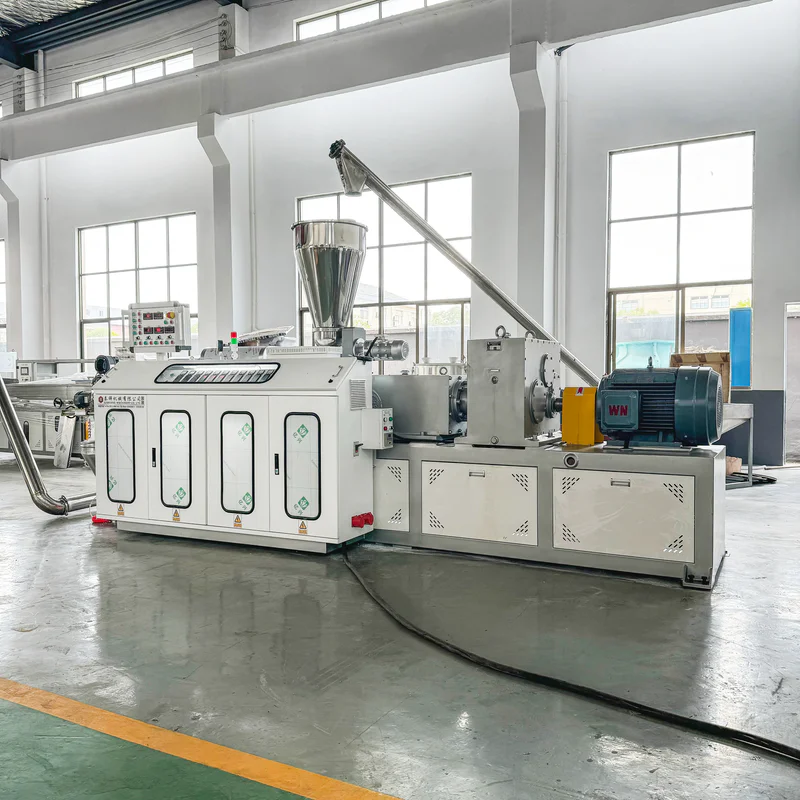
A conical twin-screw extruder is suitable for PVC because it provides strong mixing, stable conveying, good plasticizing, and lower processing stress for heat-sensitive materials.
PVC pelletizing often requires a conical twin-screw extruder because PVC powder and additives need effective mixing and controlled plasticization. Compared with a single screw extruder, a conical twin-screw extruder can offer better feeding performance, more stable material conveying, stronger mixing, and better control over PVC melting.
In the QTech PVC pelletizing case, the core machine was an SJSZ80/156 conical twin-screw extruder.
Key configuration:
| Item | Configuration |
|---|---|
| Extruder model | SJSZ80/156 conical twin-screw extruder |
| Screw diameter | Φ80/156 mm |
| Effective working length | 1800 mm |
| Screw speed | 1–37 rpm |
| Main motor power | 55 kW |
| Motor type | WN AC motor |
| Screw and barrel material | 38CrMoAlA |
| Surface treatment | Nitriding treatment |
| Surface hardness | 800–900 HV |
| Barrel cooling | Copper pipe water cooling |
| Screw core cooling | Oil cooling |
| Heating system | 36 kW cast aluminum heaters |
| Heating zones | Four heating zones |
This configuration is especially suitable for PVC compounding because the 38CrMoAlA nitrided screw and barrel provide good wear resistance and long service life. The 800–900 HV surface hardness improves durability under continuous operation. The copper pipe water cooling for the barrel and oil cooling for the screw core help control temperature and prevent PVC degradation.
4. How does the feeding system support stable PVC pellet production?
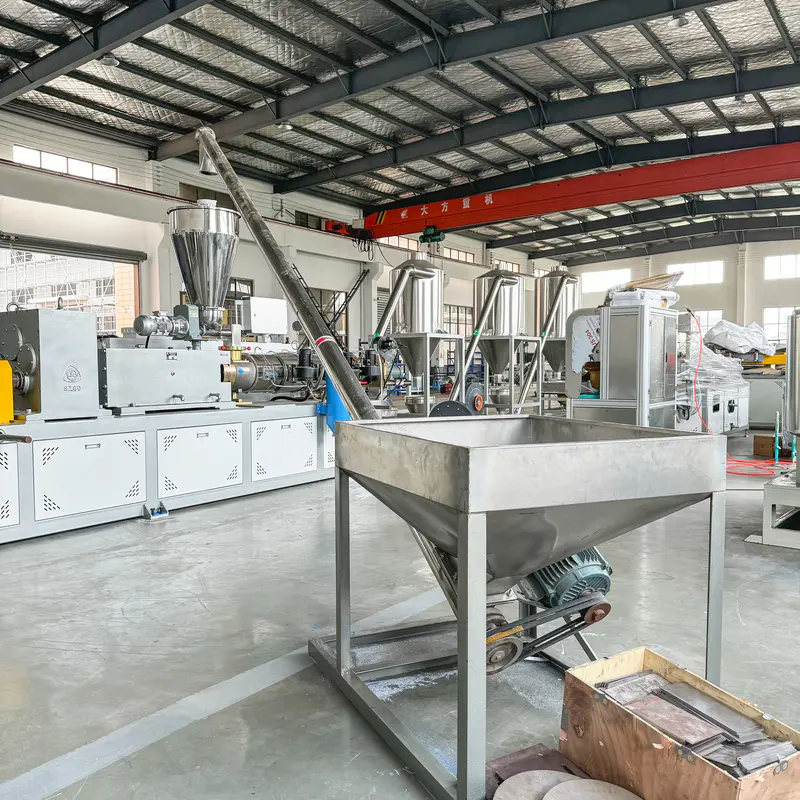
A stable feeding system ensures continuous material supply, consistent output, and better pellet uniformity.
PVC pelletizing usually involves powder, additives, plasticizer, stabilizer, filler, and sometimes pigments or masterbatch. A reliable feeding system is important because unstable feeding can cause output fluctuation, uneven plasticizing, inconsistent pellet size, and poor product quality.
In the QTech case, the line included an automatic spiral feeder.
| Feeding System | Configuration |
|---|---|
| Type | Automatic spiral feeder |
| Feeding motor power | 1.5 kW |
| Material | Stainless steel |
| Main benefit | Stable feeding and durable operation |
The stainless steel structure improves durability, cleanliness, and corrosion resistance. The spiral feeding method is suitable for powder or mixed materials and helps maintain a continuous supply to the extruder.
Stable feeding helps avoid:
- Material shortage in the extruder
- Unstable melt pressure
- Pellet size variation
- Poor additive dispersion
- Production interruptions
- Higher scrap rate
For customers using different PVC formulations, QTech Machinery can customize the feeding method according to material flowability, bulk density, powder ratio, and production capacity.
5. How does hot die face pelletizing work for PVC materials?
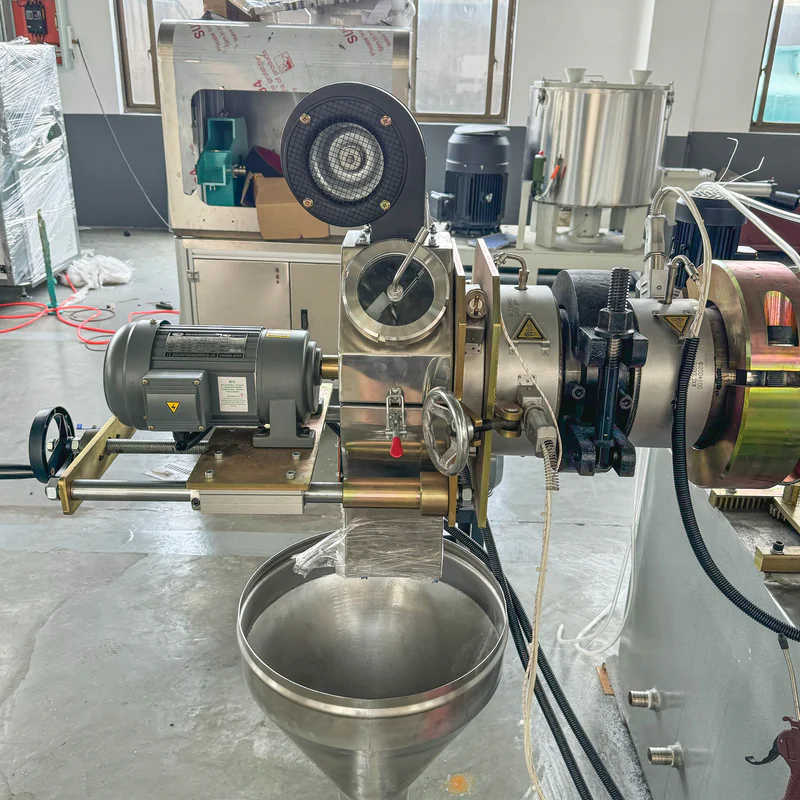
Hot die face pelletizing cuts the molten PVC directly at the die surface, producing compact and uniform pellets with efficient processing.
Hot die face pelletizing is commonly used for PVC compounds because it allows the material to be cut immediately as it exits the die. This helps form pellets quickly and reduces long strand handling problems.
In the QTech PVC pelletizing case, the line used a PVC hot die face pelletizing mold.
| Pelletizing Mold | Configuration |
|---|---|
| Pelletizing method | Die face hot cutting |
| Mold material | ZG40Cr |
| Surface treatment | Hard chrome plating |
| Cutting knives | Three Cr12 tool steel knives |
| Main benefit | Durable cutting and uniform pellets |
The ZG40Cr mold with hard chrome plating improves wear resistance and extends service life. The three Cr12 tool steel knives provide reliable cutting performance for continuous pelletizing.
Hot die face pelletizing offers several advantages:
| Advantage | Benefit |
|---|---|
| Direct die-face cutting | Shorter production process |
| Compact pellet shape | Easier storage and feeding |
| Less strand break risk | More stable operation |
| Suitable for soft PVC | Better handling of flexible compounds |
| Efficient cutting | Improves production continuity |
| Lower labor requirement | Easier operation |
For transparent soft PVC, pellet shape and surface quality are important. A stable die face cutting system helps produce clean and uniform pellets for downstream processing.
6. Why are air conveying, cooling, and screening important?
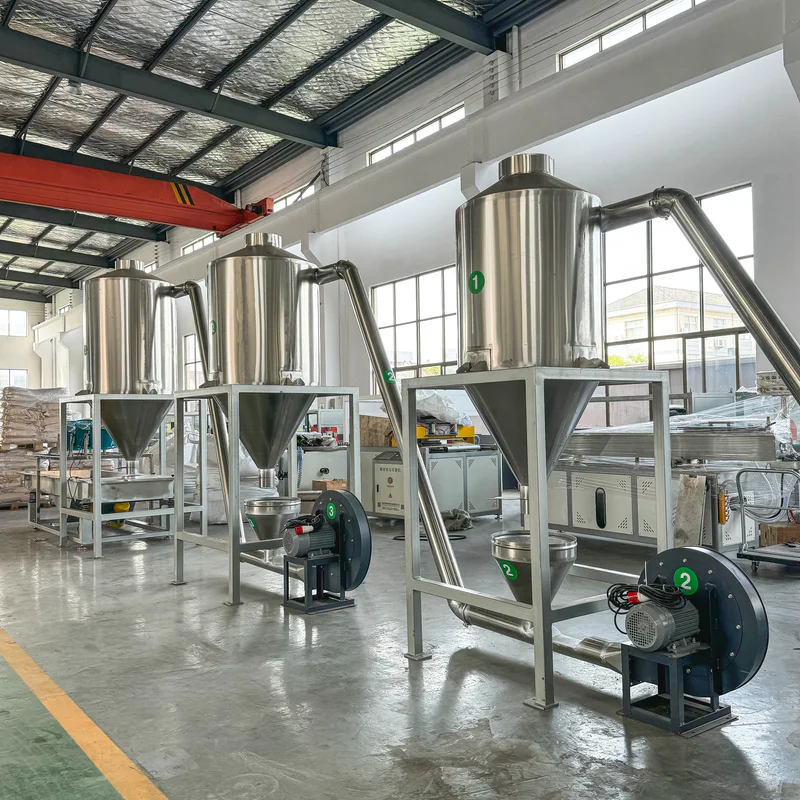
Air conveying, cooling, and screening prevent pellet sticking, remove heat, separate irregular particles, and improve final pellet quality.
After hot die face cutting, PVC pellets still contain heat. If they are not cooled quickly and evenly, they may stick together, deform, or lose surface quality. Air conveying and vibrating screening are important downstream steps.
In the QTech PVC pelletizing extrusion line case, the downstream system included:
| Equipment | Configuration | Function |
|---|---|---|
| Three-stage air conveying system | 4 kW and 3 kW blowers | Transports and cools pellets |
| Air ducts | Stainless steel | Corrosion-resistant conveying |
| Forced air cooling vibrating screen | Dual 0.2 kW vibration motors | Pellet screening |
| Cooling fan | 2.2 kW | Maintains pellet quality |
The three-stage air conveying system improves pellet transport and cooling efficiency. The stainless steel ducts help resist corrosion and contamination. The forced air cooling vibrating screen separates qualified pellets and removes oversized or undersized particles.
These systems help improve:
- Pellet cooling efficiency
- Pellet size consistency
- Pellet surface appearance
- Reduced sticking
- Easier packaging
- Cleaner production
- Better downstream feeding performance
For PVC pellet manufacturers, the downstream system is just as important as the extruder because poor cooling or screening can reduce the commercial value of finished pellets.
7. How should customers choose the right PVC pelletizing extrusion line?
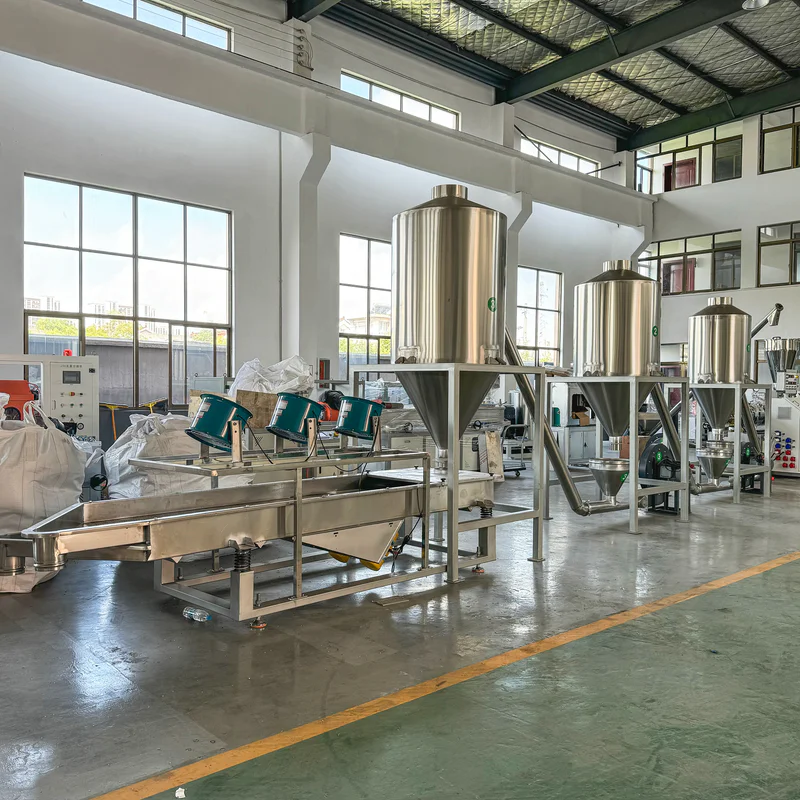
Customers should choose the line based on PVC formulation, pellet application, softness, transparency, output, cutting method, cooling system, and automation requirements.
A PVC pelletizing extrusion line should be selected according to the final pellet application. For example, transparent soft PVC requires cleaner material flow and careful temperature control, while filled PVC requires stronger wear resistance and mixing capability.
Customer Selection Steps
| Step | What to Confirm | Why It Matters |
|---|---|---|
| Step 1 | PVC type | Soft PVC, rigid PVC, transparent PVC, filled PVC |
| Step 2 | Final application | Cable, hose, profile, tube, seal, flooring, etc. |
| Step 3 | Formula details | Plasticizer, stabilizer, filler, pigment, additives |
| Step 4 | Target output | Determines extruder model and motor power |
| Step 5 | Pellet shape and size | Determines die and cutter design |
| Step 6 | Temperature sensitivity | Determines heating and cooling design |
| Step 7 | Material corrosiveness | Determines screw, barrel, and die treatment |
| Step 8 | Factory voltage | Configures electrical system |
| Step 9 | Automation level | Determines control cabinet and operator interface |
| Step 10 | Workshop layout | Determines line arrangement and conveying route |
For example, if a customer needs transparent soft PVC pellets, QTech Machinery may recommend a conical twin-screw extruder with precise cooling, hard chrome plated die face, Cr12 cutting knives, stainless steel conveying, and forced air cooling screening.
Every QTech line is configured to the buyer’s actual market. Customers can send raw material details, target output, pellet size, local voltage, and workshop layout, and QTech engineers will provide the correct screw, die, downstream, and control setup.
8. Why choose QTech Machinery for a PVC pelletizing extrusion line?
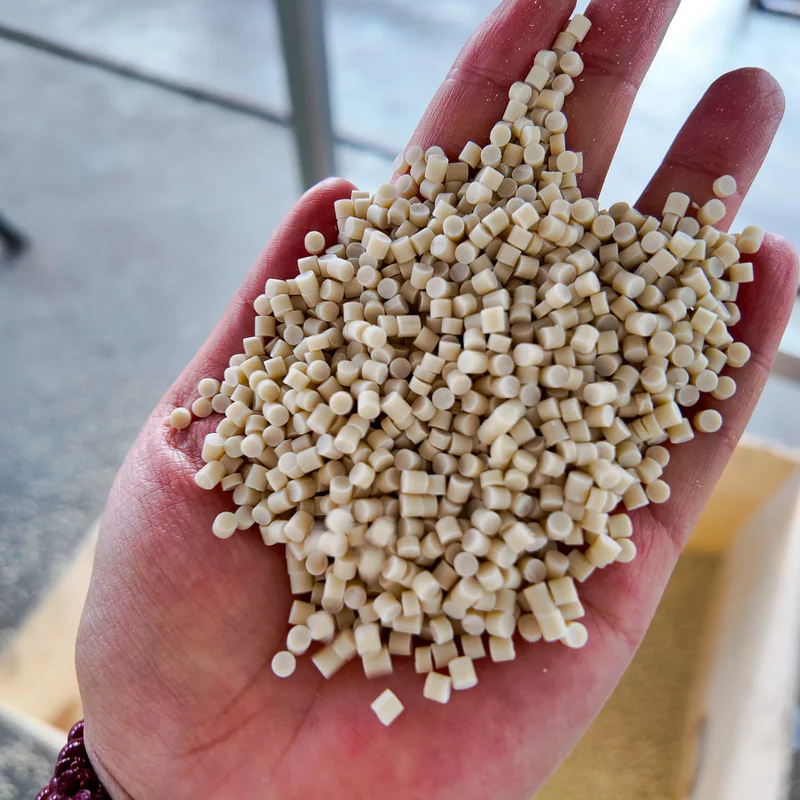
QTech Machinery provides customized PVC pelletizing solutions with durable twin-screw extruders, stable feeding, hot die face cutting, efficient cooling, and full engineering support.
PVC pelletizing requires experience because PVC is heat-sensitive and formulation-dependent. A good supplier must understand material behavior, screw configuration, heating and cooling balance, pelletizing method, and downstream cooling and screening.
In the PVC Pelletizing Extrusion Line case, QTech Machinery worked with a leading power technology company in the Asia-Pacific region. The client needed a high-efficiency line for high-quality transparent soft PVC material. QTech supplied a customized solution covering design, manufacturing, installation, and integration into the customer’s existing operations.
QTech Machinery’s advantages include:
| QTech Advantage | Customer Benefit |
|---|---|
| Customized PVC pelletizing design | Matches customer formula and product application |
| SJSZ80/156 conical twin-screw extruder | Strong mixing and stable PVC plasticizing |
| 38CrMoAlA nitrided screw and barrel | Long service life and wear resistance |
| 800–900 HV surface hardness | Better durability under continuous production |
| Barrel water cooling and screw oil cooling | Helps prevent PVC degradation |
| Cast aluminum heaters | Stable and efficient heating |
| Stainless steel spiral feeder | Stable and clean material feeding |
| Hot die face pelletizing | Efficient and uniform pellet production |
| ZG40Cr hard chrome plated mold | Durable and corrosion-resistant |
| Cr12 cutting knives | Reliable cutting performance |
| Three-stage air conveying | Efficient pellet cooling and transport |
| Forced air cooling vibrating screen | Better pellet classification |
| OEM and ODM support | Flexible customization |
| Voltage configuration | Suitable for global customers |
| Full run test before shipment | Lower startup risk |
| Quote in 24 hours | Faster project planning |
Recommended internal links:
- QTech Machinery Home
- Plastic Extrusion Machine
- Plastic Pulverizing & Pelletizing Making Machine
- PVC Pelletizing Extrusion Line Case
- QTech Machinery Cases
Recommended PVC Pelletizing Extrusion Line Configuration
The following table summarizes the reference configuration from the QTech PVC pelletizing extrusion line case.
| Section | Recommended Configuration |
|---|---|
| Material | PVC |
| Product | Transparent soft PVC pellets |
| Main extruder | SJSZ80/156 conical twin-screw extruder |
| Screw diameter | Φ80/156 mm |
| Effective working length | 1800 mm |
| Screw speed | 1–37 rpm |
| Main motor | 55 kW WN AC motor |
| Screw and barrel material | 38CrMoAlA |
| Screw and barrel treatment | Nitriding treatment |
| Surface hardness | 800–900 HV |
| Barrel cooling | Copper pipe water cooling |
| Screw core cooling | Oil cooling |
| Heating system | 36 kW cast aluminum heaters |
| Heating zones | Four zones |
| Feeding system | Automatic spiral feeder |
| Feeding motor | 1.5 kW |
| Feeder material | Stainless steel |
| Pelletizing mold | PVC hot die face pelletizing mold |
| Mold material | ZG40Cr |
| Mold treatment | Hard chrome plating |
| Cutting knives | Three Cr12 tool steel knives |
| Conveying system | Three-stage air conveying system |
| Blower power | 4 kW and 3 kW fans |
| Duct material | Stainless steel |
| Screening system | Forced air cooling vibrating screen |
| Vibration motors | Dual 0.2 kW motors |
| Cooling fan | 2.2 kW |
Products We Can Provide
QTech Machinery can provide complete equipment for PVC pelletizing and related plastic processing projects.
| Product | Function |
|---|---|
| SJSZ conical twin-screw extruder | PVC plasticizing and compounding |
| Automatic spiral feeder | Stable material feeding |
| PVC hot die face pelletizing mold | Pellet forming and cutting |
| Die face cutter | Cuts molten PVC into pellets |
| Air conveying system | Pellet transport and cooling |
| Forced air cooling vibrating screen | Pellet cooling and classification |
| Stainless steel ducts | Clean and durable material conveying |
| Control cabinet | Centralized electrical control |
| Heating and cooling system | Temperature management |
| Pellet collection system | Finished pellet collection |
| Mixer system | PVC formula mixing before extrusion |
| Spare parts | Screw, barrel, heater, cutter knife, screen, blower, sensor |
| Customized auxiliary equipment | According to formula and workshop layout |
Documents and Information Customers Should Prepare
To help QTech Machinery design the right PVC pelletizing extrusion line, customers should prepare the following information:
| Required Information | Purpose |
|---|---|
| PVC type | Determines screw and temperature design |
| PVC formulation | Confirms plasticizer, stabilizer, filler, pigment ratio |
| Pellet application | Determines pellet quality requirement |
| Soft or rigid PVC | Affects processing temperature and screw design |
| Transparency requirement | Requires cleaner and more stable processing |
| Target output | Determines extruder size and downstream capacity |
| Pellet size | Determines die hole and cutter design |
| Material form | Powder, dry blend, recycled material, compound |
| Factory voltage | Configures electrical components |
| Workshop layout | Designs machine arrangement |
| Cooling requirement | Determines air conveying and screening system |
| Packaging method | Determines collection and storage system |
| Local standards | Supports compliance and safety design |
| Sample photos or drawings | Helps engineers understand final product |
Practical References from Forums and Industry Sources
PVC pelletizing is a temperature-sensitive process. Stable feeding, controlled shear, accurate heating and cooling, and efficient pellet cooling are important for preventing degradation and maintaining pellet quality.
On the Eng-Tips Plastics Engineering Forum, engineers often discuss extrusion issues such as PVC degradation, melt instability, screw wear, temperature control, die buildup, and pellet quality problems. These discussions show why PVC processing requires careful balance between plasticizing efficiency and thermal safety.
Industry resources such as Plastics Technology regularly publish practical articles on compounding, pelletizing, extruder screw design, material handling, process control, and troubleshooting. These topics are closely related to PVC pelletizing because stable compounding and cooling directly affect pellet uniformity and downstream processability.
For general extrusion principles, ScienceDirect’s single screw extruder topic explains how plastic materials are conveyed, melted, compressed, and metered inside an extruder. Although PVC pelletizing often uses twin-screw extrusion, the basic principles of melting, pressure generation, and process stability are still useful for buyers.
For broader PVC material and sustainability information, the Vinyl Institute provides industry resources about vinyl materials, PVC applications, performance, and recycling-related topics.
These references support a key purchasing principle: a PVC pelletizing extrusion line should be selected according to formulation, temperature sensitivity, mixing demand, pelletizing method, cooling capacity, and supplier engineering experience—not only by machine price.
Conclusion
A PVC pelletizing extrusion line is a complete processing system that turns PVC powder or compound into uniform pellets through feeding, twin-screw plasticizing, hot die face cutting, air conveying, cooling, screening, and collection. It is widely used for soft PVC, rigid PVC, transparent PVC, filled PVC, and modified PVC materials.
QTech Machinery provides customized PVC pelletizing solutions for customers in cable, power technology, construction, irrigation, and industrial applications. The reference project used an SJSZ80/156 conical twin-screw extruder, automatic spiral feeder, PVC hot die face pelletizing mold, three-stage air conveying system, and forced air cooling vibrating screen to produce high-quality transparent soft PVC pellets.
If you are planning a PVC pelletizing project, send us your PVC formulation, target output, pellet size, material type, voltage, and workshop layout. Our engineering team will recommend the correct extrusion line configuration for your factory.