How Does a 110-315 HDPE Pipe Extrusion Line Work?
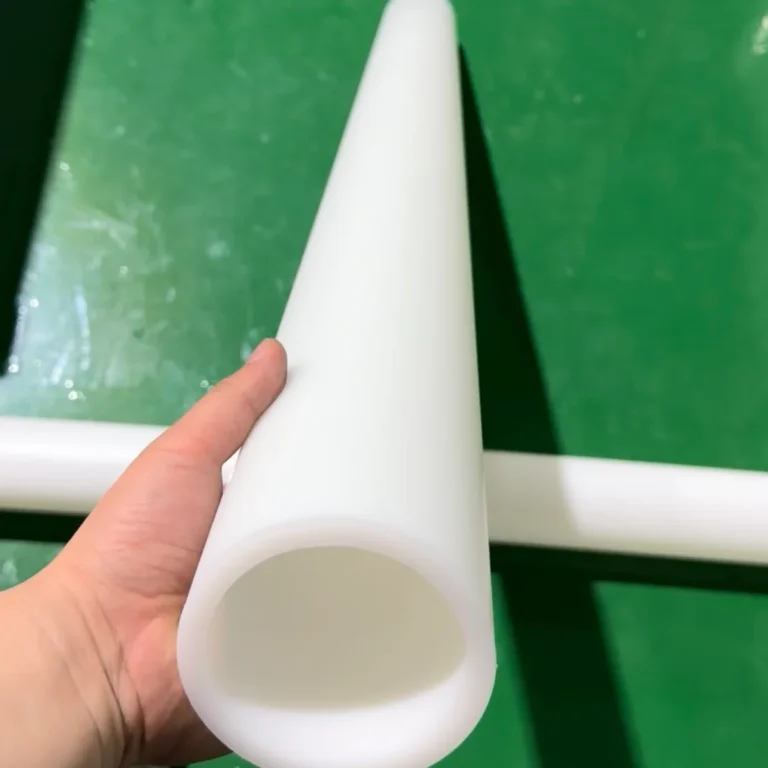
A 110-315 HDPE pipe extrusion line is a complete production system designed to manufacture medium and large diameter polyethylene pipes for agricultural irrigation, construction, infrastructure, drainage, industrial fluid transfer, and other pressure or non-pressure pipeline applications. The line works by feeding HDPE material into a high-speed extruder, melting and plasticizing it, shaping it through a pipe die, calibrating and cooling the pipe, pulling it with a servo haul-off machine, and cutting it to the required length.
For a diameter range of 110 mm to 315 mm, the extrusion line must provide high output, strong cooling capacity, accurate wall thickness control, stable traction, clean cutting, and reliable automation. Based on the QTech Machinery case for Chonzhou’s Jamay Pipe Industry Co., Ltd., a successful HDPE pipe production line requires a high-speed single screw extrusion system, auxiliary feeding and drying equipment, precise control, long vacuum calibration, multiple spray cooling tanks, servo haul-off, and chipless cutting.
1. What is a 110-315 HDPE pipe extrusion line?
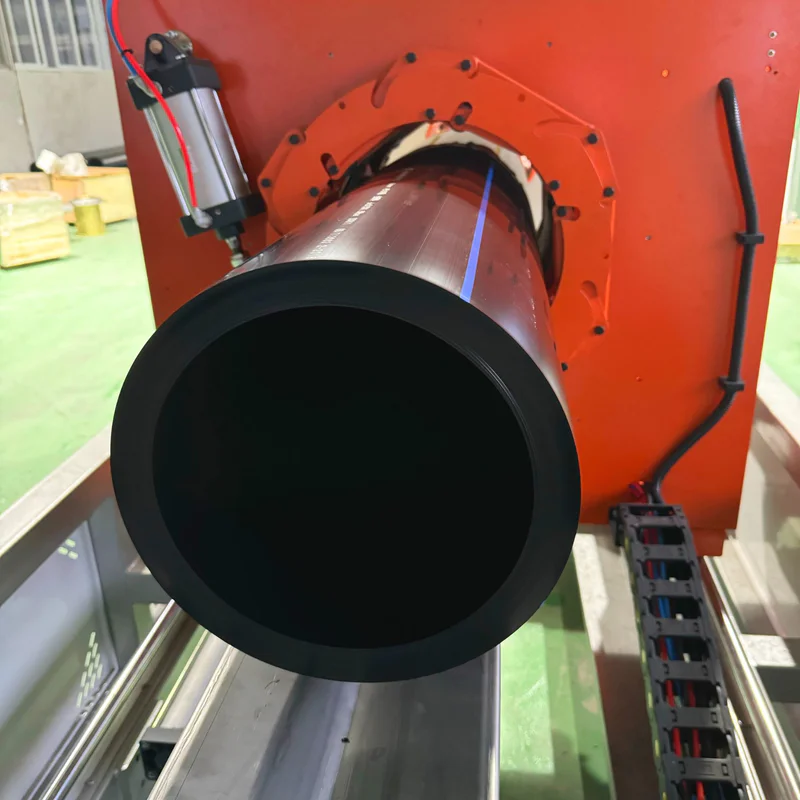
A 110-315 HDPE pipe extrusion line is a full manufacturing system that produces HDPE pipes from 110 mm to 315 mm through extrusion, forming, cooling, hauling, and cutting.
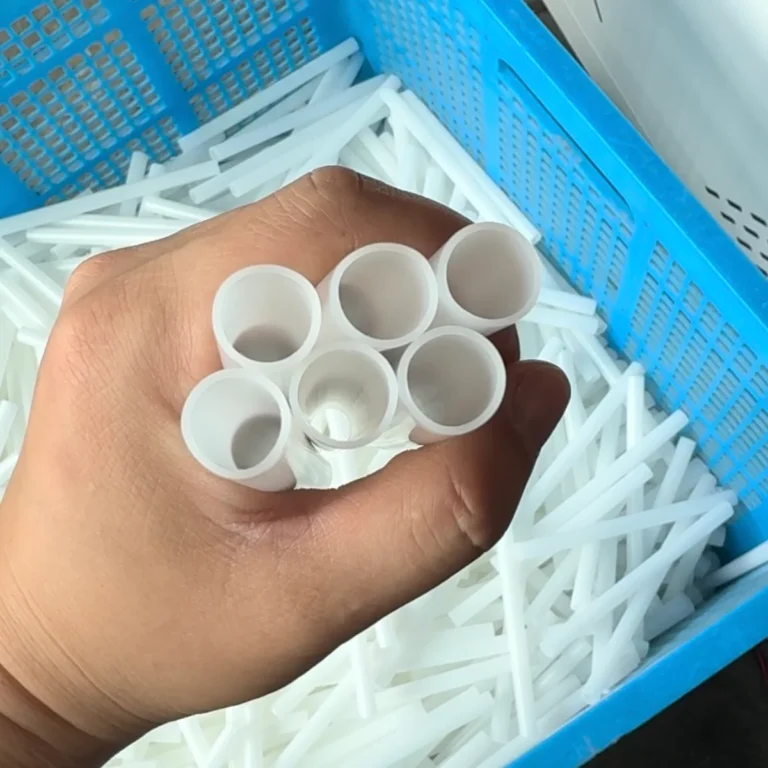
A 110-315 HDPE pipe extrusion line is used to produce polyethylene pipes with outside diameters from 110 mm to 315 mm. These pipes are widely used in water supply, irrigation, construction, industrial transportation, drainage, and infrastructure projects.
The line typically includes material feeding, drying, extrusion, pipe die forming, vacuum calibration, spray cooling, servo haul-off, cutting, and control systems. Each section works together to maintain pipe diameter, wall thickness, roundness, surface quality, and production stability.
Basic process flow:
| Process Step | Function |
|---|---|
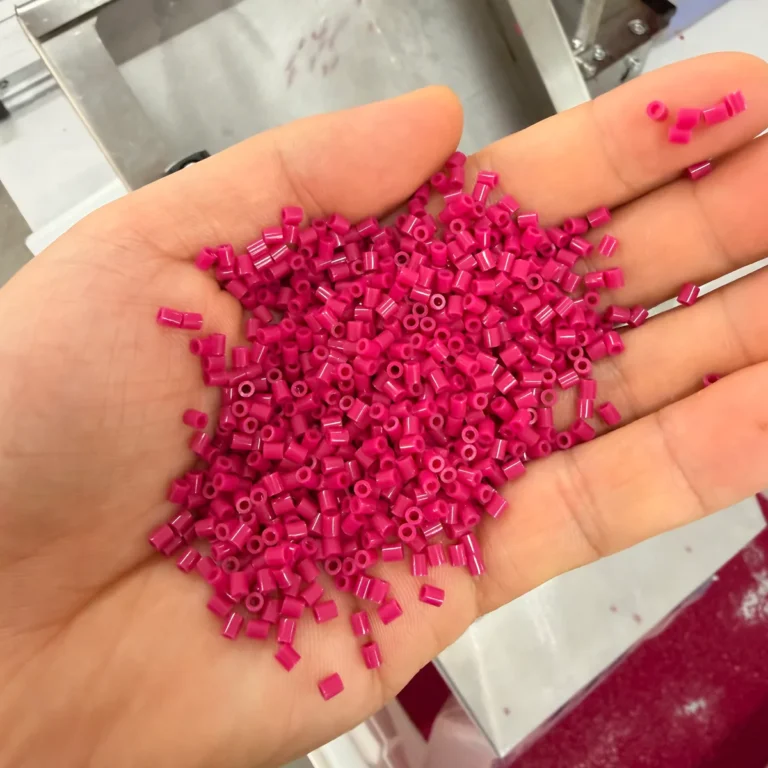
| Material feeding | Transfers HDPE pellets to the extruder |
| Material drying | Removes moisture when required |
| Extrusion | Melts and plasticizes HDPE |
| Die forming | Shapes the molten material into pipe |
| Vacuum calibration | Controls pipe diameter and roundness |
| Spray cooling | Cools and stabilizes the pipe |
| Haul-off | Pulls pipe at stable speed |
| Cutting | Cuts pipe to required length |
| Control system | Coordinates full line operation |
In the QTech Machinery case, the line was delivered to Chonzhou’s Jamay Pipe Industry Co., Ltd. in September 2023. The customer required a robust and efficient system for producing high-quality HDPE pipes from 110 mm to 315 mm.
Reference case: 110-315 HDPE Pipe Extrusion Line
2. How does the material feeding and drying system work?
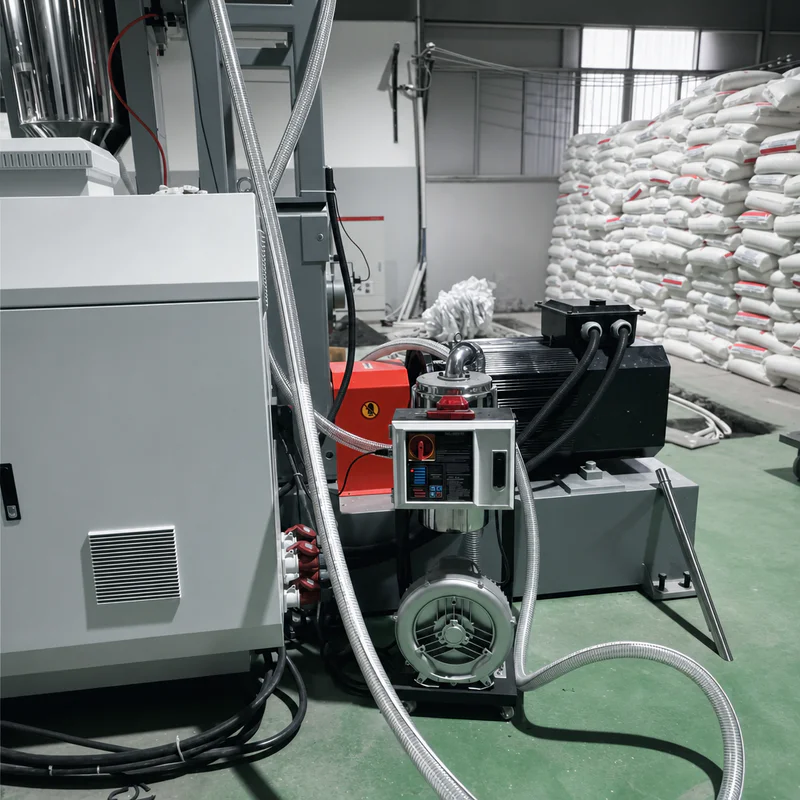
The feeding and drying system supplies stable HDPE material to the extruder and helps maintain continuous production with fewer interruptions.
Material feeding is the first step in HDPE pipe production. For medium and large pipe extrusion, the line needs a reliable feeding system that can continuously supply enough raw material to match high output.
In the QTech 110-315 HDPE pipe case, the auxiliary equipment included:
| Equipment | Configuration | Function |
|---|---|---|
| QX-900 automatic vacuum feeding system | 900 kg/h capacity | Transfers material automatically |
| QX-150 hopper dryer | 150 kg capacity, 7.5 kW heating power | Prepares material before extrusion |
The QX-900 automatic vacuum feeding system helps reduce manual feeding work and keeps material supply stable. With a capacity of 900 kg/h, it can support the high-output demand of the extrusion system.
The QX-150 hopper dryer has a 150 kg capacity and 7.5 kW heating power. Although HDPE generally has low moisture absorption compared with some engineering plastics, drying or preheating may still be useful depending on storage conditions, recycled material ratio, and production environment.
A stable feeding system helps avoid:
- Extruder starvation
- Output fluctuation
- Pipe wall thickness instability
- Surface defects caused by inconsistent material supply
- Production interruption
For customers planning high-capacity HDPE pipe production, automatic feeding is strongly recommended.
3. How does the extrusion system melt and plasticize HDPE?
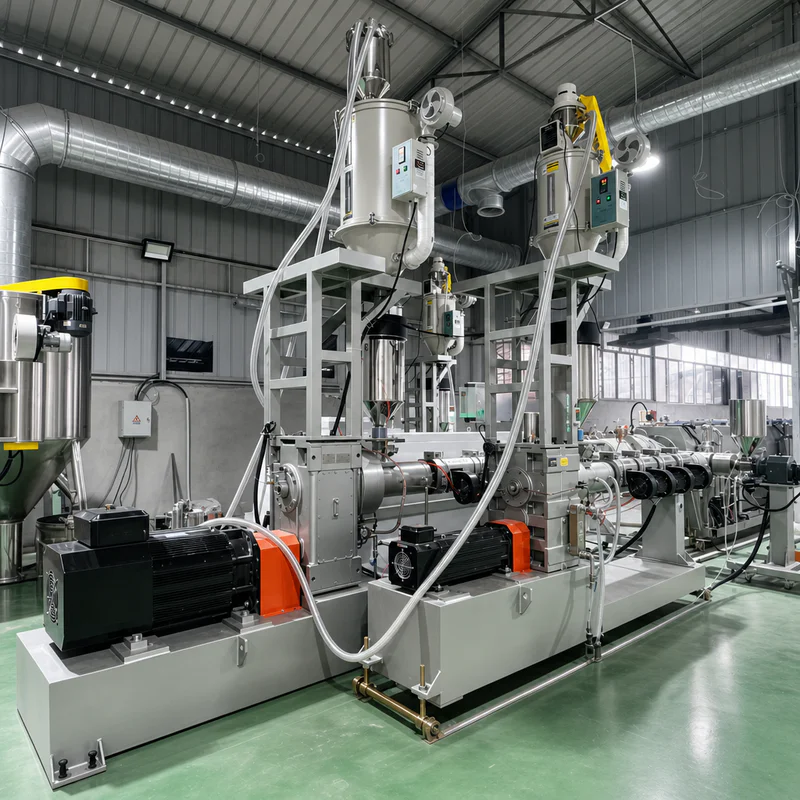
The extrusion system uses single screw extruders to melt, mix, pressurize, and continuously deliver HDPE melt into the pipe die.
The extruder is the core of the HDPE pipe extrusion line. It determines output capacity, melt quality, production stability, and energy consumption. For 110-315 mm HDPE pipes, a high-output extruder is required because larger pipe diameters and thicker walls consume more material.
In the QTech case, the extrusion system included:
| Extruder | Output | Motor Power | L/D Ratio | Function |
|---|---|---|---|---|
| SJ75/38 high-speed single screw extruder | 300–600 kg/h | 160 kW | 38:1 | Main extrusion |
| SJ50/33 single screw extruder | 30–80 kg/h | 22 kW | 33:1 | Co-extrusion or auxiliary layer |
The SJ75/38 high-speed single screw extruder provides high output and stable plasticizing for HDPE pipe production. The 38:1 L/D ratio gives a longer plasticizing path, helping improve melt uniformity and output stability.
The SJ50/33 single screw extruder can be used for co-extrusion, color layer, marking layer, or dual-layer pipe structure depending on the customer’s product design.
The QTech solution also included a dual-layer weight control system, helping maintain more accurate material distribution and product consistency.
For smaller precision extrusion needs, our uploaded SJ65/28 single screw servo extruder can also be used in customized plastic tube or pipe projects. It features a 37 kW Inovance servo motor, optimized BM screw structure, 38CrMoALA nitrided screw and barrel, Siemens PLC, MCGS touchscreen, and Ethernet communication, making it suitable for smaller or precision pipe applications where stable output and energy saving are priorities.
4. How does the pipe die form a 110-315 mm HDPE pipe?
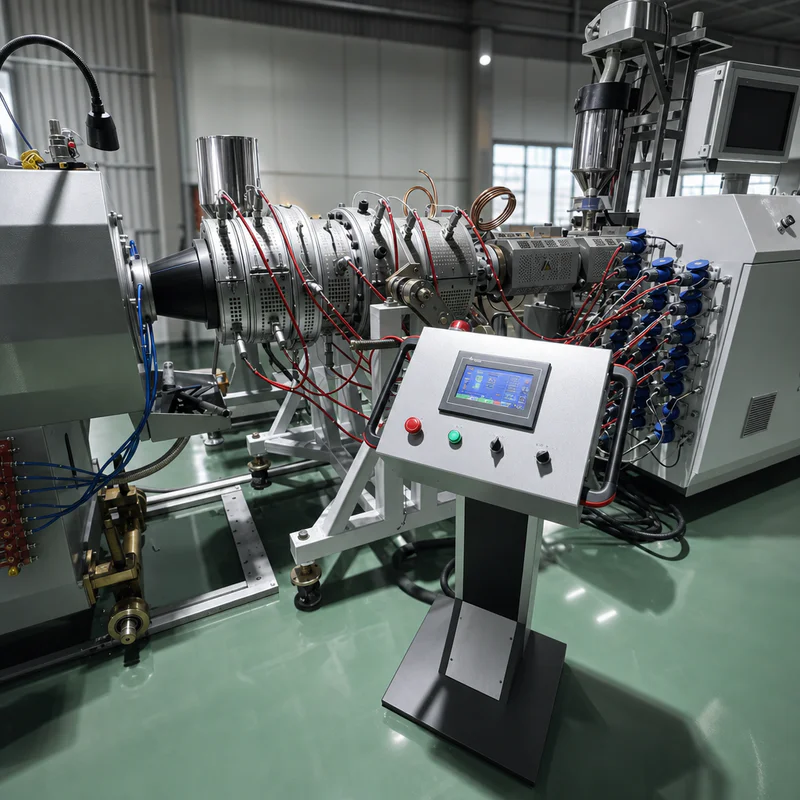
The pipe die distributes molten HDPE evenly around the mandrel to form the required pipe diameter, wall thickness, and layer structure.
After the HDPE material is plasticized by the extruder, it enters the pipe die. The die is responsible for forming the pipe shape. For large diameter HDPE pipes, the die must provide uniform flow distribution and stable pressure to avoid wall thickness variation.
A suitable die system for 110-315 mm pipes must consider:
| Die Design Factor | Why It Matters |
|---|---|
| Pipe diameter range | Determines die body and calibration sleeves |
| Wall thickness | Affects melt flow and pipe strength |
| Single-layer or co-extrusion structure | Determines die channel design |
| Material flow balance | Controls wall thickness uniformity |
| Heating zones | Maintains stable melt temperature |
| Die material | Affects durability and machining precision |
| Calibration sleeve | Controls initial pipe size |
The QTech project involved a complete HDPE pipe extrusion solution with advanced automation and a dual-layer weight control system. For customers producing multi-layer or marked pipes, the main extruder and auxiliary extruder must be synchronized through the control system.
Good die design helps improve:
- Pipe roundness
- Wall thickness consistency
- Smooth inner and outer surfaces
- Stable production speed
- Lower material waste
- Better product strength
For pipe manufacturers, the die is not a standard accessory—it must be designed according to actual pipe specifications.
5. How do vacuum calibration and spray cooling work?
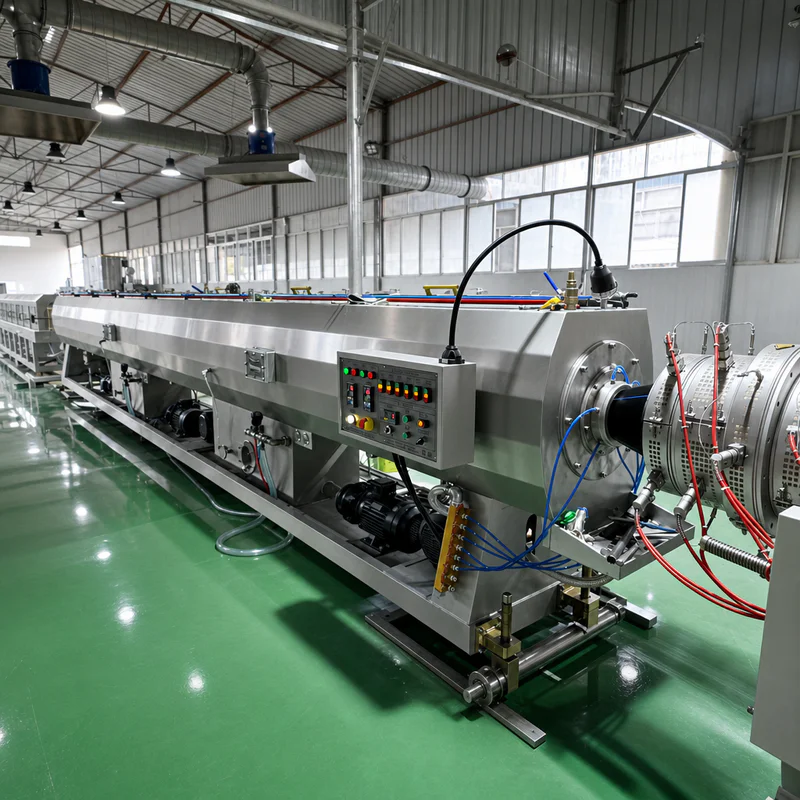
Vacuum calibration fixes the pipe diameter and roundness, while spray cooling removes heat and stabilizes the pipe before haul-off and cutting.
Once the molten HDPE pipe exits the die, it enters the vacuum calibration tank. At this stage, the pipe is still hot and soft. Vacuum force pulls the pipe surface against the calibrator, helping achieve the correct outside diameter and roundness.
In the QTech 110-315 HDPE pipe case, the cooling and calibration system included:
| Equipment | Configuration | Function |
|---|---|---|
| Vacuum calibration tank | 9 m length | Pipe sizing and roundness control |
| Calibrator | Elliptical calibrator | Accurate pipe shaping |
| Spray cooling tanks | Two 8 m units | Pipe cooling and stabilization |
| Spray pipes | Stainless steel | Durable water distribution |
| Nozzles | Nylon nozzles | Even spray cooling |
The 9-meter vacuum calibration tank provides sufficient sizing length for 110-315 mm pipes. The elliptical calibrator helps control pipe shape accurately. The two 8-meter spray cooling tanks provide extended cooling time, which is especially important for large-diameter HDPE pipes.
If cooling is insufficient, the pipe may experience:
- Ovality
- Diameter shrinkage
- Surface marks
- Internal stress
- Bending or deformation
- Poor cutting quality
- Unstable final dimensions
Therefore, for medium and large HDPE pipe production, long and stable cooling sections are essential.
6. How do haul-off and chipless cutting systems work?
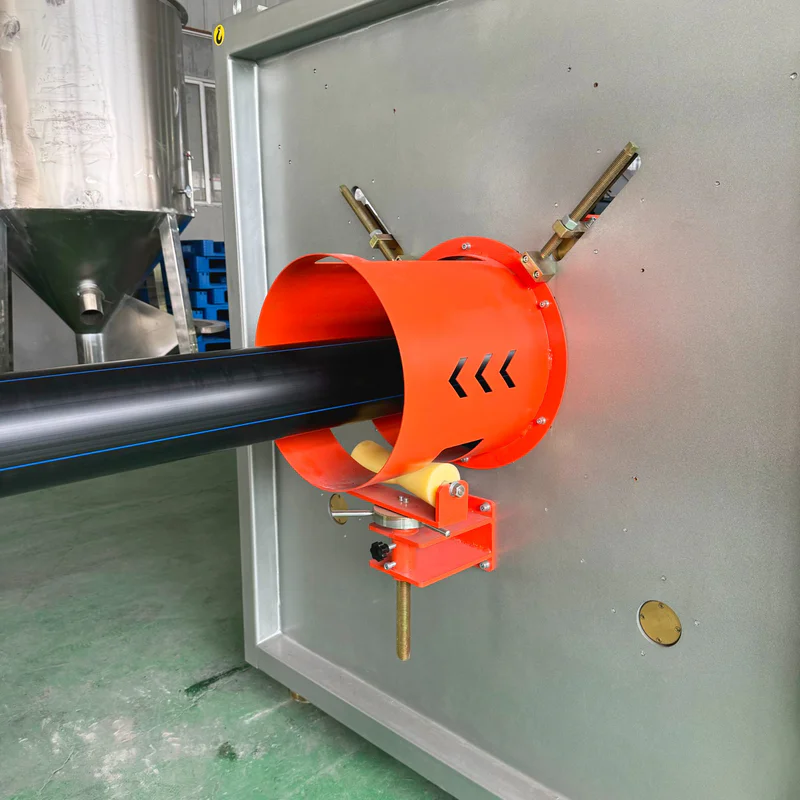
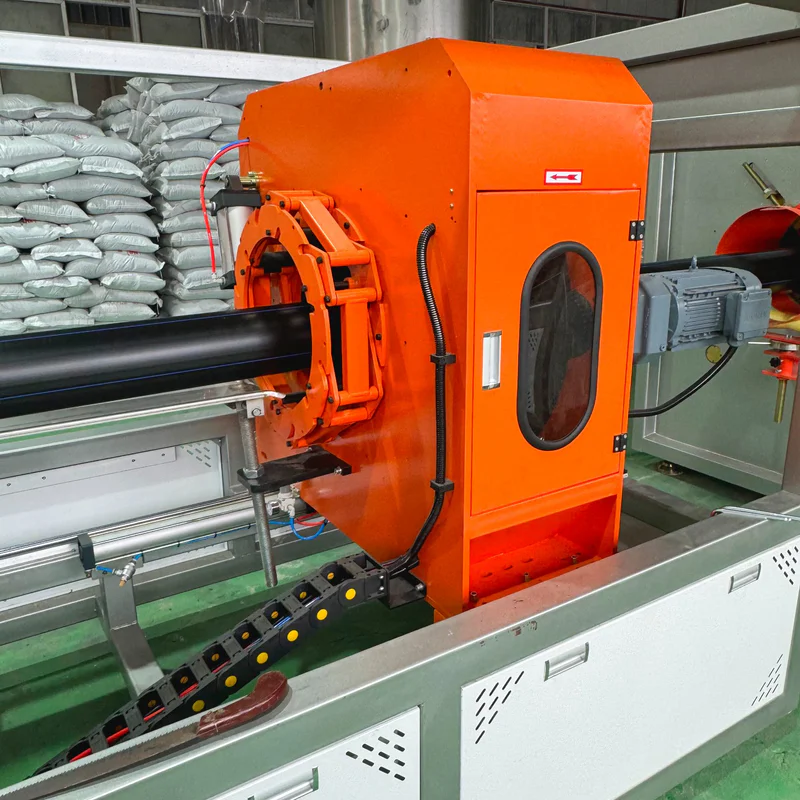
The haul-off machine pulls the pipe at a controlled speed, and the chipless cutter cuts it cleanly to the required length without excessive material waste.
The haul-off machine must pull the pipe at the same speed as the extrusion output. If the haul-off speed is unstable, the pipe wall thickness and diameter will change. For large HDPE pipes from 110 mm to 315 mm, strong traction is required.
In the QTech case, the line used:
| Downstream Equipment | Configuration | Benefit |
|---|---|---|
| Servo motor haul-off machine | 110-315 mm, four-track system | Stable traction |
| Clamping system | Pneumatic clamping | Adjustable and reliable grip |
| Cutting machine | Chipless cutting machine | Clean cutting without chips |
| Cutting feed | Hydraulic feed | Stable cutting movement |
| Blade | Custom blades | Suitable for pipe size |
| Cutter motor | 2.2 kW | Reliable cutting power |
The four-track servo haul-off machine provides balanced traction for medium and large pipes. Pneumatic clamping helps adjust grip force according to pipe size and wall thickness.
The chipless cutting machine is important because it reduces dust, chips, and waste during cutting. Clean cutting also improves pipe end quality and reduces secondary processing.
This combination improves:
- Pipe length accuracy
- Production efficiency
- Pipe end appearance
- Operator safety
- Material utilization
- Downstream handling
7. How does the control system improve HDPE pipe production?
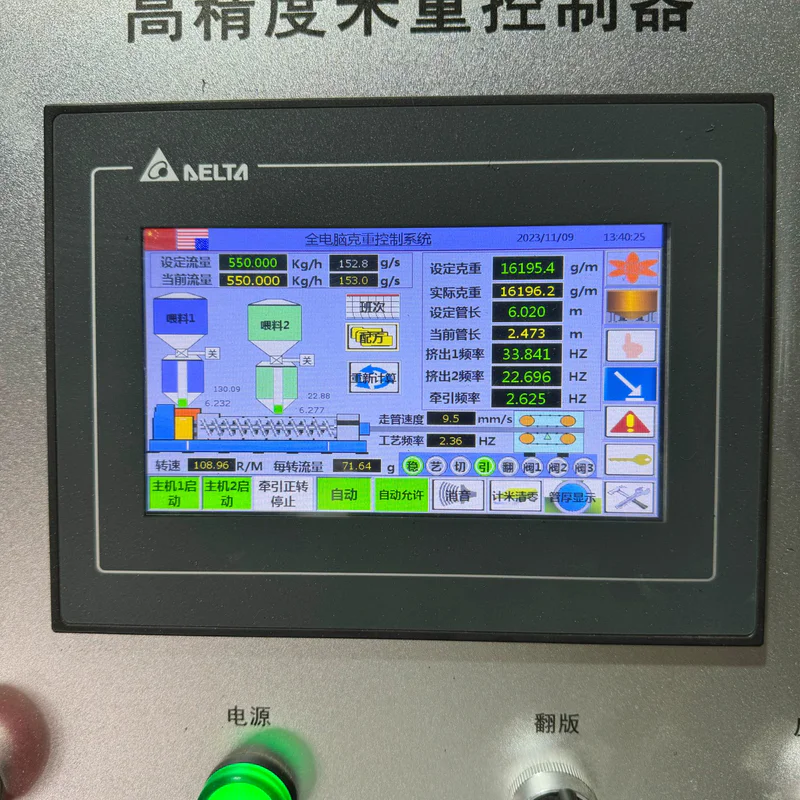
The control system synchronizes extrusion, cooling, haul-off, and cutting to improve stability, efficiency, and ease of operation.
A modern HDPE pipe extrusion line requires accurate and reliable control. The system must coordinate multiple sections, including main extruder, auxiliary extruder, feeding, cooling, haul-off, and cutter.
In the QTech case, the control system included:
| Control Component | Function |
|---|---|
| Delta PLC | Centralized process control |
| 7-inch touch screen | Operator interface |
| ABB inverters | Reliable speed control |
| Yaskawa inverters | Efficient motor control |
| Dual-layer weight control system | Better material distribution and consistency |
The PLC and touchscreen allow operators to monitor and adjust line operation. Inverters help control motor speed efficiently. The dual-layer weight control system supports more accurate pipe structure and material usage.
For smaller extrusion systems, our SJ65/28 servo extruder can include Siemens PLC, MCGS touchscreen, and Ethernet communication. This allows access to controller data and production information such as downtime rate and productivity. These features help customers improve production management and prepare for smart manufacturing upgrades.
Control system advantages include:
| Advantage | Benefit |
|---|---|
| Centralized operation | Easier machine control |
| Stable speed regulation | Better pipe dimension consistency |
| Alarm monitoring | Faster troubleshooting |
| Weight control | Lower material waste |
| Data access | Better production management |
| Automation | Less operator dependence |
8. Why choose QTech Machinery for a 110-315 HDPE pipe extrusion line?
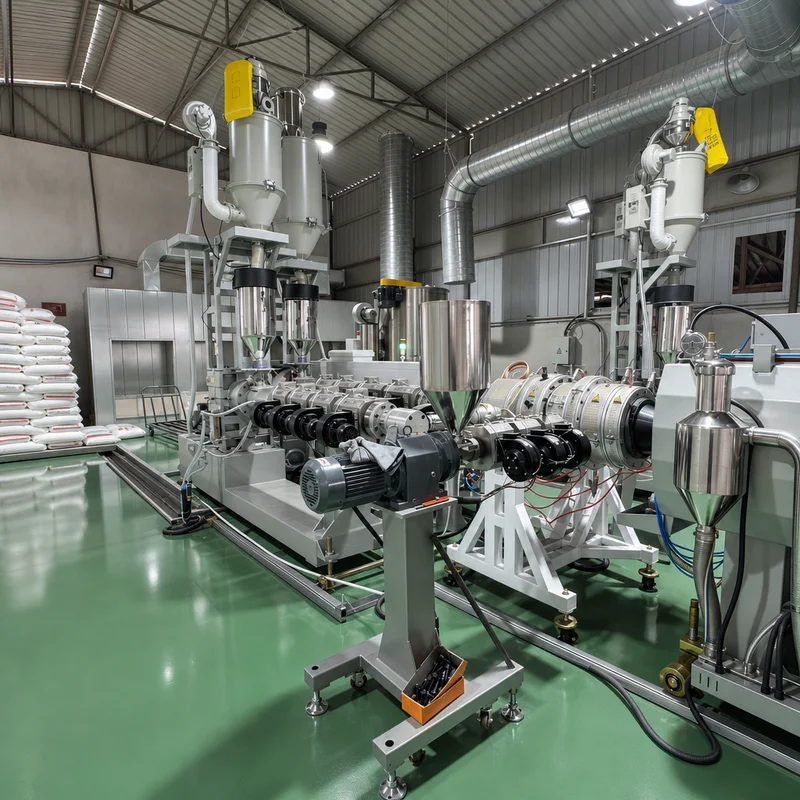
QTech Machinery provides customized HDPE pipe extrusion solutions with high-output extruders, automatic feeding, long cooling sections, servo haul-off, chipless cutting, and reliable controls.
Choosing a supplier for a 110-315 HDPE pipe extrusion line is not only about machine price. The supplier must understand pipe application, material processing, output planning, die design, cooling requirements, haul-off force, cutting method, and automation.
In the 110-315 HDPE Pipe Extrusion Line case, QTech Machinery delivered a complete production line to Chonzhou’s Jamay Pipe Industry Co., Ltd. The client required pipe diameters from 110 mm to 315 mm, output of 350–650 kg/h, operation under three-phase 380V/50Hz, and compliance with safety and environmental standards.
QTech supplied a full solution including:
- SJ75/38 high-speed single screw extruder
- SJ50/33 auxiliary single screw extruder
- QX-900 automatic vacuum feeding system
- QX-150 hopper dryer
- Delta PLC and 7-inch touchscreen
- ABB and Yaskawa inverters
- 9-meter vacuum calibration tank
- Two 8-meter spray cooling tanks
- Four-track servo haul-off machine
- Chipless cutting machine
QTech Machinery’s advantages include:
| QTech Advantage | Customer Benefit |
|---|---|
| Customized full-line design | Matches 110-315 mm pipe production |
| High-output extrusion system | Supports 350-650 kg/h production demand |
| Dual-extruder configuration | Supports multi-layer or marking needs |
| Automatic feeding and drying | Stable material supply |
| Long calibration and cooling system | Better pipe dimension stability |
| Servo haul-off | Stable traction for large pipes |
| Chipless cutting | Cleaner pipe ends and less waste |
| Reliable controls | Easier operation and monitoring |
| Voltage configuration | Suitable for different countries |
| Full run test | Reduces installation risk |
| OEM and ODM support | Flexible project cooperation |
| Quote in 24 hours | Faster purchasing process |
Recommended internal links:
- QTech Machinery Home
- Plastic Pipe Making Machine
- Plastic Extrusion Machine
- 110-315 HDPE Pipe Extrusion Line Case
- QTech Machinery Cases
Recommended 110-315 HDPE Pipe Extrusion Line Configuration
The following table summarizes the reference configuration from the QTech 110-315 HDPE pipe extrusion line case.
| Section | Recommended Configuration |
|---|---|
| Pipe material | PE/HDPE |
| Pipe diameter range | 110–315 mm |
| Required production capacity | 350–650 kg/h |
| Main extruder | SJ75/38 high-speed single screw extruder |
| Main extruder output | 300–600 kg/h |
| Main motor | 160 kW |
| Main extruder L/D ratio | 38:1 |
| Auxiliary extruder | SJ50/33 single screw extruder |
| Auxiliary output | 30–80 kg/h |
| Auxiliary motor | 22 kW |
| Auxiliary L/D ratio | 33:1 |
| Feeding system | QX-900 automatic vacuum feeding system |
| Feeding capacity | 900 kg/h |
| Hopper dryer | QX-150 |
| Dryer capacity | 150 kg |
| Dryer heating power | 7.5 kW |
| Control system | Delta PLC and 7-inch touchscreen |
| Inverters | ABB and Yaskawa |
| Vacuum tank | 9-meter 110-315 mm vacuum calibration tank |
| Calibrator | Elliptical calibrator |
| Cooling tanks | Two 8-meter spray cooling tanks |
| Spray pipes | Stainless steel |
| Nozzles | Nylon nozzles |
| Haul-off | 110-315 mm servo motor haul-off machine |
| Haul-off structure | Four-track system with pneumatic clamping |
| Cutter | Chipless cutting machine |
| Cutting feed | Hydraulic feed |
| Cutter motor | 2.2 kW |
| Power supply | Three-phase 380V/50Hz in the reference case |
Customer Selection Steps
Customers can follow these steps when choosing a 110-315 HDPE pipe extrusion line:
Step 1: Confirm pipe application
Decide whether the pipe will be used for irrigation, water supply, construction, infrastructure, drainage, or industrial fluid transportation.
Step 2: Confirm pipe diameter range
Provide the full pipe range, such as 110 mm, 160 mm, 200 mm, 250 mm, and 315 mm.
Step 3: Confirm wall thickness and pipe standard
Provide SDR, pressure rating, wall thickness, or applicable local standards.
Step 4: Confirm material formulation
Tell us whether you use virgin HDPE, recycled material, masterbatch, or co-extrusion structure.
Step 5: Confirm output target
Provide required production capacity in kg/h or meters per hour for each pipe size.
Step 6: Confirm factory voltage and layout
Send voltage, frequency, phase, workshop size, foundation conditions, and installation direction.
Step 7: Confirm automation needs
Choose standard control, PLC touchscreen, inverters, servo haul-off, weight control, or data monitoring.
Step 8: Review proposal and run test plan
QTech engineers will provide machine configuration, quotation, layout drawing, electrical information, and test arrangement before delivery.
Products We Can Provide
QTech Machinery can provide complete equipment for 110-315 HDPE pipe production projects.
| Product | Function |
|---|---|
| High-speed single screw extruder | Main HDPE plasticizing and extrusion |
| Auxiliary single screw extruder | Co-extrusion or marking layer |
| Automatic vacuum feeding system | Continuous material feeding |
| Hopper dryer | Material preparation |
| HDPE pipe die head | Pipe forming and wall thickness control |
| Vacuum calibration tank | Pipe sizing and roundness control |
| Spray cooling tank | Pipe cooling and stabilization |
| Servo haul-off machine | Stable pipe traction |
| Chipless cutting machine | Clean and accurate cutting |
| PLC control cabinet | Centralized operation |
| Touchscreen HMI | Easy monitoring and adjustment |
| Weight control system | Better material distribution |
| Pipe stacking system | Finished pipe handling |
| Electrical system | Voltage and control configuration |
| Spare parts | Screw, barrel, heater, pump, nozzle, blade, traction block, sensor |
Documents and Information Customers Should Prepare
To help QTech Machinery design the right 110-315 HDPE pipe extrusion line, customers should prepare the following information:
| Required Information | Purpose |
|---|---|
| Pipe application | Determines pipe performance requirements |
| HDPE material data sheet | Helps select screw and temperature settings |
| Pipe diameter range | Determines die, cooling, haul-off, cutter |
| Wall thickness or SDR | Calculates output and cooling demand |
| Pressure rating | Confirms production standard |
| Target output | Selects extruder and downstream capacity |
| Co-extrusion requirement | Determines auxiliary extruder and die design |
| Color marking requirement | Determines marking configuration |
| Factory voltage | Configures electrical system |
| Workshop layout | Designs production line arrangement |
| Local safety standards | Supports compliance |
| Sample photos or drawings | Improves engineering accuracy |
| Packaging or stacking method | Determines downstream collection system |
Practical References from Forums and Industry Sources
HDPE pipe extrusion depends on stable melt quality, wall thickness control, cooling efficiency, haul-off synchronization, and cutting accuracy. These topics are frequently discussed in engineering forums and extrusion technical resources.
On the Eng-Tips Plastics Engineering Forum, engineers often discuss extrusion troubleshooting issues such as melt temperature variation, unstable output, die flow imbalance, cooling limitations, and pipe dimensional changes. These discussions show why a 110-315 HDPE pipe extrusion line must be engineered as a complete system.
Industry resources such as Plastics Technology provide articles about extrusion process control, material handling, energy efficiency, screw performance, and troubleshooting. These topics are directly related to HDPE pipe production because stable processing and reduced waste are major production goals.
For general extrusion theory, ScienceDirect’s single screw extruder topic explains plastic conveying, melting, pressure generation, and metering inside the extruder. This helps buyers understand the importance of screw L/D ratio, motor control, and melt stability.
For broader plastic pipe industry information, the Plastic Pipe Institute provides resources about plastic piping systems, applications, and performance considerations.
These references support the key point that successful HDPE pipe production depends on full-line matching: feeding, extrusion, die forming, calibration, cooling, haul-off, cutting, control, and after-sales support.
Conclusion
A 110-315 HDPE pipe extrusion line works by feeding HDPE material into a high-speed extrusion system, melting and plasticizing it, shaping it through a pipe die, calibrating and cooling the pipe, pulling it with a servo haul-off machine, and cutting it accurately with a chipless cutter. For medium and large diameter pipe production, the full line must be designed for high output, strong cooling, accurate sizing, stable traction, clean cutting, and reliable automation.
QTech Machinery can provide customized 110-315 HDPE pipe extrusion solutions based on pipe diameter, wall thickness, output target, material formulation, voltage, and factory layout. The reference project for Chonzhou’s Jamay Pipe Industry included an SJ75/38 high-speed single screw extruder, SJ50/33 auxiliary extruder, QX-900 automatic vacuum feeding system, QX-150 hopper dryer, 9-meter vacuum calibration tank, two 8-meter spray cooling tanks, four-track servo haul-off machine, and chipless cutting machine.
If you are planning an HDPE pipe production project, send us your pipe sizes, wall thickness, material, output requirement, voltage, and workshop layout. Our engineering team will recommend the right extrusion line configuration for your factory.