What Is a PVC Window Profile Extrusion Line?
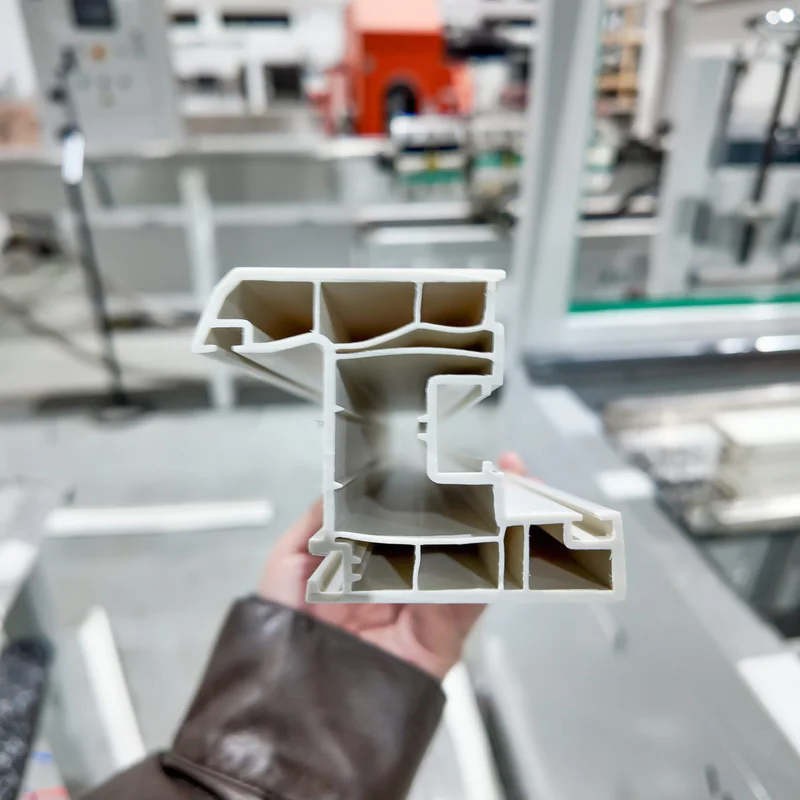
A PVC window profile extrusion line is a complete manufacturing system used to produce rigid PVC window and door profiles for construction, infrastructure, building decoration, and industrial applications. It usually includes PVC material mixing, conical twin-screw extrusion, profile mold forming, vacuum calibration, cooling, haul-off, cutting, and final collection.
Unlike simple plastic tube or sheet production, PVC window profile manufacturing requires accurate formula preparation, stable twin-screw plasticizing, precise mold design, strong vacuum calibration, controlled cooling, smooth traction, and accurate cutting. Because PVC is heat-sensitive and window profiles have complex cross-sections, the extrusion line must be engineered carefully to maintain dimensional accuracy, surface quality, impact strength, and long-term production stability.
Based on the QTech Machinery PVC window profile extrusion line case, a successful production line is not a standard machine package. It should be customized according to the customer’s PVC formulation, profile drawing, output requirement, profile width, mold structure, local voltage, workshop layout, automation level, and branding preferences such as machine color and operation direction.
Reference case: PVC Window Profile Extrusion Line
1. What is a PVC window profile extrusion line?
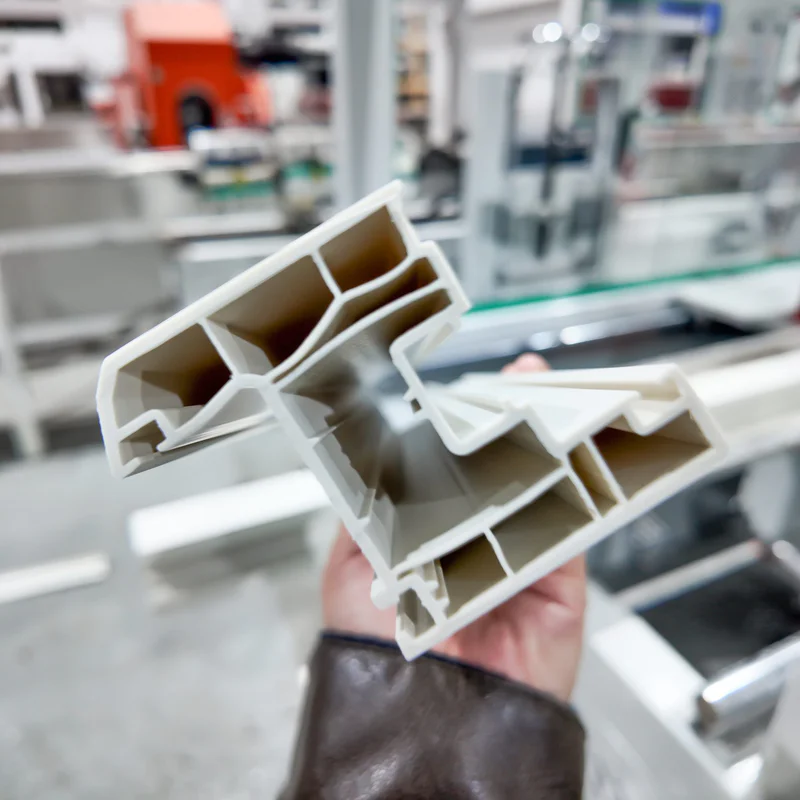
A PVC window profile extrusion line is a complete production system that mixes PVC materials, extrudes them through a profile mold, calibrates the shape, cools the profile, pulls it forward, and cuts it to length.
A PVC window profile extrusion line is designed to manufacture rigid PVC profiles used for window frames, door frames, sash profiles, glazing beads, decorative profiles, and other building-related profile products. The line converts PVC powder and additives into continuous profile products with stable dimensions and smooth surfaces.
A typical PVC window profile extrusion line includes:
| Main Section | Function |
|---|---|
| PVC mixer unit | Mixes PVC resin, stabilizer, filler, pigment, and additives |
| Conical twin-screw extruder | Plasticizes and extrudes PVC material |
| Profile extrusion mold | Forms the profile cross-section |
| Vacuum calibration table | Shapes and stabilizes profile dimensions |
| Cooling system | Removes heat and prevents deformation |
| Haul-off machine | Pulls the profile at controlled speed |
| Cutting machine | Cuts the profile to required length |
| Control cabinet | Controls line operation and synchronization |
| Stacker or collection table | Collects finished profiles |
In the QTech Machinery case, the customer needed a high-performance PVC window profile extrusion line with 100–250 kg/h output, good energy efficiency, durable components, customizable machine color, and stable production. QTech supplied a complete solution covering mixing, extrusion, calibration, haul-off, cutting, installation, commissioning, and training.
2. What materials are used in PVC window profile extrusion?
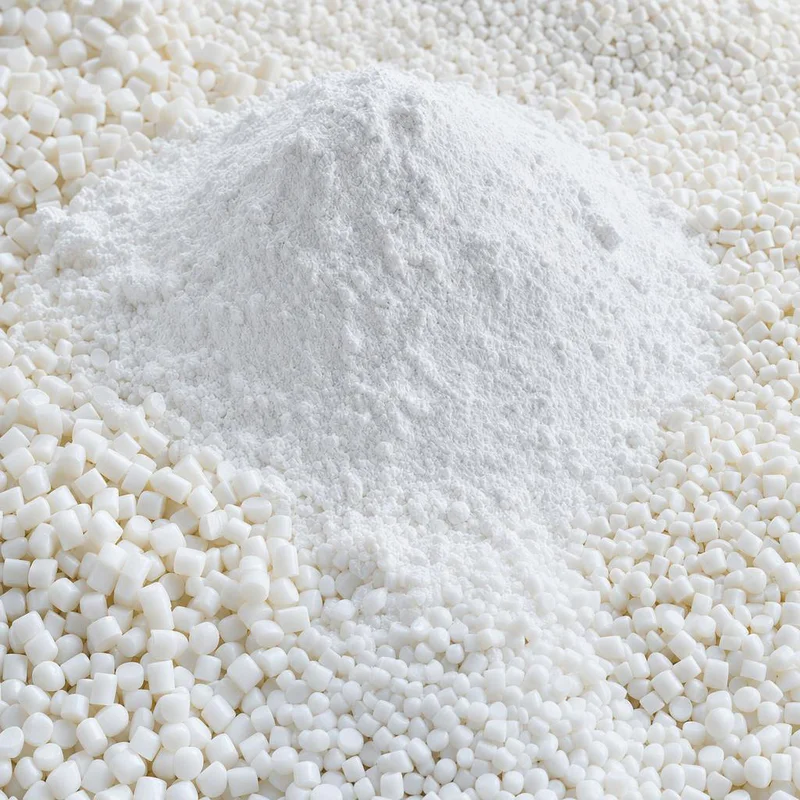
PVC window profile extrusion mainly uses PVC resin mixed with stabilizers, fillers, lubricants, pigments, impact modifiers, and processing aids.
PVC window profiles are usually made from rigid PVC dry blend. The material formula must be mixed accurately before extrusion because the final profile quality depends heavily on additive dispersion and temperature control.
Common components in PVC window profile formulas include:
| Material Component | Main Purpose |
|---|---|
| PVC resin | Main base material |
| Stabilizer | Prevents PVC degradation during heating |
| Calcium carbonate filler | Reduces cost and improves stiffness |
| Lubricant | Improves flow and reduces friction |
| Impact modifier | Improves toughness and impact resistance |
| Processing aid | Improves melt strength and surface quality |
| Titanium dioxide or pigment | Provides color and UV resistance |
| Recycled PVC powder | Optional cost reduction, depending on product grade |
PVC is sensitive to heat. If the formulation is not stable or the extrusion temperature is too high, the profile may discolor, degrade, become brittle, or show surface defects. Therefore, a reliable mixing unit and accurate temperature control system are essential.
In the QTech case, the line was designed for PVC material and construction-related profile applications. The system used a high-speed hot and cold mixer before extrusion, helping improve material uniformity before feeding the extruder.
3. Why is the SRL300-600 high-speed mixer important?
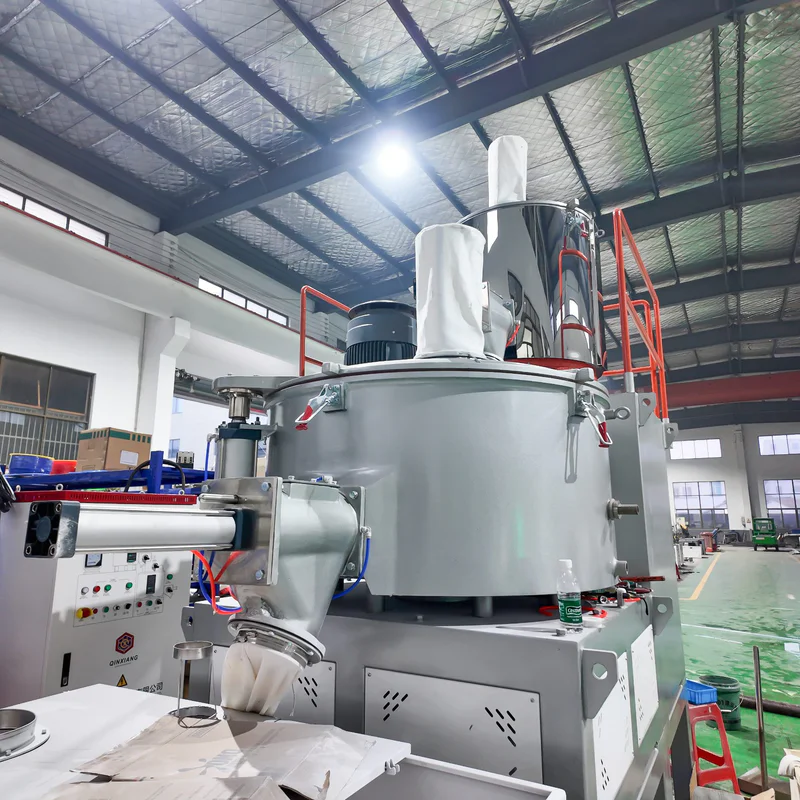
The high-speed mixer prepares a uniform PVC dry blend by heating, mixing, cooling, and stabilizing the raw material before extrusion.
PVC window profile extrusion usually starts with powder mixing. A hot mixer heats and blends PVC resin with additives, while a cold mixer cools the mixture and prevents agglomeration or premature degradation. This preparation directly affects extrusion stability and profile quality.
In the QTech PVC window profile extrusion line case, the supplied mixer was an SRL300-600 high-speed mixer.
| Mixer Item | Configuration |
|---|---|
| Mixer type | Hot and cold mixing |
| Hot mixer volume | 300 L |
| Cold mixer volume | 600 L |
| Hot mixer effective volume | 200 L |
| Cold mixer effective volume | 350 L |
| Hot mixer motor power | 55 kW |
| Cold mixer motor power | 11 kW |
| Motor brand | Wannan Motor |
| Hot mixer blade | Balanced 3-piece blades |
| Cold mixer blade | Single-piece blade |
| Inner wall material | 304 stainless steel |
| Outer wall material | Carbon steel |
| Extra features | Temperature control, cooling system, durable sealing |
The 304 stainless steel inner wall improves cleanliness and durability. The hot and cold mixing structure helps ensure that PVC resin, filler, stabilizer, pigment, and other additives are evenly dispersed. Advanced temperature control and efficient cooling are especially important because PVC can degrade if overheated.
A well-designed mixer helps improve:
- Formula consistency
- Extrusion stability
- Profile surface finish
- Color uniformity
- Reduced defects
- Higher production efficiency
- Better batch repeatability
For PVC window profile factories, the mixer is not optional auxiliary equipment—it is part of the quality control system.
4. Why does a PVC window profile line use a conical twin-screw extruder?
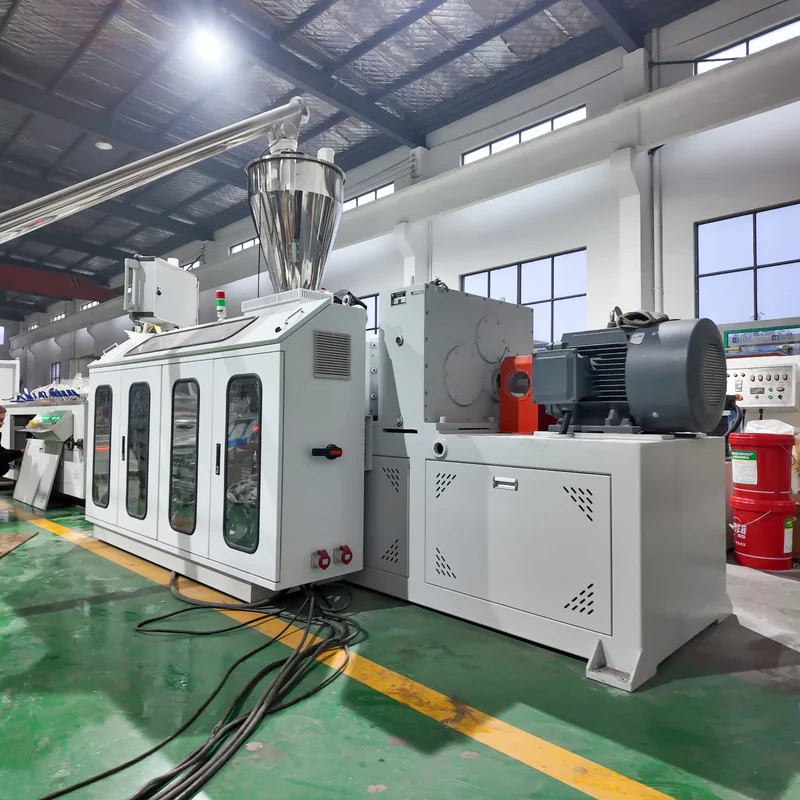
A conical twin-screw extruder is suitable for PVC profiles because it provides stable powder feeding, strong mixing, controlled plasticizing, and reliable output for heat-sensitive PVC.
PVC profile production commonly uses a conical twin-screw extruder because PVC dry blend has different processing behavior from PE or PP pellets. A twin-screw system can convey powder materials more effectively and provide better mixing and plasticizing under controlled shear.
In the QTech case, the core extrusion machine was an SJSZ65/132 conical twin-screw extruder.
| Extruder Item | Configuration |
|---|---|
| Model | SJSZ65/132 conical twin-screw extruder |
| Production capacity | 150–250 kg/h |
| Screw diameter | Φ65/132 mm |
| Motor power | 37 kW |
| Motor brand | Siemens motor |
| Screw heating zones | 5 zones |
| Mold heating zones | 8 zones |
| Main features | Advanced temperature control, durable gearbox, reliable performance |
The SJSZ65/132 extruder is suitable for medium-output PVC profile production. Its conical twin-screw design helps ensure stable feeding, uniform plasticizing, and controlled melt temperature. The 37 kW Siemens motor improves reliability, while multi-zone temperature control helps operators manage PVC processing more accurately.
For PVC window profiles, stable extrusion output is essential because any pressure fluctuation can cause:
- Uneven wall thickness
- Surface waves
- Internal stress
- Poor profile geometry
- Calibration instability
- Cutting length inconsistency
QTech Machinery can recommend the correct conical twin-screw extruder model according to customer output, profile width, formula, and mold design.
5. How does the profile mold and vacuum calibration table form the window profile?
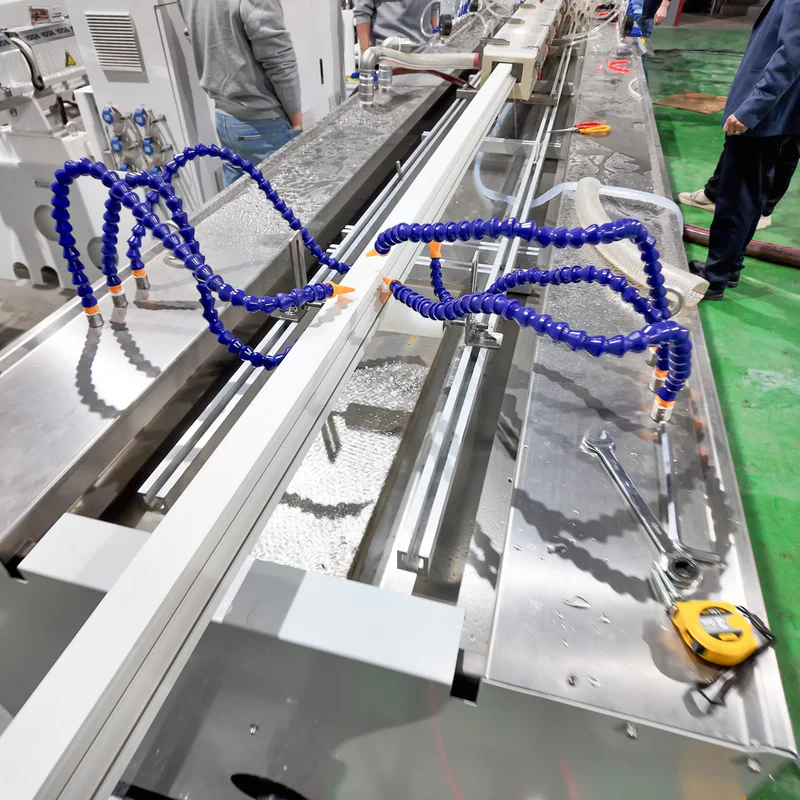
The mold shapes the molten PVC into the required window profile cross-section, while the vacuum calibration table fixes the geometry and cools the profile.
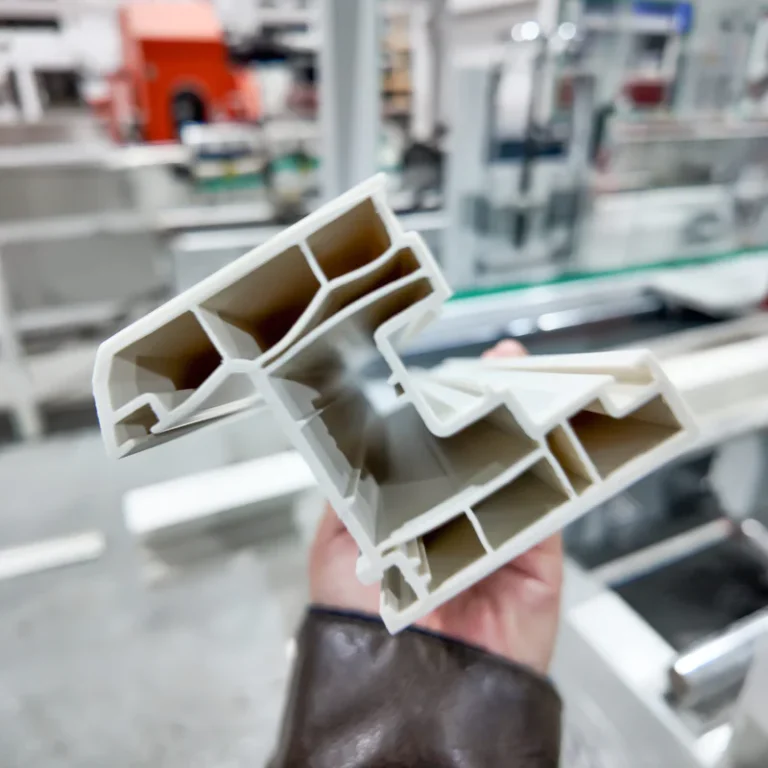
PVC window profiles often have complex shapes, including chambers, ribs, grooves, sealing areas, and reinforcement spaces. The profile mold must distribute PVC melt evenly into all channels. After leaving the mold, the hot profile enters the vacuum calibration table, where vacuum force and cooling water help lock the shape.
In the QTech project, the vacuum calibration system included:
| Calibration Item | Configuration |
|---|---|
| Equipment | Vacuum cooling calibration table |
| Length | 6 meters |
| Cooling method | Water-cooled system |
| Vacuum pumps | 5.5 kW × 3 units |
| Water tank material | 2 mm stainless steel |
| Main features | Efficient cooling, precise calibration, heat isolation |
The 6-meter vacuum calibration table provides enough length for profile shaping and cooling. The three 5.5 kW vacuum pumps support strong and stable vacuum calibration for complex PVC window profiles. The 2 mm stainless steel water tank improves durability and corrosion resistance.
Accurate calibration helps ensure:
| Quality Requirement | Why It Matters |
|---|---|
| Profile width accuracy | Supports window assembly |
| Chamber geometry | Maintains strength and insulation performance |
| Surface flatness | Improves appearance |
| Groove accuracy | Ensures sealing strip installation |
| Reinforcement cavity accuracy | Supports steel reinforcement insertion |
| Dimensional stability | Reduces warping after cooling |
For window profile production, mold design and calibration design are decisive. A good extruder cannot produce high-quality profiles if the mold and calibration table are not properly matched.
6. How do haul-off and cutting systems affect PVC window profile quality?
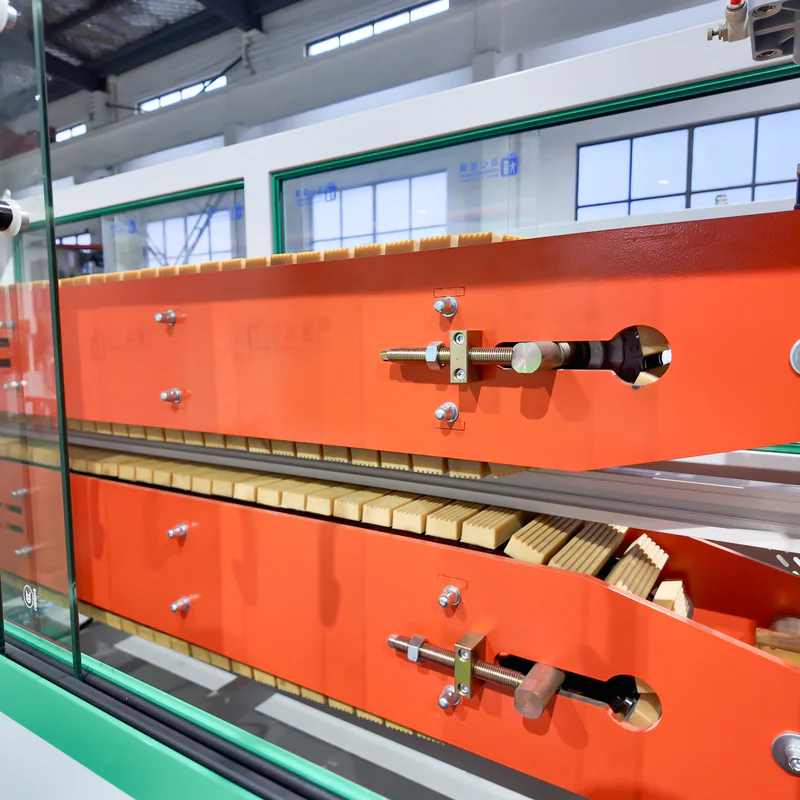
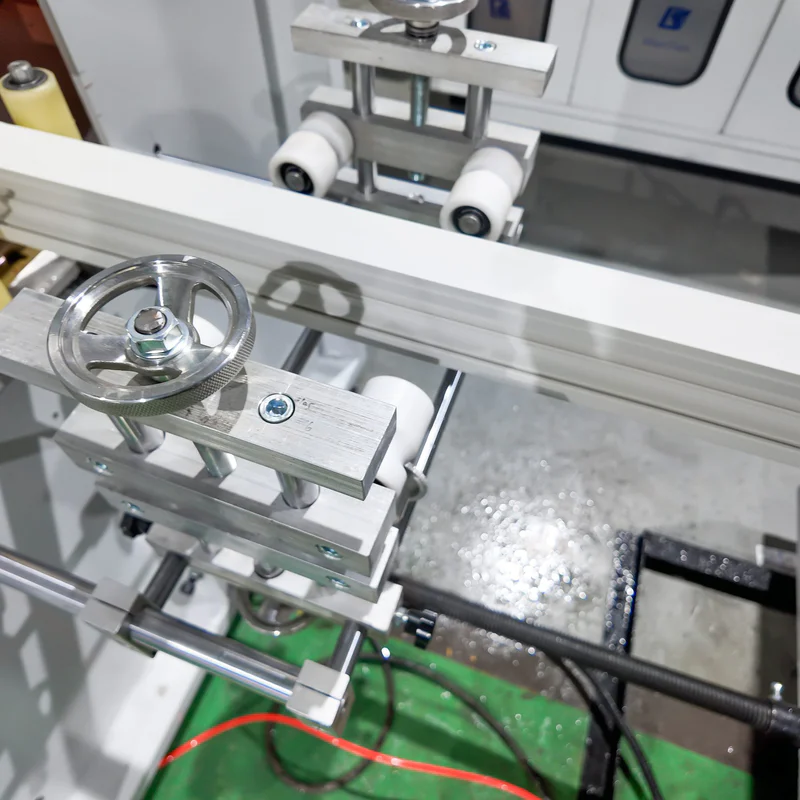
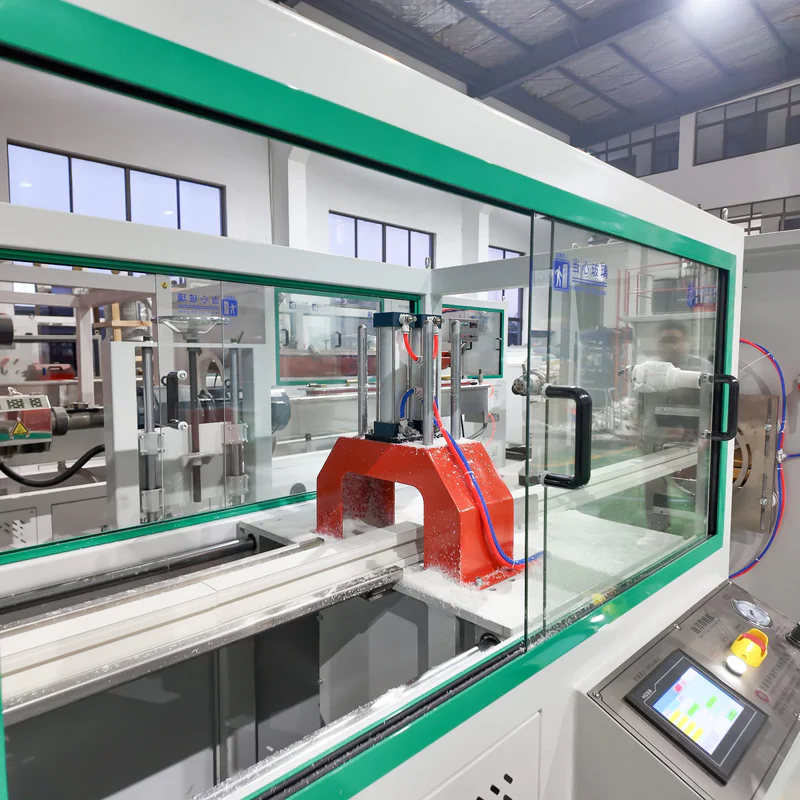
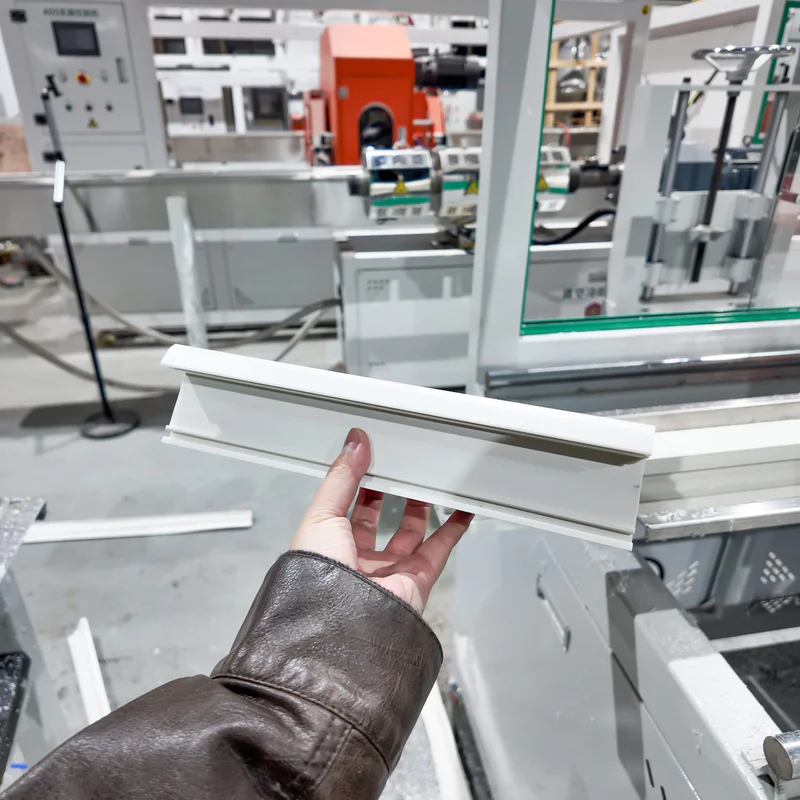
The haul-off machine controls profile speed and dimensional stability, while the cutter ensures accurate profile length and clean cutting edges.
After calibration and cooling, the profile must be pulled at a constant speed. If the haul-off speed is unstable, the profile may stretch, shrink, bend, or show dimensional variation. For PVC window profiles, gentle but stable pulling is necessary because the profile surface and hollow chamber structure must not be damaged.
In the QTech case, the haul-off system was a two-claw belt haul-off.
| Haul-Off Item | Configuration |
|---|---|
| Type | Two-claw belt haul-off |
| Motor power | 1.5 kW × 2 units |
| Speed range | 0.1–5 m/min |
| Contact material | Soft and durable rubber blocks |
| Drive | Independent upper and lower belt drive |
| Adjustment | Pneumatic elevation |
The rubber blocks protect the PVC profile surface. The independent upper and lower belt drive improves traction stability, while pneumatic elevation makes adjustment easier for different profile sizes.
The cutting system in the case was a saw blade lift cutter.
| Cutter Item | Configuration |
|---|---|
| Cutting machine | Saw blade lift cutter |
| Motor power | 2.2 kW |
| Cutting width | 0–130 mm |
| Control system | PLC with touchscreen operation |
| Main function | Accurate profile cutting |
A saw blade lift cutter is suitable for rigid PVC profiles because it can cut strong profile sections cleanly and accurately. PLC touchscreen operation helps improve control convenience and cutting repeatability.
Good haul-off and cutting systems help improve:
- Profile length accuracy
- Surface protection
- Stable profile geometry
- Reduced scrap
- Cleaner profile ends
- Better downstream packaging
- Easier window assembly
7. How should customers choose the right PVC window profile extrusion line?
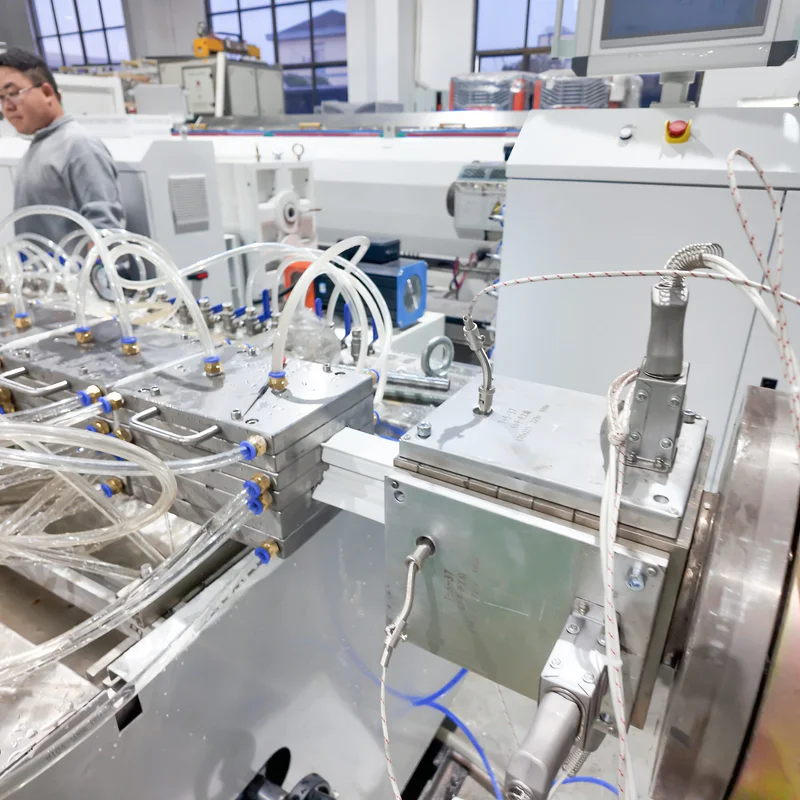
Customers should choose the line according to profile drawing, PVC formula, output target, profile width, mold design, cooling length, haul-off force, cutter type, voltage, and factory layout.
A PVC window profile extrusion line must be customized around the customer’s actual profile products. Different window systems may require different profile widths, chamber structures, wall thicknesses, surface colors, and production capacities.
Customer Selection Steps
| Step | What to Confirm | Why It Matters |
|---|---|---|
| Step 1 | Profile application | Window frame, sash, door profile, glazing bead, decorative profile |
| Step 2 | Profile drawing | Determines mold, calibrator, haul-off, and cutter |
| Step 3 | Maximum profile width | Determines cutter and calibration table size |
| Step 4 | Wall thickness | Affects strength, output, and cooling |
| Step 5 | PVC formula | Determines mixer, screw design, and temperature control |
| Step 6 | Output target | Selects extruder model and mixer capacity |
| Step 7 | Surface requirement | Determines mold polishing and cooling precision |
| Step 8 | Color requirement | Determines pigment or co-extrusion options |
| Step 9 | Factory voltage | Configures electrical system |
| Step 10 | Workshop layout | Determines line length and operation direction |
| Step 11 | Automation level | Determines PLC, touchscreen, alarms, and data functions |
| Step 12 | Branding preferences | Machine color and customized appearance |
In the QTech case, the customer required 100–250 kg/h output, PVC material compatibility, reduced downtime, energy efficiency, durable components, customized machine color, adjustable center height 1000 ± 50 mm, and right-to-left operation.
Every QTech line is configured to the buyer’s market. Customers can send target output, raw material formula, profile drawing, local voltage, and workshop layout. QTech engineers will recommend the correct mixer, extruder, mold, calibration table, haul-off, cutter, and control setup.
8. Why choose QTech Machinery for a PVC window profile extrusion line?
QTech Machinery provides customized PVC profile extrusion solutions with reliable mixers, conical twin-screw extruders, precision calibration, stable haul-off, PLC cutting, and turnkey support.
Choosing a PVC window profile extrusion line supplier is not only about machine price. The supplier must understand PVC formula preparation, twin-screw extrusion, profile mold design, vacuum calibration, cooling, traction, cutting, and factory integration.
In the PVC Window Profile Extrusion Line case, QTech Machinery delivered a complete high-performance line for a valued customer. The project focused on reliable output, energy saving, stable production, durability, and customized design.
QTech supplied:
- SRL300-600 high-speed hot and cold mixer
- SJSZ65/132 conical twin-screw extruder
- PVC window profile mold system
- 6-meter vacuum cooling calibration table
- Two-claw belt haul-off
- Saw blade lift cutter
- PLC touchscreen control
- Customized center height and operation direction
- Installation, commissioning, and training support
QTech Machinery’s advantages include:
| QTech Advantage | Customer Benefit |
|---|---|
| Customized profile line design | Matches profile drawings and factory needs |
| SRL300-600 hot/cold mixer | Better PVC formula preparation |
| 304 stainless steel mixer inner wall | Clean and durable mixing |
| SJSZ65/132 conical twin-screw extruder | Stable PVC powder processing |
| Siemens motor | Reliable drive performance |
| Advanced temperature control | Reduces PVC degradation risk |
| Durable gearbox | Better long-term operation |
| 6 m calibration table | Accurate profile shaping |
| Three vacuum pumps | Strong calibration stability |
| Stainless steel water tank | Longer service life |
| Rubber block haul-off | Protects profile surface |
| Independent belt drive | Stable traction |
| Saw blade lift cutter | Clean and accurate cutting |
| PLC touchscreen operation | Easier operation and adjustment |
| Custom machine color | Matches factory branding |
| Adjustable center height | Easier line integration |
| OEM and ODM support | Flexible customization |
| Voltage configuration | Suitable for global customers |
| Full run test before shipment | Lower startup risk |
| Quote in 24 hours | Faster project planning |
Recommended internal links:
- QTech Machinery Home
- Plastic Profile Making Machine
- Plastic Extrusion Machine
- PVC Window Profile Extrusion Line Case
- QTech Machinery Cases
Recommended PVC Window Profile Extrusion Line Configuration
The following table summarizes the reference configuration from the QTech PVC window profile extrusion line case.
| Section | Recommended Configuration |
|---|---|
| Product | PVC window profiles |
| Material | PVC |
| Application | Construction and infrastructure, industrial applications |
| Target output | 100–250 kg/h |
| Mixer | SRL300-600 high-speed hot and cold mixer |
| Hot mixer volume | 300 L |
| Cold mixer volume | 600 L |
| Hot mixer effective volume | 200 L |
| Cold mixer effective volume | 350 L |
| Hot mixer motor | 55 kW Wannan motor |
| Cold mixer motor | 11 kW Wannan motor |
| Mixer inner wall | 304 stainless steel |
| Mixer outer wall | Carbon steel |
| Main extruder | SJSZ65/132 conical twin-screw extruder |
| Extruder output | 150–250 kg/h |
| Screw diameter | Φ65/132 mm |
| Motor power | 37 kW Siemens motor |
| Screw heating zones | 5 zones |
| Mold heating zones | 8 zones |
| Calibration table | 6 m vacuum cooling calibration table |
| Vacuum pumps | 5.5 kW × 3 units |
| Water tank material | 2 mm stainless steel |
| Haul-off | Two-claw belt haul-off |
| Haul-off motor | 1.5 kW × 2 units |
| Haul-off speed | 0.1–5 m/min |
| Haul-off blocks | Soft and durable rubber blocks |
| Cutting machine | Saw blade lift cutter |
| Cutter motor | 2.2 kW |
| Cutting width | 0–130 mm |
| Control system | PLC with touchscreen operation |
| Center height | 1000 ± 50 mm |
| Operation direction | Right-to-left in reference case |
Products We Can Provide
QTech Machinery can provide complete equipment for PVC window profile extrusion and related profile production projects.
| Product | Function |
|---|---|
| SRL hot and cold mixer | PVC formula mixing and cooling |
| Conical twin-screw extruder | PVC plasticizing and extrusion |
| PVC window profile mold | Profile forming |
| Vacuum calibration table | Profile shaping and sizing |
| Cooling water system | Profile temperature reduction |
| Two-claw haul-off machine | Stable profile pulling |
| Saw blade cutting machine | Accurate profile cutting |
| PLC control cabinet | Centralized operation |
| Touchscreen HMI | Easy parameter adjustment |
| Stacker or collection table | Finished profile handling |
| Material feeding system | Automatic material transfer |
| Co-extruder | Optional color or surface layer |
| Lamination device | Optional decorative film covering |
| Punching or drilling machine | Optional downstream processing |
| Spare parts | Screw, barrel, heater, vacuum pump, blade, rubber block, sensor |
Documents and Information Customers Should Prepare
To help QTech Machinery design the correct PVC window profile extrusion line, customers should prepare the following information:
| Required Information | Purpose |
|---|---|
| Profile drawing | Designs mold, calibrator, haul-off, and cutter |
| Profile application | Determines strength and surface requirements |
| PVC formula | Selects screw design and temperature control |
| Material data sheet | Confirms processing conditions |
| Profile width and height | Determines calibration and cutter size |
| Wall thickness | Determines cooling and output requirements |
| Number of cavities | Affects mold complexity and vacuum calibration |
| Target output | Selects mixer and extruder model |
| Surface color | Determines pigment or co-extrusion needs |
| Co-extrusion requirement | Determines auxiliary extruder setup |
| Cutting length | Configures cutting system |
| Factory voltage | Configures electrical system |
| Workshop layout | Designs machine arrangement |
| Operation direction | Left-to-right or right-to-left layout |
| Center height requirement | Matches factory installation |
| Machine color requirement | Supports customer branding |
| Local standards | Supports safety and compliance design |
Practical References from Forums and Industry Sources
PVC window profile extrusion requires accurate dry blend preparation, controlled plasticizing, stable die flow, strong vacuum calibration, and careful cooling. These topics are frequently discussed in plastics engineering communities and industry resources.
On the Eng-Tips Plastics Engineering Forum, engineers often discuss extrusion problems such as PVC degradation, die buildup, dimensional instability, profile warping, surface defects, screw wear, and calibration cooling issues. These discussions support the practical point that PVC profile quality depends on full-line engineering, not just extruder size.
Industry resources such as Plastics Technology provide useful articles on extrusion troubleshooting, profile extrusion, material handling, screw design, temperature control, and process optimization. These topics are closely related to PVC window profile production because stable melt temperature and accurate downstream calibration directly affect profile quality.
For general extrusion principles, ScienceDirect’s single screw extruder topic explains how plastics are conveyed, melted, pressurized, and metered in extrusion systems. Although PVC profiles often use conical twin-screw extruders, the basic concepts of plasticizing, pressure stability, and melt control are still useful for buyers.
For broader information about vinyl materials and PVC applications, the Vinyl Institute provides industry resources related to PVC material performance, sustainability, applications, and recycling.
These references support an important purchasing principle: a PVC window profile extrusion line should be selected according to formulation, profile drawing, mold design, calibration accuracy, cooling capacity, haul-off stability, cutting method, and supplier engineering experience.
Conclusion
A PVC window profile extrusion line is a complete production system for manufacturing rigid PVC window and door profiles. The line works through PVC formula mixing, conical twin-screw plasticizing, profile mold forming, vacuum calibration, cooling, haul-off, cutting, and finished profile collection. Because PVC profiles have complex shapes and strict dimensional requirements, the complete line must be matched carefully.
QTech Machinery provides customized PVC window profile extrusion solutions based on customer profile drawings, PVC formula, output target, voltage, workshop layout, operation direction, and machine color preference. The reference project included an SRL300-600 high-speed hot and cold mixer, SJSZ65/132 conical twin-screw extruder, 6-meter vacuum cooling calibration table, two-claw belt haul-off, and PLC-controlled saw blade lift cutter.
If you are planning a PVC window profile production project, send us your profile drawing, PVC formula, output requirement, cutting length, voltage, and workshop layout. Our engineering team will recommend the correct extrusion line configuration for your factory.