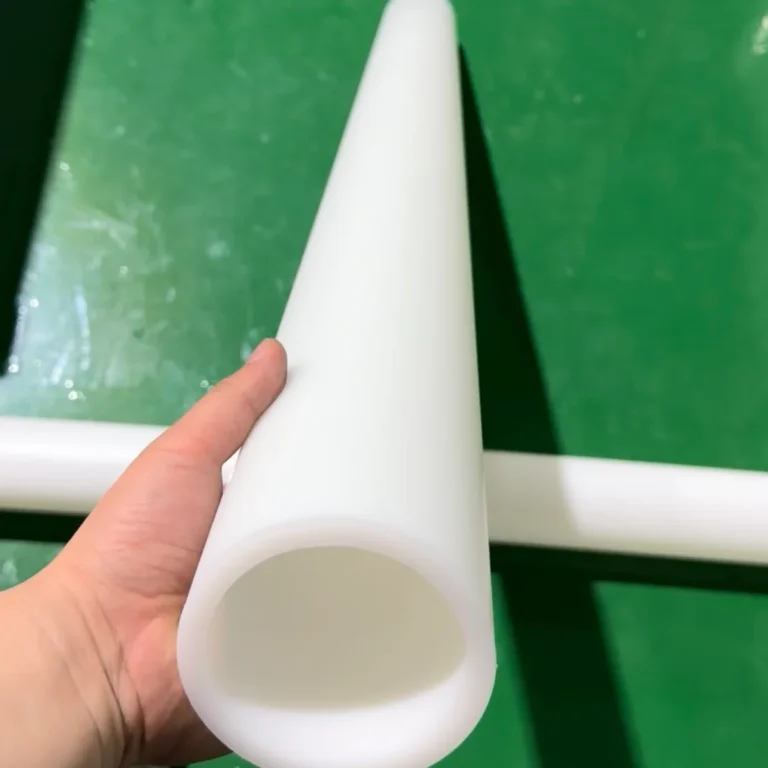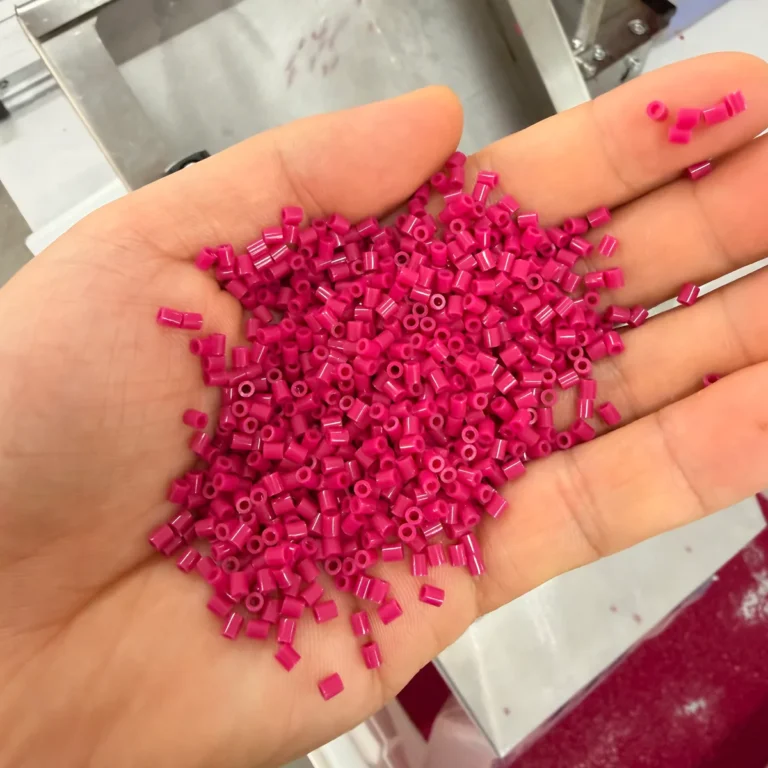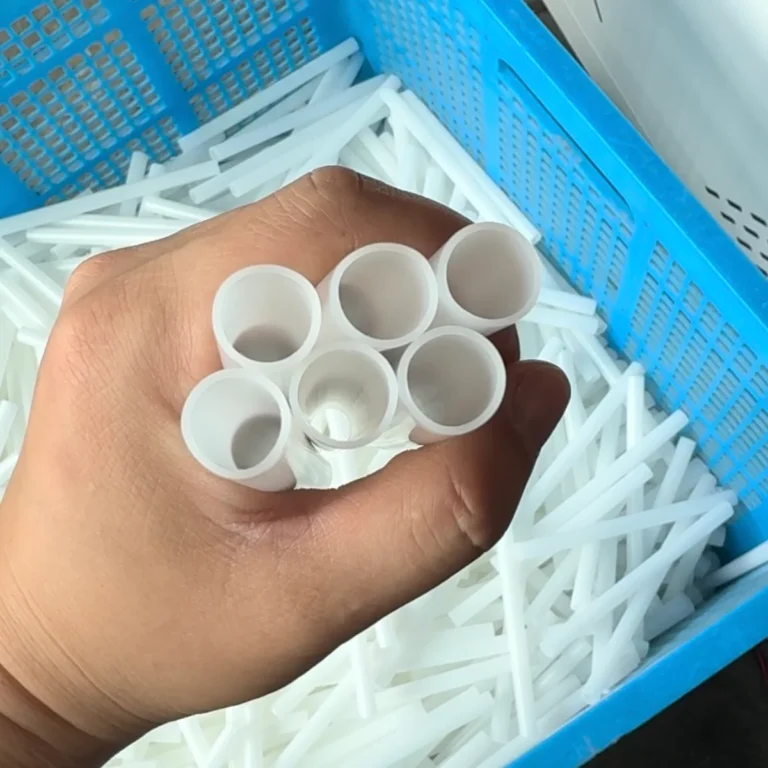
How to Choose the Right Corrugated Pipe Extrusion Machine?
Choosing the right corrugated pipe extrusion machine is an important decision for manufacturers who want stable output, consistent pipe quality, and long-term production efficiency. A suitable machine is not only determined by price, but also by raw material, pipe diameter range, output requirement, screw design, motor system, forming speed, cooling method, control system, and supplier engineering capability.
For PVC, PA, PP, PE, nylon, and engineering plastic corrugated pipe production, a well-designed extrusion line should provide stable plasticizing performance, accurate speed control, reliable downstream forming, and easy operation. Based on practical production needs, our SJ65/28 single screw servo extruder can be used as the main extruder for many corrugated pipe and flexible hose extrusion applications, especially when customers require stable output, energy efficiency, and precise extrusion control.
1. What raw material will you use for corrugated pipe production?
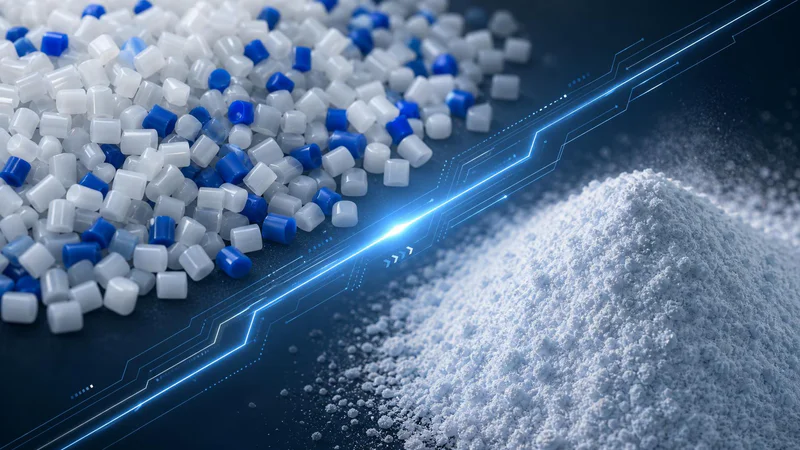
The raw material determines the screw design, temperature control, motor power, die structure, and forming process of the extrusion line.
Before choosing a corrugated pipe extrusion machine, the first question should always be about the material. Different materials have different melting behavior, processing temperature, viscosity, cooling requirements, and forming stability. Common corrugated pipe materials include PVC, PE, PP, PA, nylon, and modified engineering plastics.
For example, PVC corrugated pipe is widely used in agricultural irrigation, construction, infrastructure, cable protection, telecommunications, and industrial applications. In the customer case from QTech Machinery, the PVC corrugated pipe extrusion line was configured for flexible hose production and designed to meet the customer's requirements for high efficiency, stable output, and different pipe diameter demands.
For nylon or engineering plastic corrugated pipe production, the plasticizing system becomes even more important. Our SJ65/28 single screw servo extruder is designed with an optimized BM screw structure, which helps improve plasticizing efficiency, melt uniformity, and production continuity. The screw and barrel use 38CrMoALA material with nitriding treatment, helping the machine achieve better wear resistance and longer service life.
If you are planning a similar project, you can review our related PVC corrugated pipe extrusion line case for reference.
2. What output capacity do you need from the extrusion line?
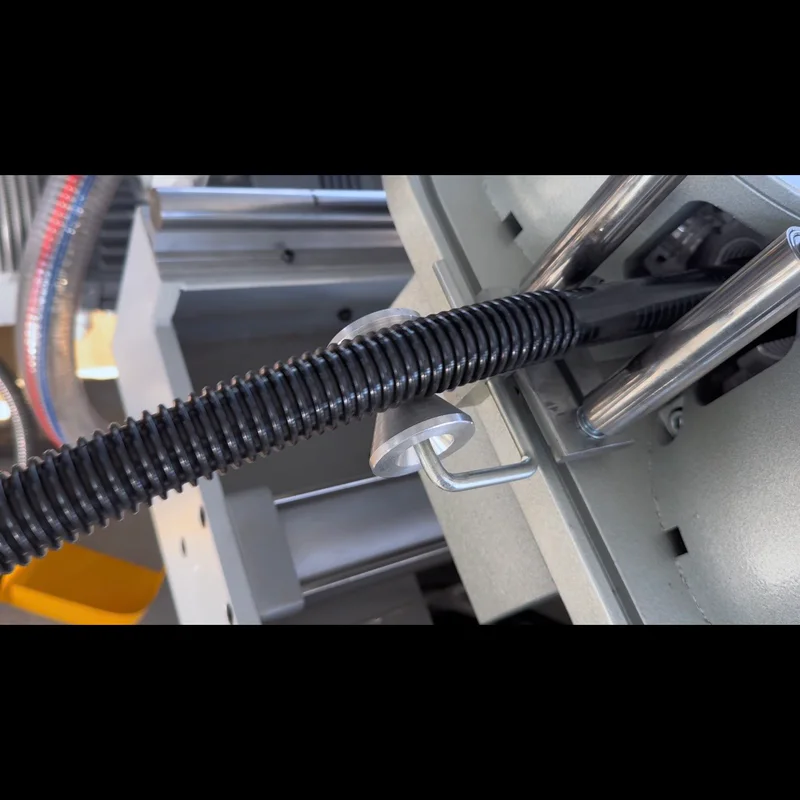
Your target output decides the extruder model, motor power, screw diameter, forming speed, and cooling capacity.
Output capacity is one of the most important factors when selecting a corrugated pipe extrusion machine. Some customers need a small line for trial production or customized products, while others require continuous industrial production.
Our SJ65/28 single screw servo extruder has a maximum output range of 0–60 kg/h, depending on raw material type, product structure, pipe diameter, die design, and production conditions. This output range is suitable for many flexible hose, corrugated pipe, nylon pipe, small-diameter pipe, and customized plastic extrusion applications.
A stable output is more important than a theoretical maximum number. In real production, poor plasticizing, unstable screw speed, or inaccurate temperature control can cause pipe wall thickness variation, surface defects, unstable corrugation shape, and excessive scrap. That is why our machine uses a 37 kW Inovance permanent magnet synchronous servo motor, helping the extruder maintain stable torque and accurate speed control during production.
For customers who need a complete production solution, our engineers can recommend suitable configurations based on material, pipe diameter, target output, and factory voltage. You may also visit our plastic extrusion machine solutions to compare different line options.
3. What pipe diameter and corrugation structure do you plan to produce?
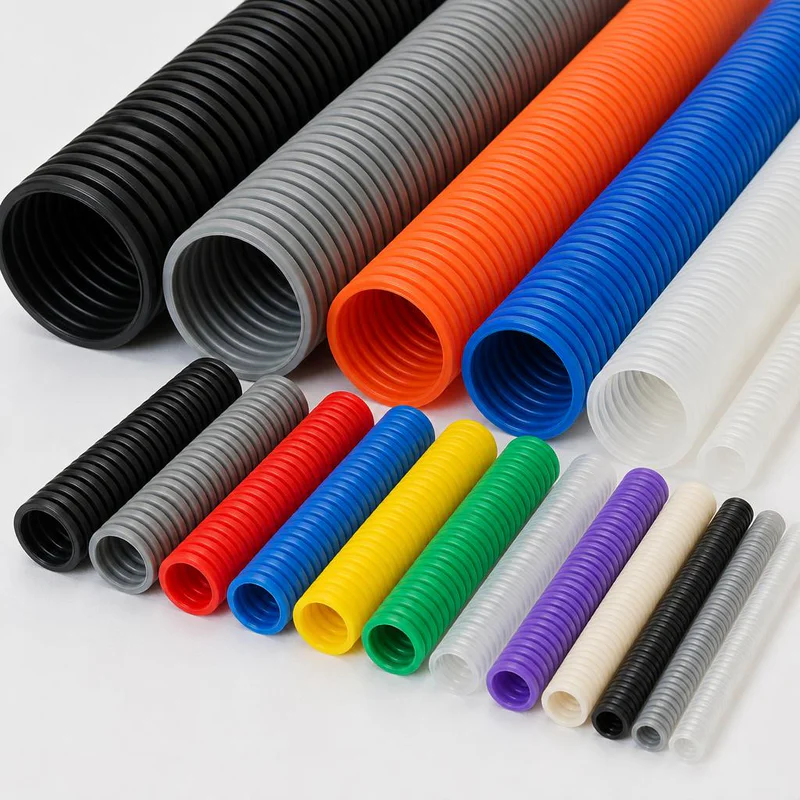
Pipe size and corrugation profile determine the die head, forming mold, vacuum or cooling system, and downstream equipment configuration.
Corrugated pipes can have different diameters, wall thicknesses, wave shapes, flexibility requirements, and application standards. A pipe used for cable protection may have different performance requirements from a pipe used for agricultural irrigation or industrial drainage.
When customers choose a corrugated pipe extrusion line, they should confirm:
| Item | Information Needed |
|---|---|
| Pipe material | PVC, PE, PP, PA, nylon, etc. |
| Pipe diameter range | Minimum and maximum outside diameter |
| Wall thickness | Standard or customized |
| Corrugation shape | Single-wall or special profile |
| Pipe application | Cable protection, irrigation, drainage, ventilation, industrial hose |
| Required speed | Meters per minute |
| Product standard | Local or customer-specific standard |
In the QTech Machinery PVC corrugated pipe case, the customer needed a flexible hose extrusion line capable of producing high-quality PVC corrugated pipes with varying diameters. To meet this requirement, the line was configured with a precision single screw extruder and a high-speed corrugated pipe forming machine.
For similar projects, our SJ65/28 extruder can be combined with downstream equipment such as a corrugated pipe forming machine, cooling system, haul-off unit, cutting machine, and winding machine according to the customer's final pipe specification.
4. Why is the screw and barrel design important for corrugated pipe extrusion?
The screw and barrel determine plasticizing quality, melt stability, output consistency, and the final appearance of the corrugated pipe.
The screw is the core part of an extrusion machine. A poorly designed screw may cause unstable feeding, uneven melting, high pressure fluctuation, material degradation, and inconsistent output. For corrugated pipe production, melt stability is especially important because the pipe must enter the forming mold continuously and evenly.
Our SJ65/28 single screw extruder is equipped with a screw designed for nylon and engineering plastic processing. Its key features include:
| Component | Configuration |
|---|---|
| Screw diameter | 65 mm |
| L/D ratio | 28:1 |
| Screw speed | 75 r/min |
| Screw structure | Optimized BM structure |
| Screw material | 38CrMoALA |
| Surface treatment | Nitriding treatment and surface hardening |
| Rotation direction | Counterclockwise when viewed from screw shank side |
The optimized BM screw structure helps improve plasticizing rate, melt uniformity, continuous production stability, and processing reliability. This is especially useful for customers who process materials with higher viscosity or stricter melt requirements.
The barrel is also made from 38CrMoALA and treated with nitriding. The inner surface hardness can reach ≥ HV940, with surface roughness ≤ Ra1.6 μm. This helps reduce wear and improves long-term extrusion stability.
For more information about single screw extrusion principles, you can refer to this technical overview from ScienceDirect on single screw extruders.
5. Should you choose a servo motor for a corrugated pipe extrusion machine?
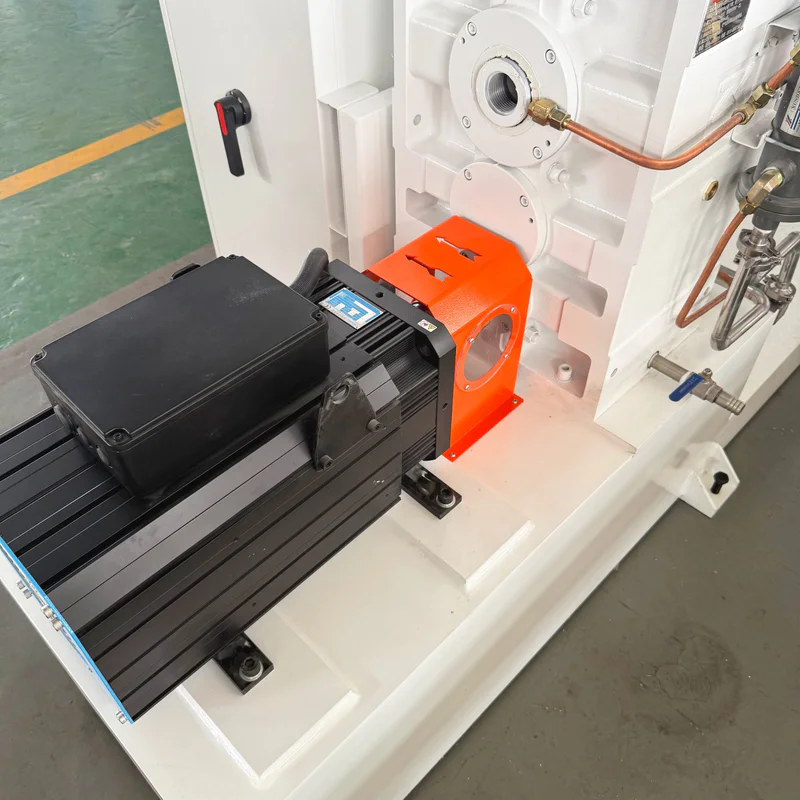
A servo motor is a good choice when you need accurate speed control, lower energy consumption, stable torque, and better production repeatability.
Servo motor technology is becoming more popular in modern extrusion lines because it provides better control compared with traditional motor systems. In corrugated pipe extrusion, stable screw speed and torque are important for maintaining consistent material flow into the die and forming machine.
Our SJ65/28 extruder uses a 37 kW Inovance servo motor with a permanent magnet synchronous servo motor system. The speed range is 50–1500 rpm, and the machine is equipped with an Inovance servo controller for speed regulation.
The main advantages include:
| Advantage | Benefit for Corrugated Pipe Production |
|---|---|
| Accurate speed control | More stable extrusion volume |
| Fast response | Easier synchronization with forming machine |
| Stable torque | Better processing of different materials |
| Energy saving | Lower long-term operating cost |
| Lower vibration | Smoother machine operation |
| Better automation | Easier integration with PLC control |
The motor and gearbox are directly connected with a Flender coupling, which improves transmission efficiency and reduces mechanical loss. The gearbox uses a Guomao 200 gearbox, providing reliable power transmission for continuous production.
This is one of our product advantages: instead of only providing a standard extruder, we configure the drive system, gearbox, screw, barrel, heating, cooling, and control system together to improve complete-line stability.
6. How important are heating, cooling, and temperature control?
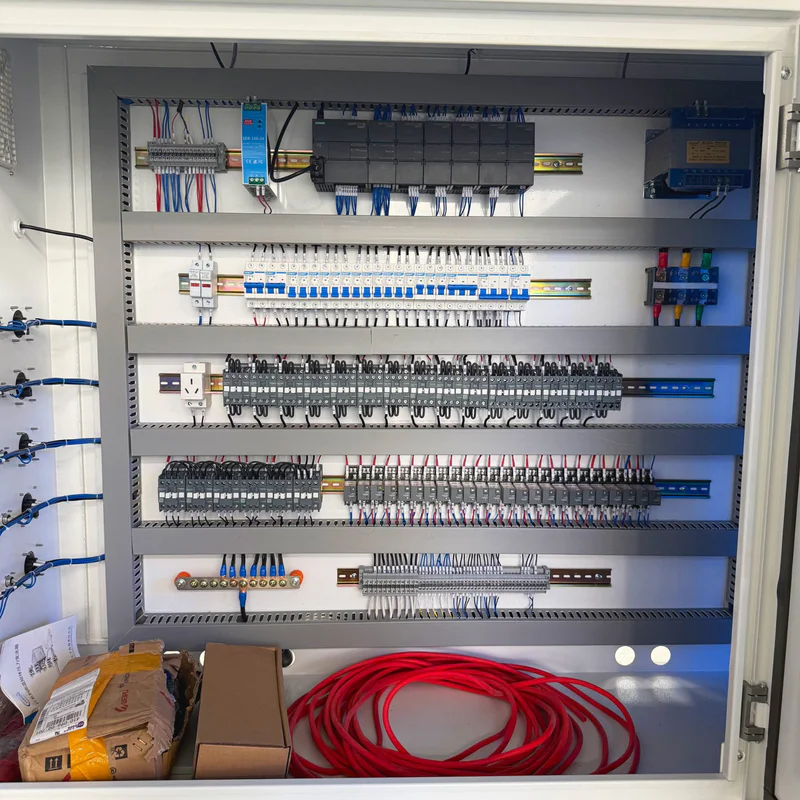
Accurate temperature control helps prevent material degradation, unstable melt flow, poor surface quality, and forming defects.
Corrugated pipe extrusion requires a stable melt temperature. If the temperature is too low, the material may not fully plasticize. If the temperature is too high, the material may degrade, burn, or lose mechanical properties. This is especially important for PVC, nylon, PA, and engineering plastics.
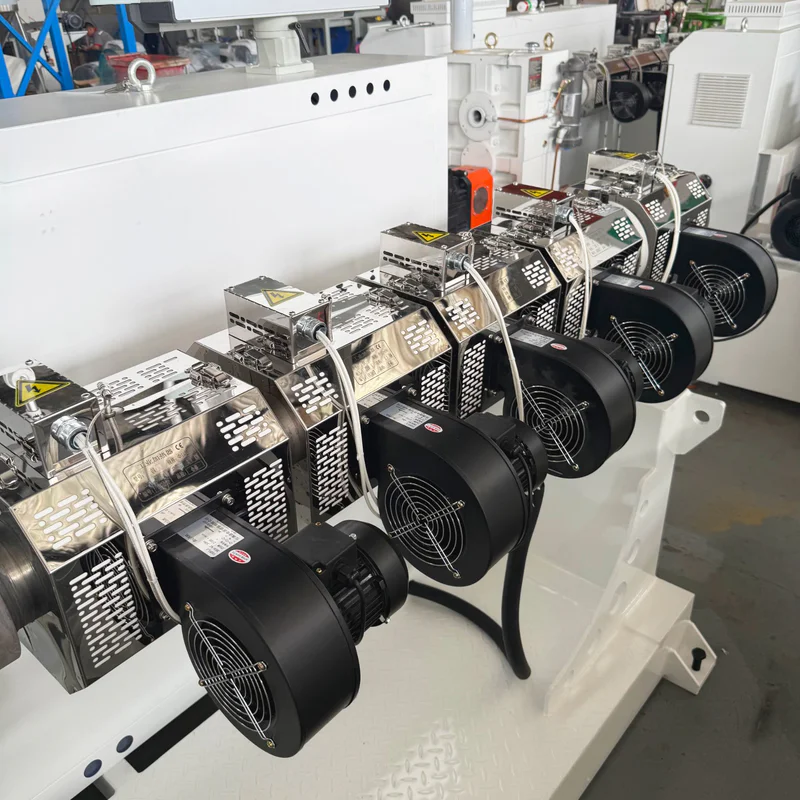
Our SJ65/28 extruder has a 5-zone barrel heating control system. The heating method uses ceramic heating rings, and the barrel is cooled by fans.
| Temperature System | Configuration |
|---|---|
| Heating zones | 5 zones |
| Heating method | Ceramic heating rings |
| Heating power | 3.2 kW × 5 zones |
| Mold heating | 5-zone mold heating |
| Cooling system | Barrel fan cooling |
| Cooling power | 250 W × 5 units |
| Temperature range | 100°C–360°C |
| Temperature control | Dongqi temperature control module |
Ceramic heating rings provide efficient and uniform heating. Fan cooling helps control the barrel temperature when the machine runs continuously. The 100°C–360°C temperature range allows the machine to process different plastic materials depending on project requirements.
For corrugated pipe production, good temperature control directly affects pipe wall uniformity, surface smoothness, forming stability, and production efficiency.
7. What control system should a modern corrugated pipe extrusion line have?
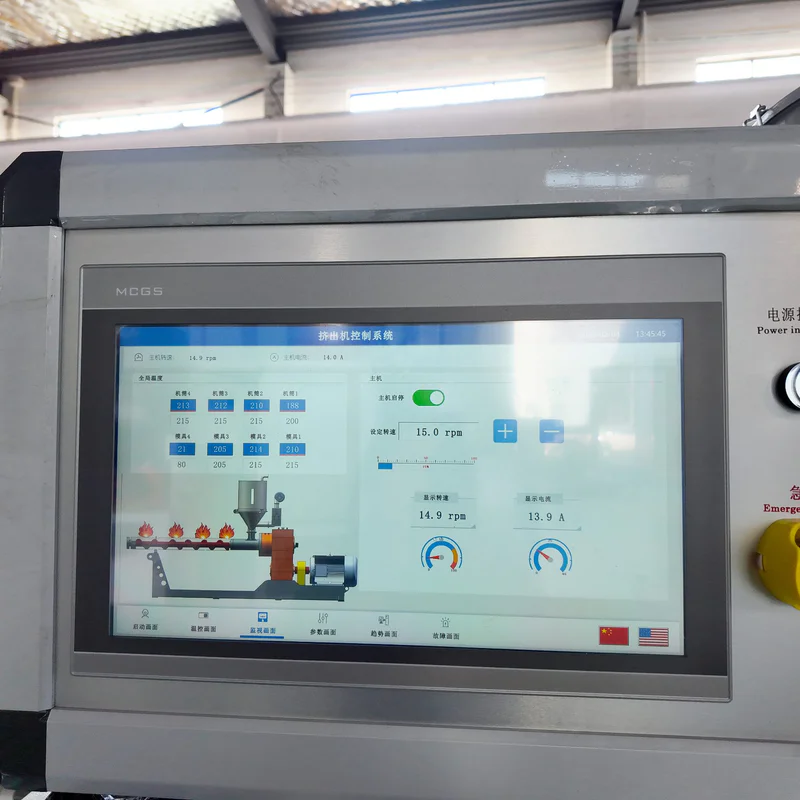
A modern extrusion line should have PLC control, touchscreen operation, communication interface, data monitoring, and reliable electrical components.
A good control system makes the extrusion line easier to operate, monitor, and maintain. For overseas customers, user-friendly operation and reliable electrical components are very important because they reduce training cost and downtime.
Our SJ65/28 extruder is equipped with a PLC control system. The PLC includes Ethernet communication and can provide access to relevant controller data or memory programs, supporting production data collection such as downtime rate and productivity.
Main electrical configuration:
| Item | Configuration |
|---|---|
| Control method | PLC control |
| PLC brand | Siemens PLC |
| Touchscreen | MCGS touchscreen |
| Electrical components | Delixi electrical parts, Schneider contactors and buttons |
| Communication | Ethernet interface |
| Data support | Downtime rate and productivity data access |
| Center height | 1050 mm |
This control configuration is suitable for customers who want better production management and future smart manufacturing upgrades. For a complete corrugated pipe line, the extruder control can also be matched with downstream forming, cooling, haul-off, cutting, and winding control.
According to many discussions in practical extrusion communities such as Eng-Tips Plastics Engineering Forum and Plastics Technology, operators often emphasize that stable temperature control, consistent screw speed, and reliable downstream synchronization are key factors for reducing extrusion defects. This also explains why PLC control and servo drive systems are increasingly used in modern extrusion equipment.
8. How should you evaluate the supplier before buying a corrugated pipe extrusion machine?
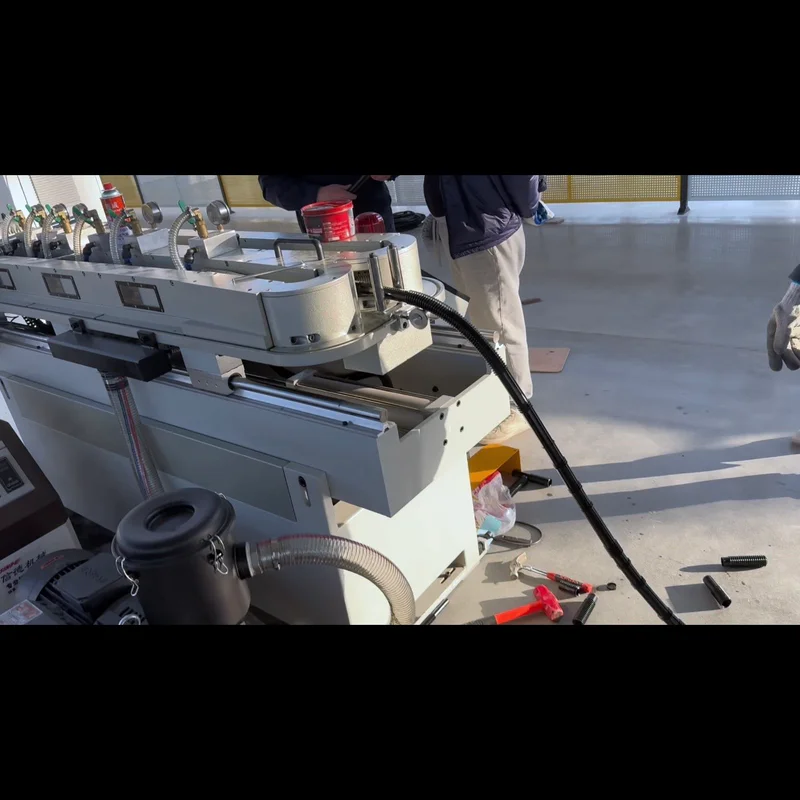
A good supplier should provide customized configuration, engineering support, full-line testing, installation guidance, technical documents, and after-sales service.
Choosing a corrugated pipe extrusion machine is not only about comparing machine specifications. The supplier's engineering capability is equally important. Every customer has different raw materials, pipe sizes, output targets, local voltage, workshop layout, and product standards.
In the QTech Machinery PVC corrugated pipe extrusion line case, the customer required:
- High production efficiency
- Stable output consistency
- Strong material handling capability
- Advanced control system
- Scalability for future production expansion
The solution was not a single machine, but a complete extrusion line configured according to the customer's market demand. This is also our advantage as a manufacturer: we can design and supply a complete customized extrusion solution instead of only selling standard equipment.
You can explore more solutions through the following pages:
- Plastic Pipe Making Machine
- Plastic Extrusion Machine
- PVC Corrugated Pipe Extrusion Line Case
- QTech Machinery Cases
- Contact QTech Machinery
Recommended Machine Configuration Table
The following table shows how our SJ65/28 single screw servo extruder can be used as the main extruder for corrugated pipe extrusion projects.
| Section | Specification |
|---|---|
| Model | SJ65/28 |
| Output | 0–60 kg/h, depending on material and product |
| Suitable materials | PVC, PA, nylon, PP, PE, engineering plastics, customized materials |
| Screw L/D ratio | 28:1 |
| Screw speed | 75 r/min |
| Screw structure | Optimized BM structure |
| Screw and barrel material | 38CrMoALA |
| Surface treatment | Nitriding treatment |
| Barrel hardness | ≥ HV940 |
| Barrel roughness | ≤ Ra1.6 μm |
| Heating zones | 5 barrel zones + 5 mold heating zones |
| Heating method | Ceramic heating rings |
| Cooling method | Barrel fan cooling |
| Main motor | 37 kW Inovance servo motor |
| Motor type | Permanent magnet synchronous servo motor |
| Speed range | 50–1500 rpm |
| Gearbox | Guomao 200 gearbox |
| Control system | Siemens PLC |
| Touchscreen | MCGS touchscreen |
| Electrical parts | Delixi, Schneider |
| Communication | Ethernet interface |
| Center height | 1050 mm |
| Optional equipment | Dryer, vacuum loader, forming machine, cooling tank, haul-off, cutter, winder |
Customer Selection Steps
To choose the right corrugated pipe extrusion machine, customers can follow these steps:
Step 1: Confirm your raw material
Tell us whether you will use PVC, PE, PP, PA, nylon, or modified engineering plastic. If recycled material is used, please also provide the recycled material ratio.
Step 2: Confirm your pipe size range
Provide the minimum and maximum pipe diameter, wall thickness, and corrugation profile drawing if available.
Step 3: Confirm your output requirement
Tell us your expected production capacity in kg/h or m/min. If you are not sure, our engineers can recommend a suitable output range based on your product.
Step 4: Confirm your application
Different applications need different pipe performance. For example, cable protection pipe, irrigation hose, drainage pipe, and industrial flexible hose may require different materials and forming methods.
Step 5: Confirm your factory voltage and layout
Please provide local voltage, frequency, phase, workshop space, and installation direction.
Step 6: Confirm automation level
Choose whether you need standard control, PLC control, data monitoring, Ethernet communication, or customized smart factory connection.
Step 7: Review technical proposal and quotation
Our team will provide machine configuration, technical drawings, quotation, delivery time, and optional equipment list.
Step 8: Arrange testing and delivery
Before shipment, we can conduct machine testing according to the agreed material and product requirements when possible.
Products We Can Provide
As a plastic extrusion and recycling line manufacturer, we can provide the following equipment for corrugated pipe production projects:
| Product | Function |
|---|---|
| Single screw servo extruder | Plasticizing and extrusion |
| Corrugated pipe forming machine | Corrugation shaping |
| Pipe die head | Material distribution and pipe forming |
| Vacuum loader | Automatic material feeding |
| Dryer | Material drying before extrusion |
| Cooling tank | Pipe cooling and stabilization |
| Haul-off machine | Stable pipe pulling |
| Cutting machine | Fixed-length cutting |
| Winding machine | Pipe collection and packaging |
| PLC control cabinet | Centralized line control |
| Electrical system | Power distribution and control |
| Customized molds | Different pipe sizes and corrugation profiles |
| Spare parts | Screw, barrel, heater, fan, sensor, contactor, coupling |
Documents Customers Should Provide Before Quotation
To help us configure the correct corrugated pipe extrusion line, customers are recommended to provide the following information:
| Document or Information | Purpose |
|---|---|
| Raw material specification | Select screw, barrel, temperature range, and motor power |
| Pipe drawing | Confirm die and mold design |
| Diameter range | Select forming machine and molds |
| Wall thickness | Calculate output and extrusion pressure |
| Target capacity | Choose extruder model and downstream speed |
| Product application | Confirm mechanical and surface requirements |
| Factory voltage | Configure motor and electrical system |
| Workshop layout | Design line arrangement |
| Local standards | Meet market or industry requirements |
| Sample pipe photos | Help engineers understand product target |
| Packaging method | Select cutting or winding solution |
Case Reference: PVC Corrugated Pipe Extrusion Line
A useful reference is the QTech Machinery customer case: Flexible Hose Extrusion Line – PVC Corrugated Pipe Extrusion Line.
In this project, QTech Machinery worked with Hubei Dafen Pipe Industry Co., Ltd. to develop a flexible hose extrusion line for PVC corrugated pipe production. The project focused on agricultural irrigation, construction and infrastructure, industrial applications, and telecommunications.
The customer required:
- High production efficiency
- Consistent output
- Good material handling
- Advanced control system
- Future production scalability
The supplied solution included a precision single screw extruder and a high-speed corrugated pipe forming machine. According to the case data, the line configuration included an extruder with 65 mm screw diameter, 28:1 L/D ratio, servo motor drive, nitrided screw and barrel treatment, and water-cooled corrugated pipe forming.
This case shows an important point: every corrugated pipe extrusion line should be configured according to the buyer's actual market. The correct configuration depends on raw material, product size, target output, local voltage, and required automation level.
Practical Notes from Industry Forums and Technical Discussions
In extrusion production, many practical issues are discussed by engineers and operators in industry forums and technical communities. For example, discussions on Eng-Tips Plastics Engineering Forum often focus on extrusion troubleshooting, melt temperature control, screw design, and processing stability. Operators commonly mention that unstable melt temperature, poor screw design, and mismatched downstream speed can lead to product defects.
Industry media such as Plastics Technology also frequently discusses extrusion process optimization, energy-saving drive systems, material handling, and automation trends. These discussions support the same conclusion: a good corrugated pipe extrusion line must be selected as a complete system, not as separate machines.
For general background on the extrusion process, technical references such as ScienceDirect single screw extruder topics can help buyers better understand screw conveying, melting, pressure building, and metering principles.
These external references are useful for buyers because they explain why screw design, temperature control, servo drive, PLC control, and downstream matching are critical factors in corrugated pipe extrusion production.
Conclusion
Choosing the right corrugated pipe extrusion machine requires a complete evaluation of raw material, output target, pipe size, screw design, motor system, temperature control, forming machine, automation level, and supplier capability.
Our SJ65/28 single screw servo extruder offers several advantages for corrugated pipe and flexible hose extrusion projects:
- 37 kW Inovance permanent magnet synchronous servo motor
- Optimized BM screw structure
- 38CrMoALA nitrided screw and barrel
- 5-zone ceramic heating system
- Barrel fan cooling
- Siemens PLC control
- MCGS touchscreen
- Ethernet communication interface
- Direct motor-gearbox connection with Flender coupling
- Reliable Guomao gearbox
- Customizable full-line configuration
For buyers who need PVC corrugated pipe lines, nylon corrugated pipe lines, flexible hose extrusion lines, or customized plastic pipe production solutions, the best approach is to share your material, pipe size, target output, voltage, and product application with our engineering team. Then we can recommend the most suitable machine configuration for your factory.