How to Choose a Reliable HDPE Pipe Extrusion Line Manufacturer in China?
Learn how to choose a reliable HDPE pipe extrusion line manufacturer in China, compare configurations, verify quality, and request the right quotation.
Choosing a reliable HDPE pipe extrusion line manufacturer in China is not only about comparing machine prices. For overseas buyers, the right supplier should understand pipe standards, raw materials, output targets, workshop layout, electrical requirements, automation needs, and long-term after-sales support.
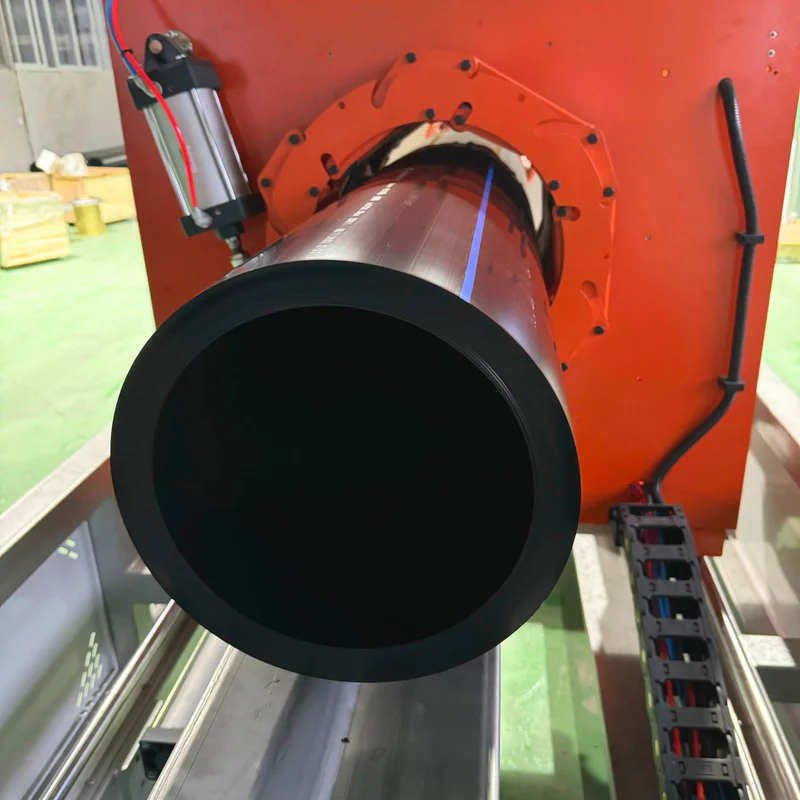
QTech-Machinery provides customized HDPE pipe extrusion line solutions for water supply, irrigation, municipal pipeline, construction, and industrial pipe applications. A typical example is our Φ20–Φ110 mm HDPE pipe extrusion line project, designed for PE100 material, black pipe production, four color stripe marking, and 200–250 kg/h output.
1. What production experience should a reliable HDPE pipe extrusion line manufacturer have?
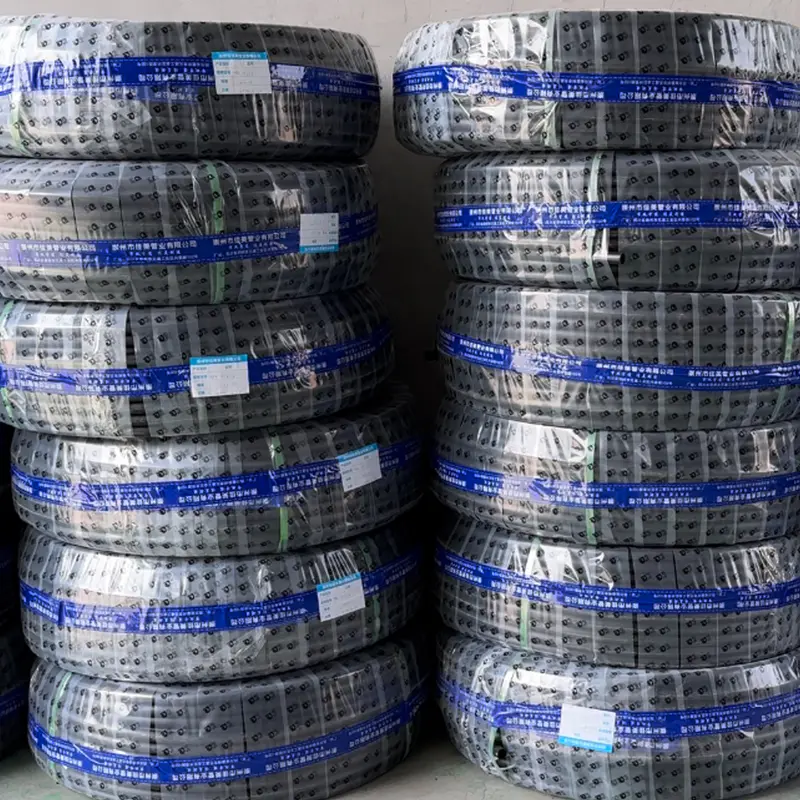
A reliable manufacturer should have proven experience in complete HDPE pipe extrusion line projects, not only single-machine supply.
A professional manufacturer should be able to design and supply the full pipe extrusion process, including material loading, drying, extrusion, co-extrusion, die tooling, vacuum calibration, spray cooling, haul-off, cutting, winding, stacking, and spare parts support.
For HDPE pipe production, experience matters because different pipe diameters, SDR values, raw materials, and output targets require different configurations. A supplier that only sells standard machines may not be able to match the actual production demand.
For example, QTech-Machinery configured a complete Φ20–Φ110 mm HDPE pipe extrusion line for a PE water supply pipe customer. The line was designed according to:
- Pipe diameter range: Φ20–Φ110 mm
- Material: PE100 grade HDPE
- Output: 200–250 kg/h
- Application: water supply pipe
- Product appearance: black pipe with four color stripes
- Handling method: winder for coiled pipes and stacker for straight pipes
This type of project experience shows that the manufacturer can provide a complete production solution instead of only individual equipment.
Recommended internal link:
Φ20–Φ110 mm HDPE Pipe Extrusion Line Project by QTech-Machinery
2. How can you check whether the extrusion line configuration is suitable for your pipe range?
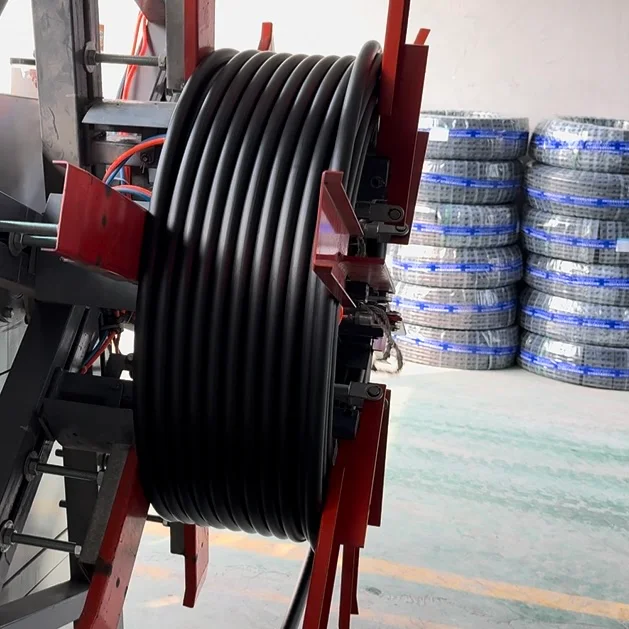
The configuration should match your pipe diameter, wall thickness, SDR standard, output target, and finished pipe collection method.
Before choosing an HDPE pipe extrusion line manufacturer in China, buyers should confirm whether the proposed configuration is technically suitable. A correct line configuration should include the right extruder size, screw design, die head, vacuum tank length, cooling capacity, haul-off force, cutting method, and winding or stacking system.
For a Φ20–Φ110 mm HDPE pipe production line, QTech-Machinery selected an SJ75/33 single-screw extruder as the main machine. This configuration is suitable for medium-output HDPE pipe production and supports stable plasticizing.
Example configuration from QTech-Machinery
| Section | Configuration | Function |
|---|---|---|
| Material handling | QX-900 automatic vacuum loader | Continuous raw material feeding |
| Drying | Hopper dryer | Moisture control before extrusion |
| Main extruder | SJ75/33 single-screw extruder | HDPE plasticizing and extrusion |
| Metering | Double-layer gravimetric system | Control pipe meter weight and wall thickness |
| Marking | SJ25/25 color stripe co-extruder | Four color stripe marking |
| Die head | Φ20–Φ110 mm PE pipe die | Pipe forming |
| Calibration | 9 m vacuum calibration tank | Diameter and roundness control |
| Cooling | Two 6 m spray cooling tanks | Further cooling and dimensional stability |
| Haul-off | Three-caterpillar servo haul-off | Stable pipe pulling |
| Cutting | Fly-knife + ring-type chipless cutter | Flexible cutting for different sizes |
| Collection | Winders + 5 m stacker | Coiled and straight pipe handling |
A complete and balanced configuration helps improve production stability and reduce problems such as unstable diameter, uneven wall thickness, poor pipe surface, and inaccurate cutting.
3. Why are extruder quality and screw design important for HDPE pipe production?
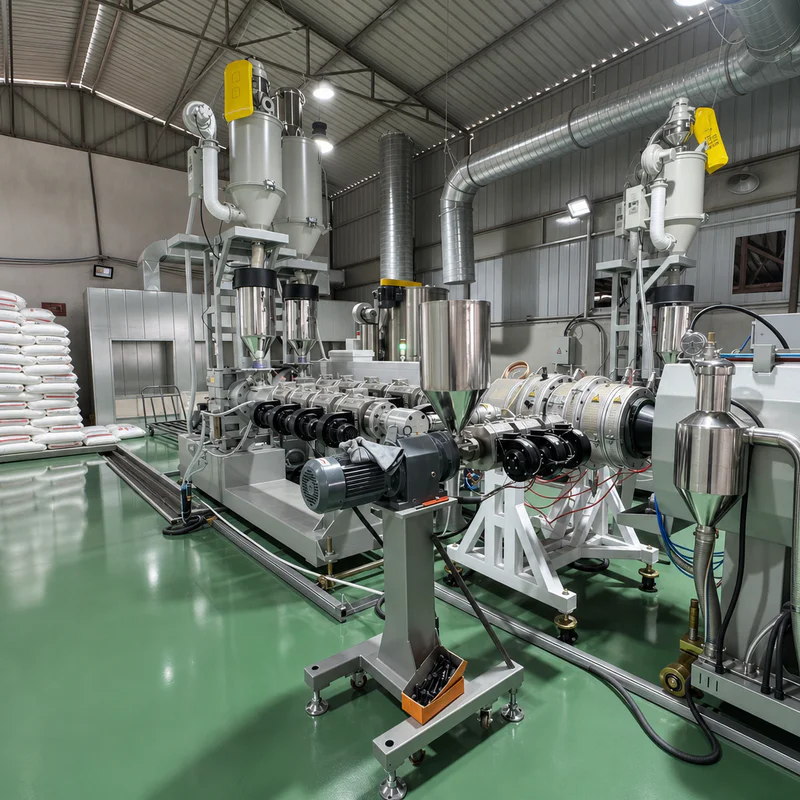
The extruder and screw design directly affect plasticizing quality, output stability, pipe surface, and long-term production efficiency.
The extruder is the core equipment of an HDPE pipe extrusion line. For HDPE material, especially PE100 grade resin, the screw must provide stable melting, uniform mixing, and consistent pressure output.
In QTech-Machinery’s Φ20–Φ110 mm project, the main extruder is equipped with:
- 75 mm screw diameter
- 33:1 L/D ratio
- 110 kW Siemens Beide AC motor
- ABB inverter
- Siemens PLC control
- MCGS touchscreen HMI
- High-torque gearbox
This combination helps the line maintain continuous production performance and makes operation easier for factory workers.
A good HDPE pipe extruder should offer:
- Stable material melting
- Uniform extrusion pressure
- Low energy consumption
- Accurate temperature control
- Easy operation and maintenance
- Compatibility with different PE grades
In plastic pipe production, extrusion stability is closely related to final pipe quality. Industry discussions and technical references often emphasize that output fluctuation, temperature instability, and improper downstream synchronization may cause pipe size variation and wall thickness problems. External technical articles also highlight that gravimetric control and balanced extrusion conditions can improve pipe processing consistency. Conair: Gravimetric Control Improves Extruded Pipe Processing [0]
4. How does a manufacturer help control pipe wall thickness and material cost?
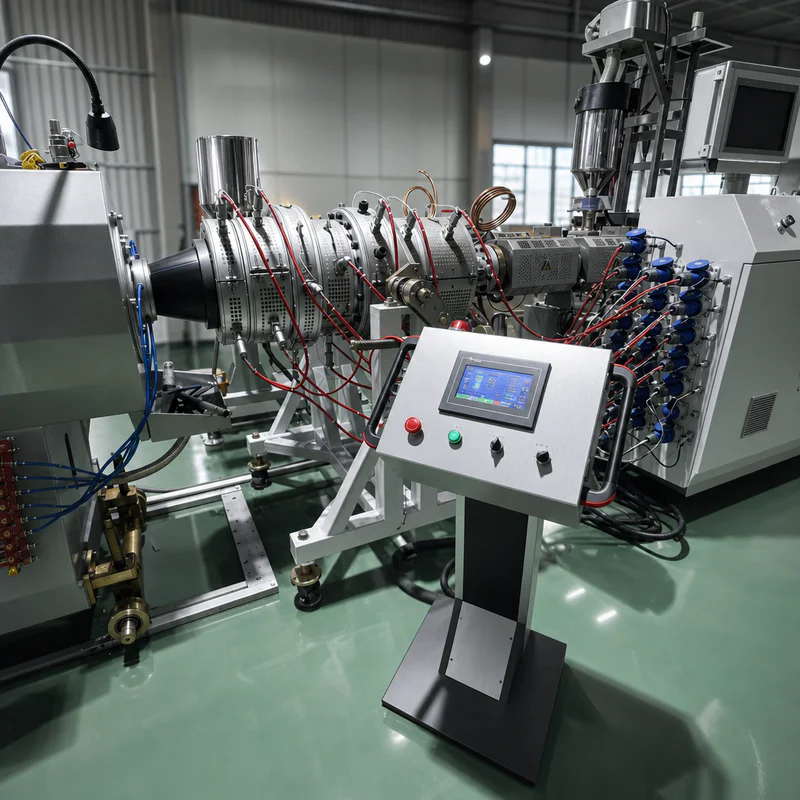
A professional manufacturer can use gravimetric metering, stable extrusion control, accurate die tooling, and synchronized haul-off to improve wall thickness consistency.
Wall thickness control is one of the most important quality points in HDPE pipe production. If the wall thickness is unstable, the pipe may fail quality inspection, waste raw material, or reduce pressure performance.
QTech-Machinery’s solution uses a double-layer gravimetric metering system. This system monitors material feeding in real time and helps control pipe meter weight. For PE pipe manufacturers, this can bring several benefits:
- More stable wall thickness
- Better meter weight control
- Lower material waste
- Easier production data monitoring
- More consistent pipe quality
- Better support for SDR pipe production
Wall thickness control factors
| Factor | Why it matters |
|---|---|
| Raw material feeding | Affects extrusion output stability |
| Screw plasticizing | Affects melt uniformity |
| Die head design | Affects material distribution |
| Vacuum calibration | Affects outer diameter and roundness |
| Haul-off speed | Affects wall thickness and pipe size |
| Cooling length | Affects pipe shape stability |
| Gravimetric system | Helps monitor and control material consumption |
For buyers, choosing a manufacturer with gravimetric control experience is valuable because HDPE raw material cost is a major part of total production cost. Even small material savings can become significant during long-term production.
5. What should you check in the pipe die, vacuum tank, and cooling system?
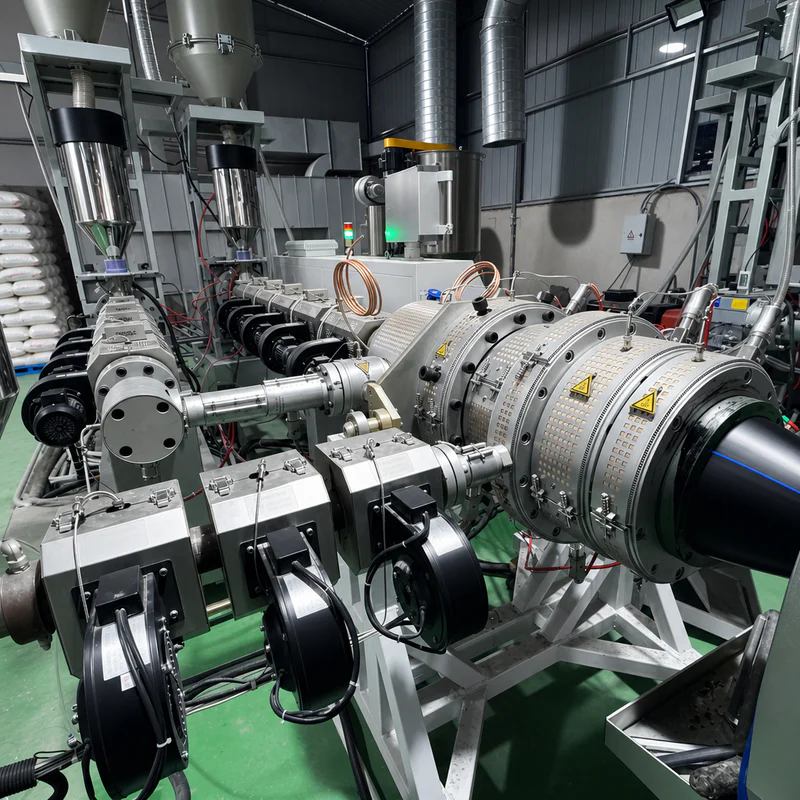
You should check die material, sizing sleeve accuracy, vacuum stability, cooling tank length, spray design, and stainless-steel construction.
The pipe forming and cooling section determines pipe diameter accuracy, surface quality, roundness, and production stability.
In QTech-Machinery’s Φ20–Φ110 mm HDPE pipe extrusion line, the pipe die is designed for a full diameter range from 20 mm to 110 mm. It uses:
- 40Cr forged steel
- Internal electroplating
- Spiral melt distribution
- Copper sizing sleeves
- Water-jacket cooling
After the die, the pipe enters a 9 m vacuum calibration tank and then passes through two 6 m spray cooling tanks. This layout provides sufficient cooling length for small and medium HDPE pipe production.
Why this section is important
A weak vacuum tank or insufficient cooling length can lead to:
- Pipe ovality
- Diameter fluctuation
- Surface deformation
- Poor dimensional stability
- Difficulty in high-speed production
- Unstable cutting length
External plastic extrusion references also note that a complete PE pipe production line usually includes the extruder, pipe die, vacuum sizing tank, spray cooling tanks, haul-off unit, and cutting station, which confirms the importance of a balanced downstream configuration. PE Pipe Making Machine Decoded [1]
6. How important are automation, PLC control, and servo haul-off?
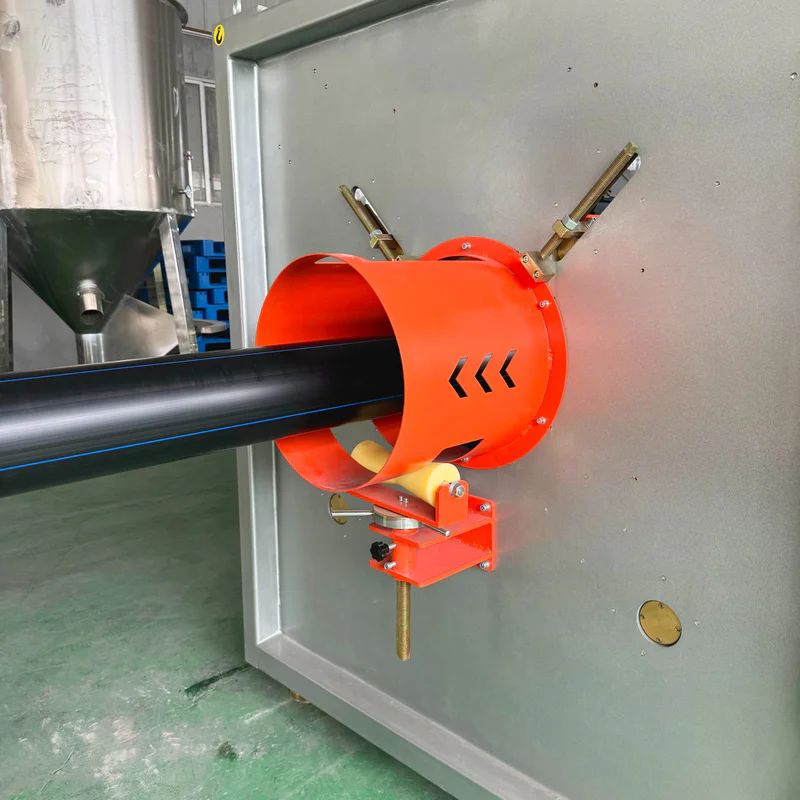
Automation improves production stability, reduces operator dependence, and helps maintain consistent pipe quality.
For modern HDPE pipe manufacturing, automation is no longer optional. Buyers should check whether the line includes reliable electrical components, touchscreen control, synchronized downstream equipment, and user-friendly operation.
QTech-Machinery’s line uses:
- Siemens PLC
- MCGS touchscreen HMI
- ABB inverter
- Servo haul-off control
- Digital speed display
- Pneumatic clamping
- Constant-pressure vacuum control
The three-caterpillar servo haul-off is especially important. It provides synchronized pulling force and helps maintain stable pipe dimensions during continuous production.
Automation advantages
| Automation feature | Benefit |
|---|---|
| PLC control | Centralized line operation |
| Touchscreen HMI | Easier parameter setting |
| ABB inverter | Stable speed control |
| Servo haul-off | Accurate pulling speed |
| Gravimetric metering | Better material control |
| Constant vacuum control | More stable pipe sizing |
| Digital speed display | Easier monitoring |
For overseas customers, automation also reduces training difficulty and makes daily operation more consistent.
7. What after-sales service and documents should a China manufacturer provide?
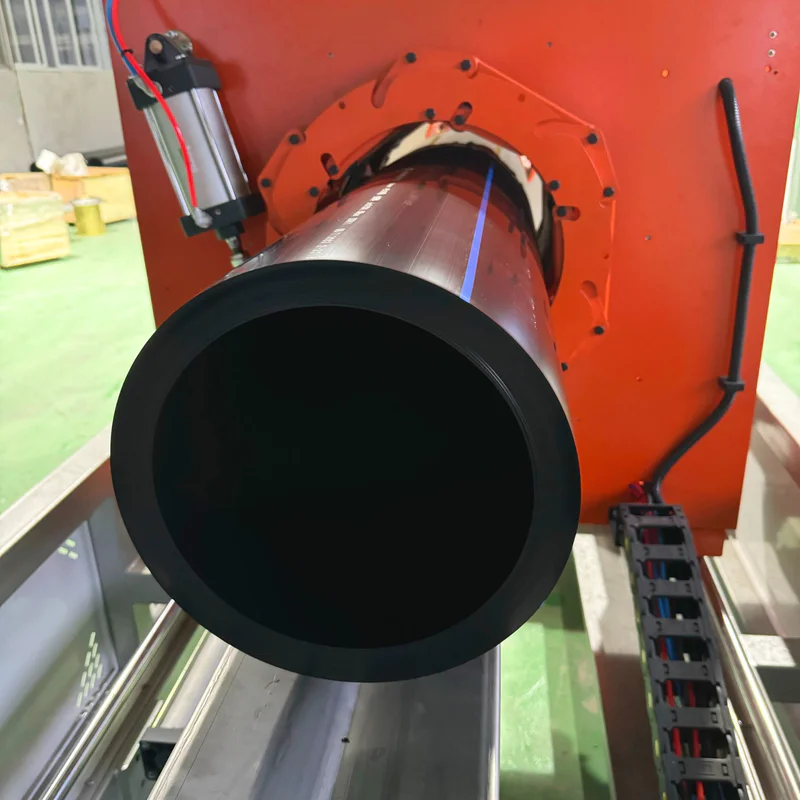
A reliable manufacturer should provide testing, installation guidance, training, spare parts, manuals, drawings, and long-term technical support.
When selecting an HDPE pipe extrusion line manufacturer in China, after-sales service is as important as machine quality. The buyer should confirm the service scope before placing the order.
QTech-Machinery can provide:
Product and service support
| Support item | Description |
|---|---|
| Customized line design | According to pipe size, output, material, voltage, and layout |
| Full run test | Machine testing before shipment |
| Installation guidance | Online or on-site support depending on project needs |
| Operator training | Machine operation and maintenance guidance |
| Spare parts support | Wearing parts and electrical spare parts |
| Technical consultation | Long-term production troubleshooting |
| Voltage configuration | Adapted to local power supply |
| OEM/ODM support | Customized machine design and branding |
Recommended document checklist
| Document | Purpose |
|---|---|
| Commercial quotation | Price and configuration confirmation |
| Technical proposal | Main technical details of the line |
| Machine layout drawing | Workshop planning |
| Electrical layout | Power supply and installation preparation |
| Machine manual | Operation and maintenance |
| Spare parts list | Future maintenance planning |
| Packing list | Shipment checking |
| Test video or FAT report | Pre-shipment verification |
| Warranty document | After-sales protection |
| Installation guide | Site installation support |
A professional supplier should not only ship machines but also help the customer start production smoothly.
Recommended internal links:
- QTech Machinery Homepage
- QTech Machinery Cases
- Contact QTech Machinery
- Φ20–Φ110 mm HDPE Pipe Extrusion Line Project
8. What steps should buyers follow when choosing an HDPE pipe extrusion line manufacturer in China?
Buyers should define their pipe requirements, compare technical proposals, verify supplier capability, review case projects, and confirm after-sales support before ordering.
Choosing the right manufacturer becomes easier if the buyer follows a clear process.
Step-by-step selection guide
| Step | What to do | Why it matters |
|---|---|---|
| Step 1 | Confirm pipe diameter range | Determines extruder, die, haul-off, cutter, and winder |
| Step 2 | Confirm SDR or wall thickness | Affects output and cooling requirements |
| Step 3 | Confirm raw material | PE80, PE100, recycled material ratio if applicable |
| Step 4 | Confirm output target | Determines extruder size and motor power |
| Step 5 | Confirm product application | Water supply, irrigation, gas, conduit, industrial pipe |
| Step 6 | Confirm collection method | Winder or stacker |
| Step 7 | Confirm voltage and frequency | Avoids electrical mismatch |
| Step 8 | Request technical proposal | Helps compare suppliers fairly |
| Step 9 | Review project cases | Verifies real manufacturing experience |
| Step 10 | Confirm service and documents | Reduces installation and production risk |
Buyer information checklist before requesting a quotation
To receive an accurate quotation, buyers should prepare:
- Pipe diameter range
- Wall thickness or SDR standard
- Required output capacity
- Raw material grade
- Pipe application
- Color stripe requirement
- Winder or stacker requirement
- Workshop layout
- Local voltage and frequency
- Automation preference
- Budget range
- Destination port or country
QTech-Machinery can configure each HDPE pipe extrusion line according to these details. For example, the Φ20–Φ110 mm line used an SJ75/33 main extruder, gravimetric system, color stripe co-extruder, 9 m vacuum tank, two 6 m spray cooling tanks, servo haul-off, combined cutter, winders, and stacker.
This means buyers receive a complete, practical, and production-ready solution.
Practical Comparison Table: Reliable Manufacturer vs. Basic Machine Supplier
| Item | Reliable HDPE Pipe Extrusion Line Manufacturer | Basic Machine Supplier |
|---|---|---|
| Project design | Customized by pipe size and output | Often standard machine only |
| Technical proposal | Detailed and complete | Limited configuration details |
| Extruder selection | Based on material and capacity | May only quote by price |
| Die tooling | Full size range and sizing sleeves | May be incomplete |
| Automation | PLC, inverter, servo, gravimetric options | Basic controls |
| Testing | Full run test before shipment | Limited or no testing |
| Documents | Manuals, layout, spare parts list | Basic documents only |
| After-sales | Installation, training, lifetime support | Limited support |
| Long-term value | Stable production and lower risk | Higher hidden cost |
Products QTech-Machinery Can Provide for HDPE Pipe Production
QTech-Machinery can supply complete and customized equipment for HDPE pipe manufacturing, including:
- Automatic vacuum loading system
- Hopper dryer
- Single-screw extruder
- Gravimetric metering system
- Color stripe co-extruder
- HDPE pipe die head
- Sizing sleeves
- Vacuum calibration tank
- Spray cooling tank
- Servo haul-off machine
- Fly-knife cutter
- Ring-type chipless cutter
- Double-station pipe winder
- Single-station pipe winder
- Pipe stacking rack
- Electrical control cabinet
- Spare parts and maintenance tools
- Complete pipe extrusion line layout design
Case Reference: Φ20–Φ110 mm HDPE Pipe Extrusion Line by QTech-Machinery
QTech-Machinery supplied a complete Φ20–Φ110 mm HDPE pipe extrusion line for a customer producing PE water supply pipes. The line was designed for PE100 HDPE material, black pipe production, and four color stripe marking.
Main project data
| Item | Data |
|---|---|
| Pipe range | Φ20–Φ110 mm |
| Application | PE water supply pipe |
| Material | PE100 grade HDPE |
| Output | 200–250 kg/h |
| Line speed | 1–25 m/min |
| Installed power | 115 kW |
| Main extruder | SJ75/33 single-screw extruder |
| Co-extruder | SJ25/25 color stripe co-extruder |
| Vacuum tank | 9 m |
| Cooling tanks | 6 m × 2 |
| Haul-off | Three-caterpillar servo haul-off |
| Collection | Winders and stacker |
The project shows QTech-Machinery’s ability to provide a complete HDPE pipe production solution based on customer requirements, factory layout, and long-term production needs.
Read the full case here:
Φ20–Φ110 mm HDPE Pipe Extrusion Line Project by QTech-Machinery
External Industry References and Useful Notes
When evaluating an HDPE pipe extrusion line, buyers can also review external industry resources and technical discussions to better understand important production factors.
-
Gravimetric control in extrusion
Conair explains that gravimetric control can help improve extruded pipe processing by monitoring material usage and process consistency. This supports the use of gravimetric systems in HDPE pipe production for wall thickness and material cost control.
Source: Conair – Gravimetric Control Improves Extruded Pipe Processing [0] -
Typical PE pipe production line structure
Industry articles commonly describe a PE pipe production line as including an extruder, die head, vacuum sizing tank, spray cooling tank, haul-off, cutting machine, and collection system. This is consistent with QTech-Machinery’s complete line configuration.
Source: PE Pipe Making Machine Decoded [1] -
Common HDPE extrusion problems
Technical discussions on HDPE pipe extrusion often mention size variation, unstable dimensions, and cooling-related issues. These problems show why proper vacuum calibration, cooling length, haul-off synchronization, and process control are important.
Source: Common Problems of HDPE Plastic Extrusion Line [2] -
PE100 pipe material and large-diameter pipe reference
PE100 technical resources discuss the use of high-performance polyethylene materials in pressure pipe production, showing the importance of raw material selection and processing stability for pipe quality.
Source: PE100+ Association – Extrusion of Thick Wall Pipes [3]
These references are useful for buyers who want to understand the relationship between machine configuration, material control, pipe quality, and long-term production performance.
Conclusion
Choosing a reliable HDPE pipe extrusion line manufacturer in China requires more than comparing prices. Buyers should evaluate the manufacturer’s project experience, extrusion technology, machine configuration, automation level, wall thickness control, downstream equipment, testing ability, documents, and after-sales support.
QTech-Machinery provides complete HDPE pipe extrusion line solutions based on customer requirements. From the SJ75/33 single-screw extruder and gravimetric system to the pipe die, vacuum tank, cooling tanks, servo haul-off, cutting machine, winder, and stacker, each section is configured for stable and efficient production.
If you are planning to produce HDPE water supply pipes, irrigation pipes, municipal pipes, or industrial PE pipes, QTech-Machinery can help you design a customized extrusion line according to your pipe range, output target, material, voltage, and factory layout.
Contact QTech-Machinery today to get a customized HDPE pipe extrusion line proposal and quotation.